
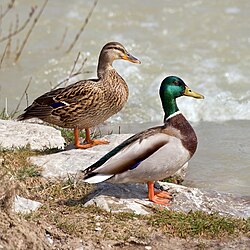
How to identify the Mallard
Anas platyrhynchos
Spotted a bird? Identify it instantly with the Birdby app
Open the appTo correctly identify the Mallard (Anas platyrhynchos), check each of these features. Birds can be tricky: habit, habitat, and call often confirm a sighting that a single photo cannot.
Size at a glance
- Length
- 50-65 cm (20-26 in)
- Wingspan
- 81-98 cm (32-39 in)
- Weight
- 720-1580 g (1.6-3.5 lbs)
Physical features to check
- 1
Plumage
Overall feather coloration and pattern.
Male (drake) in breeding plumage: iridescent green head and neck, white neck ring, chestnut breast, grey flanks, black rear, and a curled black tail feather. Female (hen): mottled brown plumage with a dark eye-stripe and an orange bill with dark markings. Both sexes have a distinctive iridescent blue speculum (wing patch) bordered by white.
- 2
Beak shape
Shape and color of the bill: a key field mark.
Spatulate (flat and broad) for dabbling. Male's bill is yellowish-green, female's is orange with a dark saddle or blotches.
- 3
Eye color
Iris color and any distinctive eye markings.
Dark brown.
- 4
Leg color
Leg and foot color.
Orange to reddish-orange in both sexes.
- 5
Distinguishing features
Standout features that separate this species.
The male's green head and white neck ring are unmistakable. The blue speculum on the wing is a key identifier for both sexes in flight or when wings are slightly open. The female's mottled brown plumage with the orange bill and dark markings helps distinguish her from other female dabbling ducks.
- 6
Juvenile appearance
How young birds differ from adults.
Juveniles resemble adult females, but are often duller and may have less distinct markings. Young males gradually acquire their adult male plumage over their first year.
- 7
Seasonal changes
Plumage variation between breeding and non-breeding seasons.
Males undergo an 'eclipse' plumage after breeding, typically from June to September. During this period, they resemble females, losing their vibrant green head and chestnut breast, becoming mottled brown. They retain the yellow bill and blue speculum, which can aid identification. They regain their breeding plumage in late summer/early autumn.
- 8
Sexual dimorphism
How males and females differ.
Pronounced. Males are much more brightly colored than females, especially during the breeding season. Females are cryptically colored for camouflage.
Key field marks
- Male Plumage. Look for the iridescent green head, white neck ring, chestnut breast, and grey body. The curled black tail feather is also distinctive.
- Female Plumage. Observe the mottled brown body, dark eye-stripe, and the orange bill with dark blotches or a saddle. The blue speculum is crucial.
- Speculum (Wing Patch). Both sexes display an iridescent blue speculum bordered by white, visible in flight or when the wings are slightly open. This is a key field mark.
- Bill Color. Males have a yellowish-green bill; females have an orange bill with dark markings. This helps differentiate them from other dabbling ducks.
- Vocalization. Listen for the loud, descending 'quack' of the female and the softer, reedy 'kwek-kwek-kwek' of the male.
- Behavior. Observe their dabbling feeding behavior, tipping head-first into shallow water. Their ability to take off vertically from water is also characteristic.
Explore the Mallard
Identify birds anywhere
Free on iOS, Android, and Web. Photo & sound identification, full species database, and your personal life list.