
Spotted a bird? Identify it instantly with the Birdby app
Open the appAbout
The Anhinga, often called the 'snakebird' due to its long, slender neck and head appearing snake-like when swimming with its body submerged, is a large, dark waterbird found in warm, shallow freshwater and brackish environments. It is a skilled underwater hunter, using its sharp, pointed bill to spear fish. Unlike many waterbirds, its feathers are not fully waterproof, allowing it to dive and hunt more effectively, but requiring it to dry its wings by perching with them spread open.
Size & lifespan
- Length
- 81-97 cm (32-38 in)
- Wingspan
- 114-122 cm (45-48 in)
- Weight
- 1.04-1.35 kg (2.3-3.0 lbs)
- Lifespan
- Up to 9 years in the wild, potentially longer in captivity.
- Diet
- Carnivore (primarily piscivorous, eating fish)
Physical characteristics
- Plumage
- Adult males are glossy black with silvery-white streaks and spots on the upper back and wings. The tail is long and fan-shaped, tipped with a pale band. Adult females are similar but have a pale brownish-gray head, neck, and upper breast, contrasting with a darker body. Juveniles are duller brown overall, lacking the distinct markings of adults.
- Beak shape
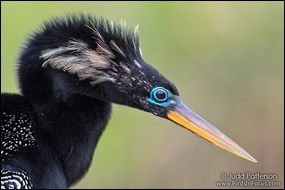
- Long, straight, and sharply pointed, yellowish to brownish-yellow, often with a darker tip.
- Eye color
- Reddish-brown, surrounded by a small patch of bare yellow skin.
- Leg color
- Dull yellow to orange-yellow, with fully webbed feet.
- Distinguishing features
- Long, slender, S-shaped neck; dagger-like bill; long, stiff tail; habit of swimming with only its head and neck visible above water; characteristic wing-spreading posture for drying feathers.
- Juvenile appearance
- Dull brown overall, paler on the underparts, lacking the distinct black and white patterns of adult males and the clear demarcation of color in females. The bill is duller yellow.
- Seasonal changes
- No significant seasonal plumage changes. Breeding plumage is essentially the same as non-breeding plumage, though colors may appear more vibrant during courtship.
- Sexual dimorphism
- Pronounced. Males are entirely glossy black with silvery-white streaking on the back and wings. Females have a pale brownish-gray head, neck, and upper breast, with a sharp demarcation to the darker body plumage.
How to identify
- 1
Swimming posture
Look for a bird swimming with only its head and long, slender neck visible above the water, resembling a snake. This is a key field mark.
- 2
Wing-drying posture
Observe birds perched with their wings spread wide open, often on a snag or branch over water. This behavior is characteristic of Anhingas and cormorants, but the Anhinga's long tail and slender neck will distinguish it.
- 3
Bill shape
Note the long, straight, and sharply pointed bill, which is used for spearing fish, unlike the hooked bill of cormorants.
- 4
Plumage (adult male)
Identify the glossy black body with prominent silvery-white streaks and spots on the upper back and wings.
- 5
Plumage (adult female)
Look for a pale brownish-gray head, neck, and upper breast that contrasts sharply with the darker body.
- 6
Tail
Observe the long, stiff, fan-shaped tail, often with a pale terminal band, especially noticeable in flight.
- 7
Flight profile
In flight, the Anhinga holds its neck extended and its long tail is very noticeable, giving it a cross-like silhouette when soaring.
Habitat & range
- Biomes
- Freshwater wetlands, swamps, marshes, slow-moving rivers, lakes, ponds, and occasionally brackish estuaries.
- Geographic range
- Southeastern United States (from North Carolina south to Florida and west to Texas, Oklahoma, Arkansas, and Missouri), Mexico, Central America, Cuba, and much of South America east of the Andes.
- Elevation range
- Typically found at low elevations, from sea level up to a few hundred meters, always near water.
- Preferred environments
- Areas with calm, clear water for hunting, and emergent vegetation or trees for perching, nesting, and drying wings. Requires perches over water or along shorelines.
Behavior
- Activity time
- Diurnal. Most active during daylight hours for hunting and drying.
- Feeding habits
- Primarily piscivorous. Hunts by swimming underwater, often submerging its entire body except for its head and neck. It spears fish with its sharp bill, then surfaces to toss the fish into the air and swallow it headfirst. Also consumes amphibians, aquatic insects, and crustaceans.
- Social behavior
- Generally solitary when foraging, but often roosts and nests colonially with other waterbirds (herons, egrets, cormorants). Can be seen in small groups, especially during migration or at communal drying sites.
- Flight pattern
- Strong, direct flight with powerful wingbeats. Often soars high on thermals, especially during midday. When taking off from water, it often runs across the surface to gain momentum. In flight, the neck is extended, and the long tail is prominent.
- Migration pattern
- Mostly resident throughout its range, particularly in the southern parts. Northern populations (e.g., in the US) may undertake short-distance migrations to warmer areas during winter, moving south from the northernmost breeding grounds.
- Territoriality
- Defends a small area around the nest during breeding season, but foraging areas are generally not strictly territorial.
Song & calls
- Song
- Anhingas are generally quiet birds. They do not have a complex song.
- Call
- Primarily vocalizes with a series of low, guttural grunts, croaks, and clicks, especially around the nest or when disturbed. Young birds make begging calls. A harsh 'ka-ka-ka' or 'karrr' may be heard during courtship or aggression.
- When they vocalize
- Most vocal during the breeding season, particularly at the nest site, and when interacting with conspecifics or perceived threats.
Breeding & reproduction
- Breeding season
- Varies geographically; typically spring and summer in temperate regions (e.g., March-July in the US), but can be year-round in tropical areas, often coinciding with periods of high food availability.
- Nesting habits
- Nests colonially, often with other wading birds, in trees or shrubs over water or on islands. The nest is a bulky platform of sticks, lined with green leaves. Both sexes participate in nest building.
- Clutch size
- 2-6 eggs
- Egg description
- Typically 2-6 (usually 3-5) pale bluish-green or greenish-white eggs, often stained brown during incubation. Eggs are oval-shaped.
- Incubation period
- 25-30 days, incubated by both parents.
- Fledging period
- Young are altricial and remain in the nest for approximately 3-4 weeks, then climb out onto nearby branches. They become independent and capable of flight around 6 weeks of age.
- Parental care
- Both parents share incubation duties and feed the young by regurgitation. Young are dependent on parents for several weeks after fledging.
Where to find
Freshwater wetlands
Look in swamps, marshes, and slow-moving rivers with abundant aquatic vegetation and submerged trees.
Lakes and ponds
Check the edges of large and small freshwater bodies, especially those with emergent vegetation or dead trees for perching.
Estuaries
Occasionally found in brackish water, particularly in coastal areas of its range.
Field tips
- Scan for 'snakeheads'. Look for just the head and neck emerging from the water, often moving slowly as it hunts.
- Look for drying birds. Spot them perched on snags, branches, or docks with wings spread wide to dry their feathers after diving.
- Observe flight patterns. Watch for them soaring high on thermals, often in groups, or flying low over the water with powerful wingbeats.
- Check colonial nesting sites. During breeding season, visit rookeries where they often nest alongside herons and egrets.
Similar species
Double-crested Cormorant
Phalacrocorax auritus
Cormorants have a hooked bill, while Anhingas have a straight, pointed bill. Cormorants swim with more of their body visible above water and often have a more upright posture. In flight, cormorants have a shorter tail and a more hunched appearance. Anhingas have a much longer, more slender neck and tail, and the silvery wing patches are distinctive on adult males.
Neotropic Cormorant
Phalacrocorax brasilianus
Similar to Double-crested Cormorant but smaller. Still distinguishable by the hooked bill, shorter tail, and more robust body compared to the Anhinga's slender, snake-like neck and dagger bill.
Quick facts
- Nickname:
- Snakebird
- Hunting method:
- Spears fish underwater
- Feather characteristic:
- Not fully waterproof, requires drying
- Social behavior:
- Solitary hunter, colonial nester
- Diet:
- Almost exclusively fish
Fun facts
- The Anhinga's bones are denser than those of most other waterbirds, which helps it submerge and swim underwater with less effort.
- Its unique S-shaped neck allows it to rapidly extend its head and spear fish with incredible speed and precision.
- The name 'Anhinga' comes from the Tupi language of Brazil and means 'devil bird' or 'snake bird', referring to its appearance when swimming.
- Unlike ducks or geese, Anhingas do not have oil glands that produce waterproofing for their feathers. This allows them to become waterlogged and reduce buoyancy, making underwater pursuit of fish easier.
Scientific classification
- Kingdom
- Animalia
- Phylum
- Chordata
- Class
- Aves
- Order
- Suliformes
- Family
- Anhingidae
- Genus
- Anhinga
- Species
- Anhinga anhinga
Explore the Anhinga
Identify birds anywhere
Free on iOS, Android, and Web. Photo & sound identification, full species database, and your personal life list.