
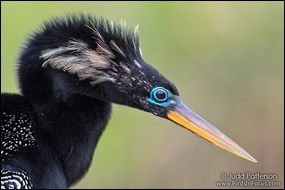
How to identify the Anhinga
Anhinga anhinga
Spotted a bird? Identify it instantly with the Birdby app
Open the appTo correctly identify the Anhinga (Anhinga anhinga), check each of these features. Birds can be tricky: habit, habitat, and call often confirm a sighting that a single photo cannot.
Size at a glance
- Length
- 81-97 cm (32-38 in)
- Wingspan
- 114-122 cm (45-48 in)
- Weight
- 1.04-1.35 kg (2.3-3.0 lbs)
Physical features to check
- 1
Plumage
Overall feather coloration and pattern.
Adult males are glossy black with silvery-white streaks and spots on the upper back and wings. The tail is long and fan-shaped, tipped with a pale band. Adult females are similar but have a pale brownish-gray head, neck, and upper breast, contrasting with a darker body. Juveniles are duller brown overall, lacking the distinct markings of adults.
- 2
Beak shape
Shape and color of the bill: a key field mark.
Long, straight, and sharply pointed, yellowish to brownish-yellow, often with a darker tip.
- 3
Eye color
Iris color and any distinctive eye markings.
Reddish-brown, surrounded by a small patch of bare yellow skin.
- 4
Leg color
Leg and foot color.
Dull yellow to orange-yellow, with fully webbed feet.
- 5
Distinguishing features
Standout features that separate this species.
Long, slender, S-shaped neck; dagger-like bill; long, stiff tail; habit of swimming with only its head and neck visible above water; characteristic wing-spreading posture for drying feathers.
- 6
Juvenile appearance
How young birds differ from adults.
Dull brown overall, paler on the underparts, lacking the distinct black and white patterns of adult males and the clear demarcation of color in females. The bill is duller yellow.
- 7
Seasonal changes
Plumage variation between breeding and non-breeding seasons.
No significant seasonal plumage changes. Breeding plumage is essentially the same as non-breeding plumage, though colors may appear more vibrant during courtship.
- 8
Sexual dimorphism
How males and females differ.
Pronounced. Males are entirely glossy black with silvery-white streaking on the back and wings. Females have a pale brownish-gray head, neck, and upper breast, with a sharp demarcation to the darker body plumage.
Key field marks
- Swimming posture. Look for a bird swimming with only its head and long, slender neck visible above the water, resembling a snake. This is a key field mark.
- Wing-drying posture. Observe birds perched with their wings spread wide open, often on a snag or branch over water. This behavior is characteristic of Anhingas and cormorants, but the Anhinga's long tail and slender neck will distinguish it.
- Bill shape. Note the long, straight, and sharply pointed bill, which is used for spearing fish, unlike the hooked bill of cormorants.
- Plumage (adult male). Identify the glossy black body with prominent silvery-white streaks and spots on the upper back and wings.
- Plumage (adult female). Look for a pale brownish-gray head, neck, and upper breast that contrasts sharply with the darker body.
- Tail. Observe the long, stiff, fan-shaped tail, often with a pale terminal band, especially noticeable in flight.
- Flight profile. In flight, the Anhinga holds its neck extended and its long tail is very noticeable, giving it a cross-like silhouette when soaring.
Explore the Anhinga
Identify birds anywhere
Free on iOS, Android, and Web. Photo & sound identification, full species database, and your personal life list.