
Spotted a bird? Identify it instantly with the Birdby app
Open the appAbout
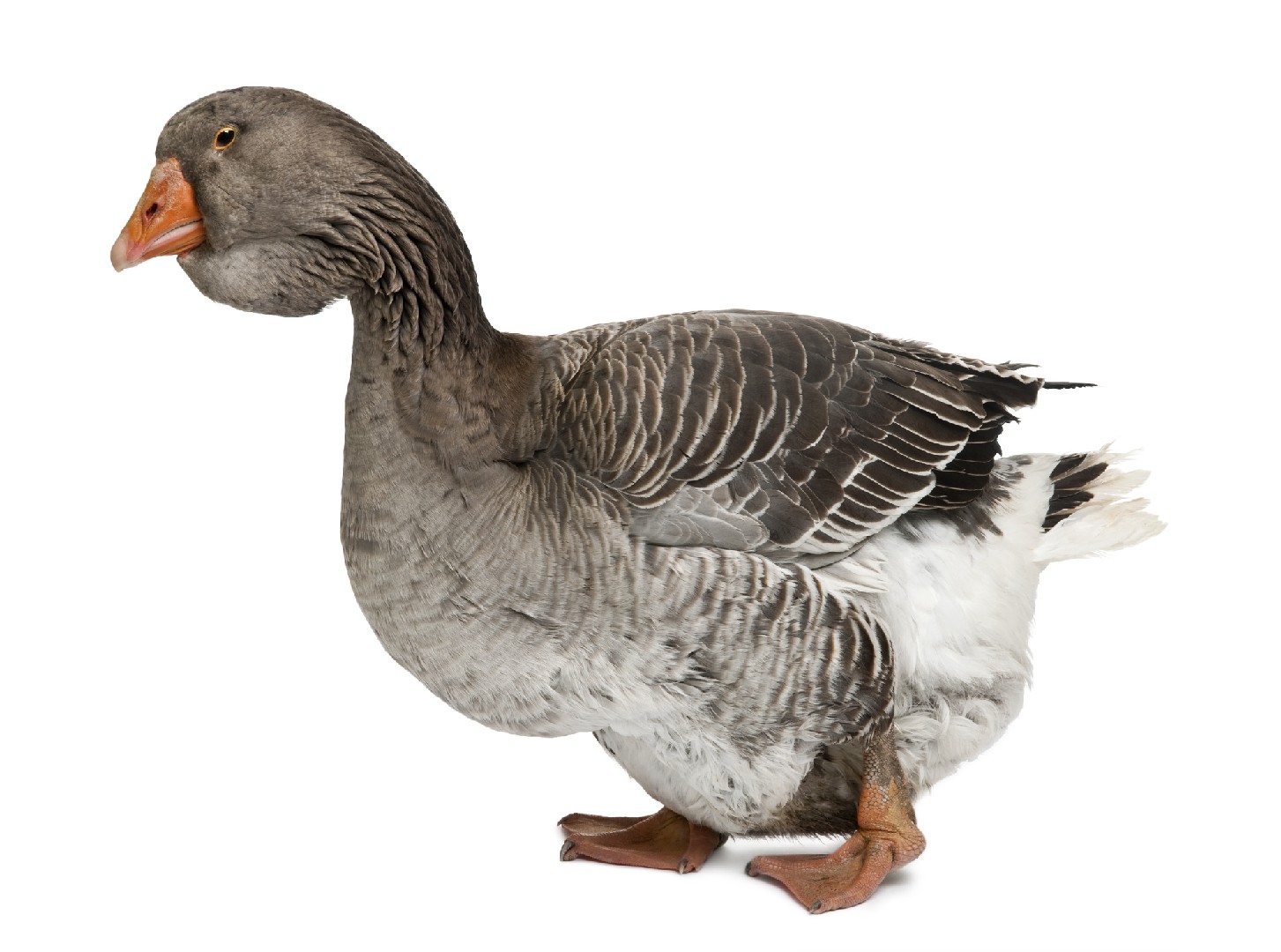
The Domestic Goose (Anser anser domesticus) is a domesticated subspecies of the Greylag Goose (Anser anser). It is one of the oldest domesticated animals, bred for meat, eggs, and feathers. Domestic geese exhibit a wide range of sizes, plumages, and temperaments, often differing significantly from their wild ancestor due to selective breeding. They are typically larger and heavier than wild geese, with a more upright posture and often a prominent 'knob' or 'dewlap' depending on the breed.
Size & lifespan
- Length
- 70-100 cm (28-39 in)
- Wingspan
- 130-180 cm (51-71 in)
- Weight
- 3-15 kg (6.6-33 lbs), highly variable by breed
- Lifespan
- 10-20 years (up to 30 years in captivity)
- Diet
- Herbivore
Physical characteristics
- Plumage
- Highly variable depending on the breed. Common colors include pure white, grey (resembling wild Greylag), pied (patches of grey and white), buff, and brown. Some breeds have a prominent fatty 'dewlap' under the chin or a knob on the bill. Plumage is generally dense and waterproof.
- Beak shape
- Strong, conical, and relatively broad bill, typically orange or pinkish-orange, sometimes black in certain breeds. Some breeds, like the African Goose, have a prominent basal knob on the upper mandible.
- Eye color
- Typically blue, brown, or hazel, depending on the breed and plumage color.
- Leg color
- Orange or pinkish-orange, stout and webbed for swimming.
- Distinguishing features
- Generally larger and heavier build than wild geese, often with a more upright stance. Many breeds possess a prominent 'keel' (fat deposit) on the breast or a 'dewlap' under the chin. The presence of a bill knob (e.g., African, Chinese Geese) is a clear indicator of domestic origin. Their flight is often heavy and labored, or they may be flightless due to selective breeding for increased body mass.
- Juvenile appearance
- Goslings are covered in soft down, typically yellow or grey, often with darker markings. They grow rapidly, developing adult plumage within a few months, though they may retain some juvenile characteristics (e.g., smaller size, less developed dewlap/knob) until full maturity.
- Seasonal changes
- Domestic geese do not exhibit significant seasonal plumage changes. Their appearance remains consistent throughout the year, apart from molting periods where feathers are shed and replaced.
- Sexual dimorphism
- Males (ganders) are typically larger and heavier than females (geese) within the same breed, but plumage differences are usually absent. Ganders may have a more pronounced knob on the bill (if present) and a thicker neck. Behavioral differences, such as ganders being more aggressive during breeding season, are more apparent than visual ones.
How to identify
- 1
Size and Build
Look for a large, heavy-bodied goose, often appearing more robust and less streamlined than wild geese. Many breeds have a distinctive waddling gait due to their heavy build.
- 2
Plumage Color
Pure white plumage is a strong indicator of a domestic goose, as it is rare in wild goose species. Pied (grey and white) or buff coloration is also common in domestic breeds. If grey, look for a heavier build than a wild Greylag.
- 3
Bill Knob or Dewlap
The presence of a prominent knob at the base of the bill (e.g., Chinese, African breeds) or a fatty 'dewlap' under the chin (e.g., Toulouse) are definitive signs of a domestic goose.
- 4
Posture
Many domestic breeds hold a more upright, almost vertical posture compared to the more horizontal stance of wild geese.
- 5
Flight Capability
Observe if the bird is flightless or struggles to fly. Many domestic geese have been bred for meat and are too heavy for sustained flight.
- 6
Behavior and Location
Domestic geese are typically found in close proximity to human settlements, farms, parks, or ponds where they are fed or managed. Their tameness or aggression towards humans can also be an indicator.
Habitat & range
- Biomes
- Anthropogenic landscapes, including farms, parks, suburban ponds, and agricultural areas. They are entirely dependent on human care or semi-feral populations near human settlements.
- Geographic range
- Worldwide, wherever humans have introduced them for agriculture or ornamental purposes. Originating from Europe and Asia, they are now globally distributed.
- Elevation range
- Primarily found in lowlands and areas accessible to human habitation, typically from sea level up to moderate elevations where agriculture is practiced.
- Preferred environments
- Areas with access to fresh water (ponds, lakes, slow-moving rivers) for swimming and preening, and grassy areas for grazing. They thrive in environments where they are provided with shelter and food by humans.
Behavior
- Activity time
- Diurnal. They are active during daylight hours, grazing, swimming, and interacting with their flock.
- Feeding habits
- Primarily grazers, feeding on grasses, clover, and other herbaceous vegetation. They also consume seeds, grains, and some aquatic plants. They are efficient foragers and can keep pastures well-trimmed.
- Social behavior
- Highly social birds, typically living in flocks. They form strong pair bonds and family groups. They are known for their territoriality, especially during the breeding season, and can be quite vocal and aggressive towards perceived threats.
- Flight pattern
- Many domestic goose breeds are heavy-bodied and either flightless or capable of only short, heavy flights. Those that can fly do so with strong, deliberate wingbeats, often in V-formations if in a flock, but this is less common than in wild geese.
- Migration pattern
- Non-migratory. Domestic geese are resident wherever they are kept by humans. Feral populations may make local movements in search of food or water.
- Territoriality
- Highly territorial, particularly ganders during the breeding season. They will aggressively defend their nests, mates, and goslings from intruders, including humans and other animals, often hissing, honking, and biting.
Song & calls
- Song
- Domestic geese do not have a 'song' in the typical avian sense. Their vocalizations are primarily calls.
- Call
- Loud, resonant honks and hisses. The honk is a characteristic 'HAA-onk' or 'HAA-aah' sound, often repeated. Hissing is a common defensive or warning sound, particularly when agitated or protecting young. Vocalizations vary slightly between breeds.
- When they vocalize
- Vocalize throughout the day, especially when communicating with the flock, warning of perceived threats, or expressing excitement (e.g., at feeding time).
Breeding & reproduction
- Breeding season
- Typically early spring to early summer, though this can be influenced by climate and management practices. Some breeds may lay multiple clutches if eggs are removed.
- Nesting habits
- Nests are usually built on the ground, often in a secluded, sheltered spot near water. The female constructs a shallow depression lined with grass, leaves, and down feathers plucked from her own breast. Ganders often stand guard nearby.
- Clutch size
- 5-15 eggs, with an average of 8-12. Clutch size can vary significantly by breed and individual.
- Egg description
- Large, oval eggs, typically white or creamy white, sometimes with a pale greenish tint. The shell is thick and strong.
- Incubation period
- 28-35 days, depending on the breed. The female primarily incubates, though the gander remains nearby for protection.
- Fledging period
- Goslings are precocial, meaning they are covered in down and able to walk and feed themselves shortly after hatching. They remain with their parents for several weeks to months, learning foraging skills and protection. They are capable of independent survival (if flighted) after about 2-3 months, but often stay with the family group longer.
- Parental care
- Both parents are highly protective of their goslings. The gander guards the family, while the goose leads the goslings to food and water. They will aggressively defend their young from predators.
Where to find
Farms and Agricultural Areas
The most common place to find domestic geese, often kept for agricultural purposes.
Public Parks and Ponds
Many parks, especially in urban and suburban areas, have resident populations of domestic geese, often alongside ducks and other waterfowl.
Lakes and Rivers near Settlements
Feral or semi-feral populations can be found on bodies of water adjacent to human habitation.
Wildlife Sanctuaries and Zoos
Some sanctuaries or zoos may keep domestic breeds as part of their collection or for educational purposes.
Field tips
- Look for distinctive features. Pay close attention to bill knobs, dewlaps, and unusual plumage colors (like pure white) that are not typical of wild geese.
- Observe behavior. Note their interaction with humans; domestic geese are often less wary than wild species, or conversely, can be quite aggressive if territorial.
- Consider the context. If you see a goose in a park pond or on a farm, it is highly likely to be a domestic goose or a hybrid.
- Listen to vocalizations. Their loud honks and hisses are characteristic and can help distinguish them from other waterfowl.
Similar species
Greylag Goose
Anser anser
The wild ancestor. Domestic geese are generally larger, heavier, and often have a more upright posture. Many domestic breeds have white plumage, a bill knob, or a dewlap, which are absent in wild Greylags. Wild Greylags are typically uniform grey-brown with an orange bill and pink legs, and are strong flyers.
Canada Goose
Branta canadensis
Canada Geese are easily distinguished by their black neck and head with a prominent white 'chinstrap' marking. They are generally smaller than most domestic geese and have black bills and legs.
Swan Goose
Anser cygnoides
The wild ancestor of the Chinese Goose breed. Wild Swan Geese are slimmer, with a longer neck, a dark brown cap, and a white line at the base of the bill. Domestic Chinese Geese retain the long neck and often the dark cap, but are larger and typically have a prominent black knob on the bill, which is absent in wild Swan Geese.
Quick facts
- Origin:
- Domesticated from the Greylag Goose (Anser anser) in Europe and the Swan Goose (Anser cygnoides) in Asia.
- Purpose:
- Bred for meat, eggs, feathers (down), and as guard animals.
- Social Structure:
- Live in flocks, form strong pair bonds.
- Dietary Preference:
- Primarily grazers, consuming grasses and other vegetation.
- Flight:
- Many breeds are flightless or have limited flight capabilities.
Fun facts
- Domestic geese were among the first animals to be domesticated, with evidence dating back over 5,000 years.
- The famous 'Capitoline Geese' are said to have saved Rome by alerting its defenders to a Gallic invasion in 390 BC, demonstrating their effectiveness as guard animals.
- Goose down is highly prized for its insulating properties and is used in bedding and winter clothing.
- Some domestic goose breeds, like the African and Chinese Geese, are descended from the Asian Swan Goose, while most European breeds come from the Greylag Goose.
- Geese are known for their intelligence and can be trained to recognize and respond to their owners.
Scientific classification
- Kingdom
- Animalia
- Phylum
- Chordata
- Class
- Aves
- Order
- Anseriformes
- Family
- Anatidae
- Genus
- Anser
- Species
- Anser anser domesticus
Explore the Domestic Goose
Identify birds anywhere
Free on iOS, Android, and Web. Photo & sound identification, full species database, and your personal life list.