
Spotted a bird? Identify it instantly with the Birdby app
Open the appAbout
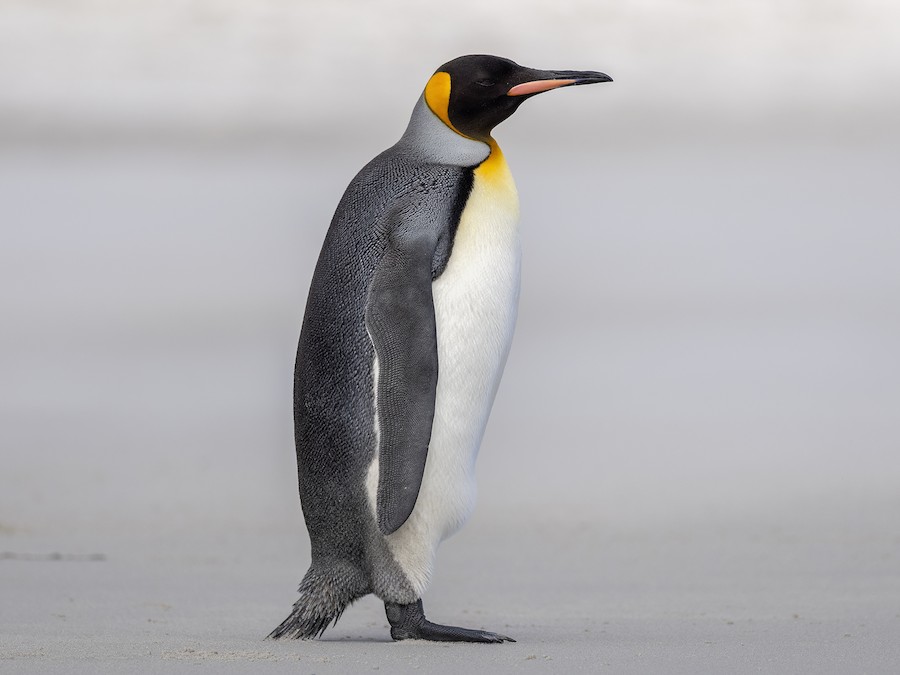
The King Penguin is the second-largest species of penguin, renowned for its striking orange-gold plumage on its head and chest. These highly social birds form vast breeding colonies on subantarctic islands, exhibiting a unique and extended breeding cycle.
Size & lifespan
- Length
- 85-95 cm (33-37 in)
- Wingspan
- Not applicable (flippers)
- Weight
- 9.3-18 kg (20.5-39.7 lb), averaging 11-16 kg (24-35 lb)
- Lifespan
- 15-20 years in the wild
- Diet
- Carnivore (primarily fish and squid)
Physical characteristics
- Plumage
- Adults have a dark grey-black back, head, and throat, sharply delineated from a white belly. A distinctive bright orange-gold patch extends from behind the eye down the sides of the neck and onto the upper chest. The upper breast is also tinged with orange-gold, fading to white on the lower breast and belly. The flippers are black on the dorsal side and white with a black tip on the ventral side.
- Beak shape
- Long, slender, and slightly decurved. The upper mandible is black, while the lower mandible has a prominent orange-pink to yellow-orange streak along its length, which is a key identification feature.
- Eye color
- Dark brown.
- Leg color
- Black, with strong, webbed feet.
- Distinguishing features
- The large size, the vibrant orange-gold ear patches and upper chest, and the orange-pink streak on the lower mandible are the most distinctive features. Their upright posture and stately walk are also characteristic.
- Juvenile appearance
- Newly hatched chicks are naked, then develop a dense, chocolate-brown downy plumage, which they retain for 10-13 months. This brown down is uniform and lacks the adult's distinctive orange patches. Subadults (after their first molt) resemble adults but often have paler, less vibrant orange patches and a duller lower mandible streak.
- Seasonal changes
- Plumage remains largely consistent throughout the year. However, the vibrancy of the orange-gold patches can be slightly more intense during the breeding season. Penguins undergo an annual catastrophic molt, during which they replace all their feathers over a period of 3-4 weeks, during which they cannot enter the water to feed and appear scruffy.
- Sexual dimorphism
- Males and females are outwardly similar in plumage and size, though males tend to be slightly larger and heavier on average. Sex determination typically requires behavioral observation during breeding or genetic analysis.
How to identify
- 1
Size and Stature
Look for a large, upright penguin, second only to the Emperor Penguin in size. Their stately posture is distinctive.
- 2
Head and Neck Markings
Observe the prominent, vibrant orange-gold patches on the sides of the head, extending from behind the eye down the neck and onto the upper chest. This is the most striking field mark.
- 3
Beak Coloration
Note the long, slender beak with a distinctive orange-pink to yellow-orange streak along the lower mandible. This streak is absent in Emperor Penguins.
- 4
Juvenile Plumage
Young King Penguins are entirely covered in dense, chocolate-brown down, lacking any orange markings. This 'fuzzy brown' appearance is unique among penguin chicks of this size.
- 5
Vocalization
Listen for their characteristic loud, trumpeting calls, especially within a colony. These calls are quite distinct from other penguin species.
Habitat & range
- Biomes
- Subantarctic islands and surrounding cold, productive ocean waters.
- Geographic range
- Breeds on subantarctic islands including South Georgia, Falkland Islands, Prince Edward Islands, Crozet Islands, Kerguelen Islands, Heard Island, and Macquarie Island. Forages in the Southern Ocean.
- Elevation range
- Primarily coastal, breeding colonies are found at sea level on flat, ice-free ground, often near freshwater sources.
- Preferred environments
- Rocky or sandy beaches and tussock grass areas for breeding colonies. They require access to the open ocean for foraging, preferring areas with high marine productivity.
Behavior
- Activity time
- Diurnal, with foraging trips typically occurring during daylight hours. Breeding activities are also primarily diurnal.
- Feeding habits
- Pursuit divers, capable of diving to depths of over 300 meters (980 ft) and remaining submerged for several minutes. They primarily feed on myctophid fish (lanternfish) and squid, using their powerful flippers for propulsion and their strong beaks to grasp prey. They swallow prey whole underwater.
- Social behavior
- Highly colonial, forming immense breeding colonies that can number in the hundreds of thousands. They are social at sea, often foraging in groups. Within colonies, they exhibit complex social interactions, including pair-bonding, territorial displays, and chick-rearing cooperation.
- Flight pattern
- Flightless. They move on land by walking upright, often waddling, or tobogganing on their bellies across ice and snow.
- Migration pattern
- Non-migratory in the traditional sense, but individuals disperse widely at sea outside the breeding season, often covering thousands of kilometers in search of food. They return to their natal colonies for breeding.
- Territoriality
- While not strictly territorial over large areas, breeding pairs defend a small personal space around their chick or egg, using vocalizations and aggressive displays (pecking, flipper slapping) to deter intruders.
Song & calls
- Song
- King Penguins do not have a 'song' in the typical avian sense. Their vocalizations are complex calls used for communication within the colony.
- Call
- They produce a variety of loud, trumpeting, braying, and squawking calls. The most characteristic is a long, drawn-out, resonant 'trumpet' call used for advertising territory, attracting mates, and communicating with chicks. Chicks emit high-pitched peeping calls. Calls are individually recognizable, allowing parents and chicks to locate each other in crowded colonies.
- When they vocalize
- Vocalize frequently, especially within the breeding colony, throughout the day and night, particularly during chick-rearing to maintain contact and identify individuals.
Breeding & reproduction
- Breeding season
- King Penguins have an unusually long and asynchronous breeding cycle, lasting approximately 14-16 months. This means they can only successfully raise two chicks every three years. Breeding can occur year-round within a colony, with peaks in November-December for egg-laying.
- Nesting habits
- They do not build nests. The single egg is incubated on the parents' feet, covered by a brood patch. Parents take turns incubating the egg and brooding the chick, often for shifts lasting several days to weeks. Chicks are initially brooded on the feet, then form crèches (groups) for warmth and protection while both parents forage.
- Clutch size
- 1 egg.
- Egg description
- A single, pyriform (pear-shaped) egg, typically pale greenish-white, measuring approximately 10 x 7 cm (3.9 x 2.8 in) and weighing around 300 g (10.6 oz).
- Incubation period
- Approximately 54-56 days.
- Fledging period
- Chicks are dependent on parents for 10-13 months, a period that includes the crèche stage and the development of adult plumage. They fledge (become independent) once they have fully molted into their juvenile plumage.
- Parental care
- Both parents share incubation duties and chick-rearing. They alternate long foraging trips with periods of guarding the egg/chick. Parental care is extensive and prolonged due to the chick's slow development and the long molting period.
Where to find
Subantarctic Islands
The primary breeding grounds are on islands such as South Georgia, Falkland Islands, Crozet Islands, Kerguelen Islands, and Macquarie Island. These islands host massive colonies.
Coastal Areas
Within these islands, look for them on flat, ice-free beaches, tussock grass areas, and rocky shores where colonies are established.
Southern Ocean
While at sea, they can be found foraging in the cold, productive waters of the Southern Ocean, often far from land.
Field tips
- Visit Breeding Colonies. The best way to observe King Penguins is to visit their breeding colonies during the breeding season (which is extended, but peaks for egg-laying in late spring/early summer in the Southern Hemisphere). Tour operators offer expeditions to these remote islands.
- Observe Behavior. Spend time watching their social interactions, their waddling gait on land, and their powerful swimming and diving if seen at sea. Their unique breeding cycle means you might see eggs, small chicks, or large brown 'oakum boy' chicks at various times.
- Listen for Calls. Their loud, trumpeting calls are a constant feature of a King Penguin colony and can help locate them even before visual contact.
- Distinguish from Emperor Penguins. Pay close attention to the extent and vibrancy of the orange patches and the beak coloration to differentiate them from the larger, more polar-dwelling Emperor Penguin.
Similar species
Emperor Penguin
Aptenodytes forsteri
Emperor Penguins are larger (the largest penguin species), have a more muted yellow-orange ear patch that is less extensive, and a shorter, entirely black lower mandible. They breed exclusively on Antarctic sea ice, whereas King Penguins breed on subantarctic islands.
Macaroni Penguin
Eudyptes chrysolophus
Macaroni Penguins are much smaller and belong to the crested penguin genus. They have distinctive yellow-orange crests (superciliary plumes) extending from above their eyes, a reddish-brown beak, and lack the extensive orange-gold neck and chest patches of the King Penguin.
Quick facts
- Size Rank:
- Second largest penguin species
- Breeding Cycle:
- 14-16 months, allowing only two chicks every three years
- Diet Specialization:
- Primarily myctophid fish and squid
- Incubation Method:
- Egg incubated on feet, not in a nest
- Chick Appearance:
- Dense, chocolate-brown down, often called 'oakum boys'
Fun facts
- King Penguins have one of the longest breeding cycles of any bird, taking over a year to raise a single chick to independence.
- Their chicks, covered in thick brown down, were once mistaken for a separate species by early explorers.
- They can dive to depths exceeding 300 meters (980 feet) and hold their breath for over 5 minutes while hunting.
- King Penguin colonies can be incredibly noisy and smelly due to the sheer number of birds and their guano.
- The orange-pink streak on their lower mandible is unique to each individual, much like a human fingerprint.
Scientific classification
- Kingdom
- Animalia
- Phylum
- Chordata
- Class
- Aves
- Order
- Sphenisciformes
- Family
- Spheniscidae
- Genus
- Aptenodytes
- Species
- Aptenodytes patagonicus
Explore the King Penguin
Identify birds anywhere
Free on iOS, Android, and Web. Photo & sound identification, full species database, and your personal life list.