
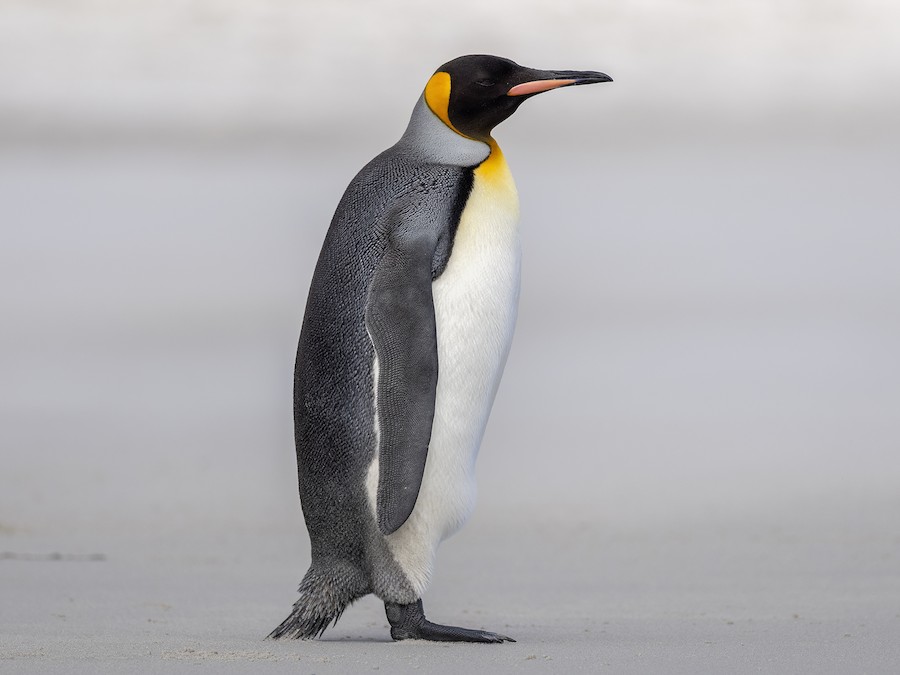
How to identify the King Penguin
Aptenodytes patagonicus
Spotted a bird? Identify it instantly with the Birdby app
Open the appTo correctly identify the King Penguin (Aptenodytes patagonicus), check each of these features. Birds can be tricky: habit, habitat, and call often confirm a sighting that a single photo cannot.
Size at a glance
- Length
- 85-95 cm (33-37 in)
- Wingspan
- Not applicable (flippers)
- Weight
- 9.3-18 kg (20.5-39.7 lb), averaging 11-16 kg (24-35 lb)
Physical features to check
- 1
Plumage
Overall feather coloration and pattern.
Adults have a dark grey-black back, head, and throat, sharply delineated from a white belly. A distinctive bright orange-gold patch extends from behind the eye down the sides of the neck and onto the upper chest. The upper breast is also tinged with orange-gold, fading to white on the lower breast and belly. The flippers are black on the dorsal side and white with a black tip on the ventral side.
- 2
Beak shape
Shape and color of the bill: a key field mark.
Long, slender, and slightly decurved. The upper mandible is black, while the lower mandible has a prominent orange-pink to yellow-orange streak along its length, which is a key identification feature.
- 3
Eye color
Iris color and any distinctive eye markings.
Dark brown.
- 4
Leg color
Leg and foot color.
Black, with strong, webbed feet.
- 5
Distinguishing features
Standout features that separate this species.
The large size, the vibrant orange-gold ear patches and upper chest, and the orange-pink streak on the lower mandible are the most distinctive features. Their upright posture and stately walk are also characteristic.
- 6
Juvenile appearance
How young birds differ from adults.
Newly hatched chicks are naked, then develop a dense, chocolate-brown downy plumage, which they retain for 10-13 months. This brown down is uniform and lacks the adult's distinctive orange patches. Subadults (after their first molt) resemble adults but often have paler, less vibrant orange patches and a duller lower mandible streak.
- 7
Seasonal changes
Plumage variation between breeding and non-breeding seasons.
Plumage remains largely consistent throughout the year. However, the vibrancy of the orange-gold patches can be slightly more intense during the breeding season. Penguins undergo an annual catastrophic molt, during which they replace all their feathers over a period of 3-4 weeks, during which they cannot enter the water to feed and appear scruffy.
- 8
Sexual dimorphism
How males and females differ.
Males and females are outwardly similar in plumage and size, though males tend to be slightly larger and heavier on average. Sex determination typically requires behavioral observation during breeding or genetic analysis.
Key field marks
- Size and Stature. Look for a large, upright penguin, second only to the Emperor Penguin in size. Their stately posture is distinctive.
- Head and Neck Markings. Observe the prominent, vibrant orange-gold patches on the sides of the head, extending from behind the eye down the neck and onto the upper chest. This is the most striking field mark.
- Beak Coloration. Note the long, slender beak with a distinctive orange-pink to yellow-orange streak along the lower mandible. This streak is absent in Emperor Penguins.
- Juvenile Plumage. Young King Penguins are entirely covered in dense, chocolate-brown down, lacking any orange markings. This 'fuzzy brown' appearance is unique among penguin chicks of this size.
- Vocalization. Listen for their characteristic loud, trumpeting calls, especially within a colony. These calls are quite distinct from other penguin species.
Explore the King Penguin
Identify birds anywhere
Free on iOS, Android, and Web. Photo & sound identification, full species database, and your personal life list.