
Spotted a bird? Identify it instantly with the Birdby app
Open the appAbout
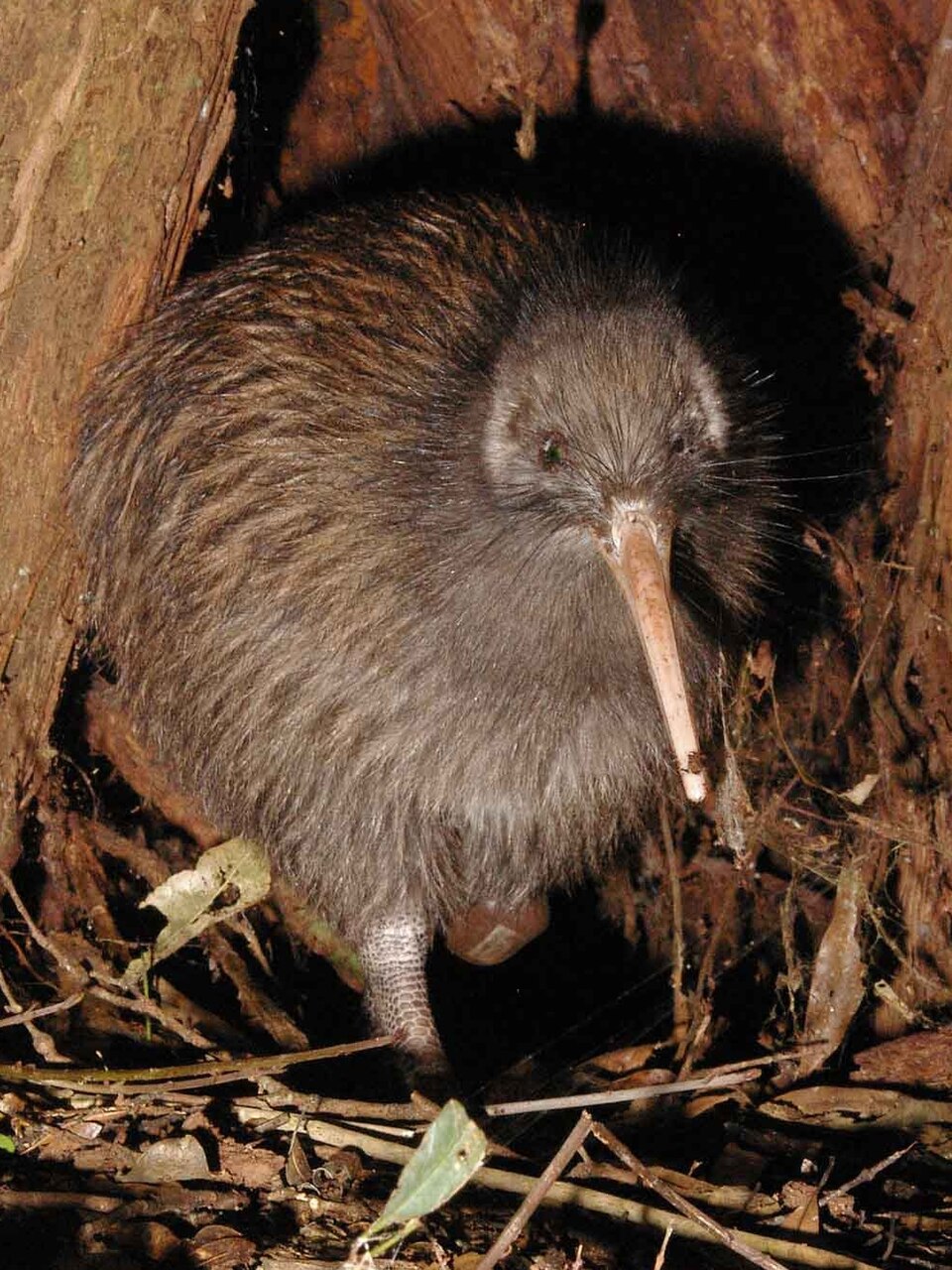
The North Island Brown Kiwi (Apteryx mantelli) is a flightless, nocturnal bird endemic to New Zealand. It is one of five species of kiwi and is characterized by its long, slender bill with nostrils at the tip, shaggy, hair-like plumage, and strong legs. As a ratite, it is related to ostriches and emus, but is much smaller. It plays a crucial ecological role as a nocturnal invertebrate predator in its native forest ecosystems.
Size & lifespan
- Length
- 35-45 cm
- Wingspan
- Vestigial wings, not measurable as a functional wingspan (approx. 5 cm long)
- Weight
- Males: 1.4-2.8 kg; Females: 2.1-3.9 kg
- Lifespan
- Up to 30-50 years in the wild
- Diet
- Omnivore (primarily insectivore/invertivore)
Physical characteristics
- Plumage
- The plumage is shaggy, coarse, and hair-like, typically mottled brown or reddish-brown with streaking of lighter buff or grey. This cryptic coloration provides excellent camouflage in the forest undergrowth. The feathers lack barbules, giving them a fur-like texture.
- Beak shape
- Long, slender, slightly downcurved bill, typically pale ivory to brownish-pink. Unique among birds, the nostrils are located at the very tip of the bill, which is highly sensitive and used for foraging.
- Eye color
- Small, dark brown eyes, adapted for nocturnal vision but with limited acuity.
- Leg color
- Strong, stout legs and feet, typically pale grey to brownish-pink. Four-toed feet with sharp claws.
- Distinguishing features
- Flightless, nocturnal, long sensitive bill with nostrils at the tip, shaggy hair-like plumage, strong legs, absence of a tail, and vestigial wings.
- Juvenile appearance
- Juveniles resemble smaller versions of adults, with similar plumage and bill characteristics. They grow rapidly.
- Seasonal changes
- No significant seasonal changes in plumage. Their appearance remains consistent year-round.
- Sexual dimorphism
- Females are generally larger and heavier than males, and their bills are typically longer. Otherwise, plumage coloration is similar.
How to identify
- 1
Size and Shape
Look for a medium-sized, plump, pear-shaped bird with strong legs, no visible tail, and a hunched posture. It moves with a distinctive waddle.
- 2
Plumage
Observe the shaggy, hair-like, mottled brown or reddish-brown feathers. This texture is unique among birds.
- 3
Bill
The most distinctive feature is the very long, slender, pale bill with nostrils at the tip. This is used for probing and is unlike any other bird in New Zealand.
- 4
Behavior
Nocturnal activity is a key indicator. Listen for its characteristic calls at night. If seen, it will be foraging by probing the ground with its bill.
- 5
Habitat
Found exclusively in dense native forests and scrubland of the North Island.
Habitat & range
- Biomes
- Temperate forests, scrubland, regenerating native bush, and sometimes exotic pine plantations.
- Geographic range
- Endemic to the North Island of New Zealand. Found in scattered populations across the North Island, particularly in Northland, Coromandel, and parts of the central North Island.
- Elevation range
- Sea level up to approximately 1,200 meters, depending on suitable habitat availability.
- Preferred environments
- Dense native forest with a thick understory, deep leaf litter, and moist soil for foraging. Requires areas with suitable burrowing sites for nesting and roosting.
Behavior
- Activity time
- Nocturnal. Active from dusk until dawn, foraging and moving through its territory. Roosts in burrows, hollow logs, or dense vegetation during the day.
- Feeding habits
- Primarily insectivorous/invertivorous. Forages by probing its long bill into the soil and leaf litter to detect and extract invertebrates such as earthworms, beetle larvae, cicada larvae, wētā, spiders, and snails. Also consumes fallen fruit, fungi, and some plant material. Uses its keen sense of smell to locate prey.
- Social behavior
- Generally solitary or found in monogamous pairs. Pairs maintain territories year-round and often roost together in shared burrows or dens.
- Flight pattern
- Flightless. Has vestigial wings and a keel-less sternum, making flight impossible. Moves by walking and running on its powerful legs.
- Migration pattern
- Resident. Non-migratory, remaining within its established territory throughout its life.
- Territoriality
- Highly territorial. Pairs defend their territories (typically 25-100 hectares) through vocalizations and sometimes physical encounters. Males are particularly vocal in defending territory.
Song & calls
- Song
- Males emit a loud, ascending, shrill whistle, often repeated 'kee-wee, kee-wee'. Females produce a harsher, lower-pitched, guttural 'krr-krr' or 'kurr-kurr' call. These calls are primarily for territorial advertisement and communication between pairs.
- Call
- In addition to territorial calls, they may produce soft snuffling or grunting sounds while foraging. Alarm calls are typically sharp, hissing sounds.
- When they vocalize
- Most vocal during the breeding season (autumn to spring) and at night, particularly at dusk and dawn, to establish and maintain territories.
Breeding & reproduction
- Breeding season
- Typically from June to March, with peak activity from August to January. Can breed year-round if conditions are favorable.
- Nesting habits
- Nests in burrows dug by the male, hollow logs, tree roots, or dense vegetation. The nest chamber is often lined with leaves and moss. Males do most of the incubation.
- Clutch size
- Usually 1 egg, occasionally 2. Females can lay up to 3 clutches per year.
- Egg description
- One of the largest eggs relative to body size of any bird. Eggs are typically creamy white or greenish-white, smooth, and oval-shaped. A single egg can weigh up to 450 grams, about 20% of the female's body weight.
- Incubation period
- Approximately 75-85 days, one of the longest incubation periods among birds. Primarily incubated by the male.
- Fledging period
- Chicks are precocial, hatching fully feathered and able to feed themselves within a few days. They remain dependent on parental protection for several weeks to months, but are not 'fledged' in the typical sense due to flightlessness.
- Parental care
- The male primarily incubates the egg and cares for the chick for the first few weeks. The female may assist with some chick rearing, especially if multiple clutches are laid.
Where to find
Sanctuaries and Predator-Free Areas
Best chances are in fenced sanctuaries like Maungatautari Ecological Island, Zealandia (Karori Sanctuary), and predator-free islands such as Little Barrier Island (Hauturu) or Kapiti Island, where populations are more robust and protected.
Native Forests (Northland, Coromandel)
In areas with active predator control, such as parts of Northland (e.g., Puketi Forest, Trounson Kauri Park) and the Coromandel Peninsula, though sightings are rare and require patience and local knowledge.
Field tips
- Go at Night. Kiwi are strictly nocturnal. Your best chance of encountering one is after dark. Use a red-filtered headlamp to minimize disturbance.
- Listen for Calls. Learn their distinctive calls (male's shrill whistle, female's guttural 'krr-krr'). Listening for these calls is often the first sign of their presence.
- Be Patient and Quiet. Kiwi are shy and cryptic. Remain still and quiet in suitable habitat for extended periods. Avoid sudden movements or loud noises.
- Look for Foraging Signs. In soft ground, you might find small probe marks from their bills where they have been searching for invertebrates.
- Join a Guided Tour. Many sanctuaries and conservation projects offer guided night walks specifically designed to find kiwi, significantly increasing your chances of a sighting while ensuring minimal disturbance to the birds.
Similar species
Great Spotted Kiwi
Apteryx haastii
Larger in size, with more prominent pale spotting on its plumage, giving it a 'spotted' appearance. Found in the South Island.
Little Spotted Kiwi
Apteryx owenii
Significantly smaller, with finer, more uniform pale spotting. Now restricted to predator-free islands. Its call is a higher-pitched whistle.
Southern Brown Kiwi (Tokoeka)
Apteryx australis
Generally darker brown plumage, often with a reddish tinge. Found in the South Island and Stewart Island. Some populations are active during the day.
Quick facts
- Status:
- Endangered
- Diet:
- Invertebrates, fruit, fungi
- Activity:
- Nocturnal
- Flight:
- Flightless
- Egg Size:
- Largest egg relative to body size of any bird
- Nostrils:
- At the tip of the bill
Fun facts
- Kiwi are the only birds in the world with nostrils at the end of their long bills, giving them an exceptional sense of smell for foraging in the dark.
- Despite being birds, their bones contain marrow, similar to mammals, rather than being hollow like most other birds.
- The kiwi egg is proportionally the largest of any bird, taking up about 20% of the female's body volume before laying.
- Kiwi have whiskers around their bill, which are modified feathers, helping them navigate in the dark undergrowth.
- They have a relatively low body temperature for a bird, closer to that of a mammal.
- The name 'kiwi' is onomatopoeic, derived from the male's distinctive call.
Scientific classification
- Kingdom
- Animalia
- Phylum
- Chordata
- Class
- Aves
- Order
- Apterygiformes
- Family
- Apterygidae
- Genus
- Apteryx
- Species
- Apteryx mantelli
Explore the North Island Brown Kiwi
Identify birds anywhere
Free on iOS, Android, and Web. Photo & sound identification, full species database, and your personal life list.