
Spotted a bird? Identify it instantly with the Birdby app
Open the appAbout
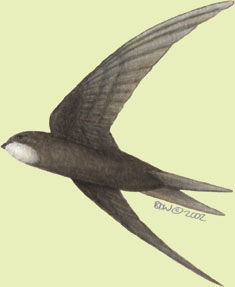
The Common Swift is a highly aerial migratory bird, renowned for spending almost its entire life in flight, only landing to breed. It is a master of the air, feeding, drinking, mating, and even sleeping on the wing. Its distinctive silhouette and screaming calls are characteristic sounds of summer in many parts of Europe and Asia.
Size & lifespan
- Length
- 16-17 cm
- Wingspan
- 42-48 cm
- Weight
- 35-56 g
- Lifespan
- Up to 21 years in the wild, typically 5-10 years
- Diet
- Insectivore
Physical characteristics
- Plumage
- Sooty brown to blackish-brown overall, with a small, indistinct whitish or pale grey patch on the chin/throat. The plumage appears uniformly dark in most lighting conditions. The feathers are short and dense, adapted for aerodynamic efficiency.
- Beak shape
- Small, black, and triangular when closed, but capable of opening very wide to form a large 'gape' for catching insects in flight.
- Eye color
- Dark brown, appearing black.
- Leg color
- Blackish, very short and weak, adapted for clinging to vertical surfaces rather than perching or walking.
- Distinguishing features
- Long, scythe-shaped wings (often described as boomerang-shaped) that are held stiffly in flight. A short, forked tail, which appears less deeply forked than that of swallows. Its entirely dark plumage and characteristic flight pattern are key identifiers.
- Juvenile appearance
- Juveniles are very similar to adults but often show a slightly more prominent and whiter chin patch, and their plumage may appear fresher with a faint scaly pattern on the underparts due to pale feather fringes. The wing feathers may also have paler tips.
- Seasonal changes
- No significant seasonal plumage changes. The plumage may appear slightly browner and more worn towards the end of the breeding season before the annual moult.
- Sexual dimorphism
- None; males and females are identical in plumage and size.
How to identify
- 1
Silhouette and Flight
Look for the distinctive scythe-shaped (boomerang) wings and short, forked tail. Flight is fast, powerful, and direct, with rapid wing beats and long glides. They rarely flap their wings below the body plane. They never perch on wires or trees, only cling to vertical surfaces.
- 2
Plumage Color
Uniformly sooty brown to blackish-brown plumage. Appears entirely dark against the sky. The only pale area is a small, indistinct whitish patch on the chin/throat, which is often hard to see.
- 3
Vocalizations
Listen for the characteristic high-pitched, screaming 'sree-sree-sree' calls, especially when groups are flying excitedly around buildings in the evenings or mornings.
- 4
Behavior
Observe their highly aerial lifestyle. They are almost always in flight, even when feeding, drinking, or mating. Their preference for nesting in crevices of buildings is also a key indicator.
Habitat & range
- Biomes
- Urban areas, towns, villages, cliffs, and sometimes mature woodlands (for nesting sites). Requires open airspace for foraging.
- Geographic range
- Breeds across most of Europe and temperate Asia, from the Atlantic coast east to Siberia and China. Winters in sub-Saharan Africa.
- Elevation range
- From sea level up to 2,000 meters (and occasionally higher) in breeding areas, depending on suitable nesting sites and insect availability.
- Preferred environments
- Primarily human-made structures for nesting, such as eaves, roof spaces, and crevices in old buildings. Also uses natural cliff faces. Forages over a wide variety of open habitats including farmland, wetlands, forests, and urban areas.
Behavior
- Activity time
- Diurnal, active from dawn to dusk. Can remain airborne for extended periods, including overnight, during which it may sleep by entering a state of 'unihemispheric slow-wave sleep' while gliding.
- Feeding habits
- Feeds exclusively on aerial insects (aeroplankton), including flies, beetles, aphids, and spiders, caught in its wide gape while in continuous flight. Often forages in large flocks, especially before storms or during periods of low insect abundance.
- Social behavior
- Highly social, especially during the breeding season, forming large colonies at nesting sites. Forages in flocks, sometimes numbering hundreds or thousands of individuals. Migrates in large groups.
- Flight pattern
- Extremely fast, agile, and powerful flight, characterized by rapid wing beats interspersed with long glides. Capable of sudden changes in direction. Often flies high, but descends to lower altitudes to feed or drink. Rarely seen perched, and never on the ground.
- Migration pattern
- Long-distance migratory. Arrives in breeding grounds in Europe and Asia from late April to early May, and departs for sub-Saharan Africa from late July to September. Non-breeding birds may undertake 'irruptive' movements during the breeding season in response to weather and food availability.
- Territoriality
- Defends a small area immediately around the nest site, but foraging areas are shared. Colonial nesters, often returning to the same nest site year after year.
Song & calls
- Song
- Does not have a complex song. Its vocalizations are primarily calls.
- Call
- A distinctive, high-pitched, piercing 'screaming' or 'sree-sree-sree' call, often given in rapid bursts, especially when flying in groups around nesting sites. The calls are often described as 'screaming parties' or 'devil's choruses'.
- When they vocalize
- Most vocal during the breeding season, particularly in the mornings and evenings when groups are flying around their nesting colonies. Less vocal during migration and in wintering grounds.
Breeding & reproduction
- Breeding season
- May to August, with peak activity in June and July.
- Nesting habits
- Nests colonially in crevices and cavities, primarily in buildings (under eaves, in roof spaces, behind fascia boards) and occasionally in natural cliff faces or tree holes. Nests are cup-shaped, made of airborne debris (feathers, plant material, paper) glued together with saliva.
- Clutch size
- 1-3 eggs, most commonly 2.
- Egg description
- Typically 2-3 (sometimes 1-4) pure white, oval eggs, measuring approximately 24-27 mm x 16-17 mm.
- Incubation period
- 19-20 days, shared by both parents.
- Fledging period
- 38-56 days, highly variable depending on food availability. Young are fed by both parents and leave the nest fully feathered and capable of flight.
- Parental care
- Both parents share incubation duties and feed the young. Young are capable of surviving periods of food shortage by entering a state of torpor.
Where to find
Urban and Suburban Areas
Look for them flying high over towns and cities, especially around older buildings with suitable nesting crevices under eaves or in roof spaces. Their screaming calls often draw attention to their presence.
Coastal Cliffs and Inland Rock Faces
In some regions, they nest in natural rock crevices, particularly along coastlines or in mountainous areas.
Open Countryside
While nesting in built-up areas, they forage widely over farmland, wetlands, and forests, wherever aerial insects are abundant.
Field tips
- Look Up. Swifts spend almost all their time in the air, often at considerable heights. Scan the sky, especially on warm, sunny days.
- Listen for Calls. Their distinctive screaming calls are often the first indication of their presence, particularly around nesting colonies in the mornings and evenings.
- Observe Flight Pattern. Familiarize yourself with their unique scythe-winged silhouette and powerful, direct flight. This distinguishes them from swallows and martins.
- Timing is Key. They are summer visitors to their breeding grounds. Look for them from late April/early May until late July/August.
Similar species
Pallid Swift
Apus pallidus
Slightly larger and paler brown overall, with a more extensive and whiter throat patch that often extends onto the breast. Its flight is often described as more languid or 'floppy' than the Common Swift. Found primarily in southern Europe and North Africa.
Alpine Swift
Tachymarptis melba
Much larger than the Common Swift (wingspan up to 58 cm) with a distinctive white belly and throat, contrasting with dark brown upperparts and breast band. Its flight is powerful and graceful, often at higher altitudes. Tail is less deeply forked.
Barn Swallow
Hirundo rustica
Swallows have a much longer, deeply forked tail, often with streamers, and are iridescent blue-black above with rufous underparts and throat. They perch frequently on wires and buildings, and their flight is more undulating. Swifts are entirely dark and rarely perch.
House Martin
Delichon urbicum
Martins are smaller than swifts, with a distinctive white rump and pure white underparts, contrasting with blue-black upperparts. They have a shorter, less deeply forked tail. They also perch frequently and build mud nests under eaves.
Quick facts
- Flight Time:
- Spends up to 10 months of the year continuously in flight.
- Speed:
- Can reach speeds of over 110 km/h (70 mph).
- Migration Distance:
- Migrates thousands of kilometers between breeding grounds in Europe/Asia and wintering grounds in Africa.
- Nesting Material:
- Uses saliva to glue together airborne debris for nest construction.
Fun facts
- Common Swifts are among the most aerial of all birds, capable of sleeping, mating, and feeding entirely on the wing.
- Young swifts can survive periods of food scarcity by entering a state of torpor, slowing their metabolism and body temperature.
- They have specialized feet (pamprodactyl) where all four toes point forward, allowing them to cling to vertical surfaces but making walking impossible.
- A single swift can consume thousands of insects in a day, playing an important role in insect control.
- They often return to the exact same nesting site year after year, sometimes for decades.
Scientific classification
- Kingdom
- Animalia
- Phylum
- Chordata
- Class
- Aves
- Order
- Apodiformes
- Family
- Apodidae
- Genus
- Apus
- Species
- Apus apus
Explore the Common Swift
Identify birds anywhere
Free on iOS, Android, and Web. Photo & sound identification, full species database, and your personal life list.