
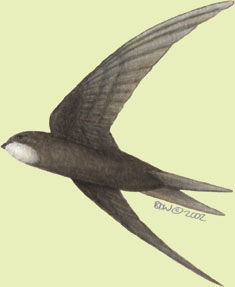
How to identify the Common Swift
Apus apus
Spotted a bird? Identify it instantly with the Birdby app
Open the appTo correctly identify the Common Swift (Apus apus), check each of these features. Birds can be tricky: habit, habitat, and call often confirm a sighting that a single photo cannot.
Size at a glance
- Length
- 16-17 cm
- Wingspan
- 42-48 cm
- Weight
- 35-56 g
Physical features to check
- 1
Plumage
Overall feather coloration and pattern.
Sooty brown to blackish-brown overall, with a small, indistinct whitish or pale grey patch on the chin/throat. The plumage appears uniformly dark in most lighting conditions. The feathers are short and dense, adapted for aerodynamic efficiency.
- 2
Beak shape
Shape and color of the bill: a key field mark.
Small, black, and triangular when closed, but capable of opening very wide to form a large 'gape' for catching insects in flight.
- 3
Eye color
Iris color and any distinctive eye markings.
Dark brown, appearing black.
- 4
Leg color
Leg and foot color.
Blackish, very short and weak, adapted for clinging to vertical surfaces rather than perching or walking.
- 5
Distinguishing features
Standout features that separate this species.
Long, scythe-shaped wings (often described as boomerang-shaped) that are held stiffly in flight. A short, forked tail, which appears less deeply forked than that of swallows. Its entirely dark plumage and characteristic flight pattern are key identifiers.
- 6
Juvenile appearance
How young birds differ from adults.
Juveniles are very similar to adults but often show a slightly more prominent and whiter chin patch, and their plumage may appear fresher with a faint scaly pattern on the underparts due to pale feather fringes. The wing feathers may also have paler tips.
- 7
Seasonal changes
Plumage variation between breeding and non-breeding seasons.
No significant seasonal plumage changes. The plumage may appear slightly browner and more worn towards the end of the breeding season before the annual moult.
- 8
Sexual dimorphism
How males and females differ.
None; males and females are identical in plumage and size.
Key field marks
- Silhouette and Flight. Look for the distinctive scythe-shaped (boomerang) wings and short, forked tail. Flight is fast, powerful, and direct, with rapid wing beats and long glides. They rarely flap their wings below the body plane. They never perch on wires or trees, only cling to vertical surfaces.
- Plumage Color. Uniformly sooty brown to blackish-brown plumage. Appears entirely dark against the sky. The only pale area is a small, indistinct whitish patch on the chin/throat, which is often hard to see.
- Vocalizations. Listen for the characteristic high-pitched, screaming 'sree-sree-sree' calls, especially when groups are flying excitedly around buildings in the evenings or mornings.
- Behavior. Observe their highly aerial lifestyle. They are almost always in flight, even when feeding, drinking, or mating. Their preference for nesting in crevices of buildings is also a key indicator.
Explore the Common Swift
Identify birds anywhere
Free on iOS, Android, and Web. Photo & sound identification, full species database, and your personal life list.