
Spotted a bird? Identify it instantly with the Birdby app
Open the appAbout
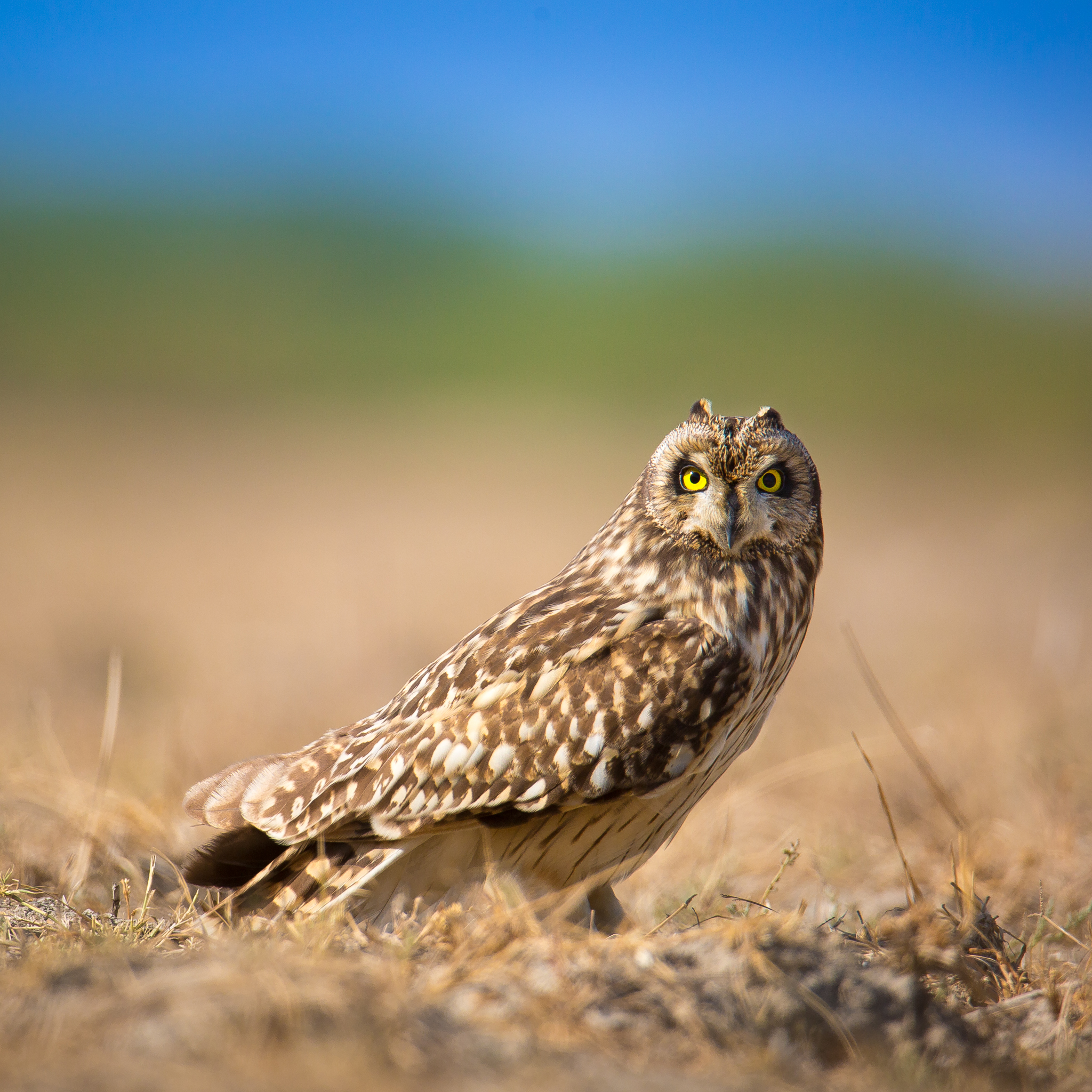
The Short-eared Owl is a medium-sized owl found in open country across much of the world. It is known for its buoyant, moth-like flight and often hunts during the day, especially at dawn and dusk. Its name comes from its very small, often inconspicuous ear tufts.
Size & lifespan
- Length
- 34-43 cm (13-17 in)
- Wingspan
- 90-110 cm (35-43 in)
- Weight
- 200-475 g (7.1-16.8 oz)
- Lifespan
- Up to 13 years in the wild, typically 4-5 years
- Diet
- Carnivore, primarily small mammals (voles, mice, shrews), occasionally small birds and insects.
Physical characteristics
- Plumage
- Overall buffy-brown and streaky. Upperparts are mottled brown with darker streaks, while underparts are pale buff to whitish with prominent dark brown streaking on the breast and flanks. The facial disc is pale, often whitish, with dark patches around the eyes, giving a 'masked' appearance. The wings have a distinctive dark carpal patch (wrist mark) on the underside, and dark tips to the primary feathers. The 'ear' tufts are very small and often not visible.
- Beak shape
- Small, sharply hooked, dark grey to black.
- Eye color
- Bright yellow, often appearing intense.
- Leg color
- Feathered legs and feet, yellowish-brown to greyish-brown.
- Distinguishing features
- Small ear tufts (often not visible), pale facial disc with dark eye patches, dark carpal patches on underwings, buoyant, moth-like flight, often seen hunting during the day.
- Juvenile appearance
- Juveniles resemble adults but are often darker and more uniformly rufous-brown, especially on the underparts, with less distinct streaking. The facial disc may be less defined.
- Seasonal changes
- No significant seasonal plumage changes. Plumage may appear slightly worn or faded towards the end of the breeding season before molting.
- Sexual dimorphism
- Females are generally slightly larger and heavier than males, but plumage differences are subtle and not reliably used for field identification. Males may be slightly paler overall.
How to identify
- 1
Habitat and Activity
Look for them in open grasslands, marshes, and fields, especially at dawn, dusk, or even during the day. If you see an owl flying low over open ground during daylight, it's likely a Short-eared Owl.
- 2
Flight Style
Observe their flight: it's often described as buoyant, erratic, or moth-like, with deep, slow wing beats and frequent glides. They may hover briefly.
- 3
Plumage and Markings
Note the streaky brown upperparts and pale, heavily streaked underparts. Crucially, look for the dark carpal patches (wrist marks) on the underside of the wings, which are very prominent in flight. The dark patches around the bright yellow eyes on a pale facial disc are also key.
- 4
Ear Tuft Size
While their name suggests 'short ears,' these tufts are often so small they are not visible, especially when the bird is relaxed. Do not rely on seeing ear tufts for identification; rather, the *absence* of prominent ear tufts helps distinguish them from Long-eared Owls.
- 5
Vocalizations
Listen for the male's 'toot-toot-toot' hooting song during breeding season display flights, or the harsh 'kee-ow' alarm calls.
Habitat & range
- Biomes
- Grasslands, prairies, tundra, marshes, bogs, open fields, agricultural areas, coastal dunes.
- Geographic range
- Nearly cosmopolitan, breeding across North America, Eurasia, and parts of South America. Winters in southern parts of its breeding range and further south.
- Elevation range
- Sea level up to 4,000 meters (13,000 feet) in some mountainous regions, but typically found in lowlands.
- Preferred environments
- Open, treeless or sparsely treed habitats with abundant small mammal populations and suitable ground cover for nesting.
Behavior
- Activity time
- Crepuscular (active at dawn and dusk) and diurnal, especially during winter or when feeding young. Less strictly nocturnal than many other owl species.
- Feeding habits
- Primarily hunts by flying low over open ground, often hovering or gliding, listening and watching for prey. When prey is detected, it drops swiftly onto it. Diet consists mainly of voles, but also shrews, mice, lemmings, and occasionally small birds, especially during winter or when mammal prey is scarce. Pellets are regurgitated, containing indigestible parts of prey.
- Social behavior
- Generally solitary or found in loose pairs during the breeding season. In winter, they may gather in communal roosts, sometimes numbering dozens of individuals, especially in areas with high prey availability.
- Flight pattern
- Distinctive buoyant, erratic, and moth-like flight with deep, slow wing beats. Often glides on uplifted wings. Can hover in place while hunting.
- Migration pattern
- Highly migratory in northern parts of its range, moving south for winter. Irruptive movements can occur in response to prey availability. Southern populations may be resident or undertake shorter, localized movements.
- Territoriality
- Males establish territories during the breeding season, defending them with aerial displays and vocalizations. Winter roosts are not territorial.
Song & calls
- Song
- The male's primary song is a series of low, hooting 'voo-voo-voo' notes, often described as a 'toot-toot-toot' or 'poo-poo-poo' repeated 10-20 times, accelerating towards the end. This is typically given during aerial display flights.
- Call
- Various calls include a harsh, barking 'kee-ow' or 'waak-waak-waak' alarm call, especially when disturbed near the nest. Young birds make a high-pitched 'pseep' begging call. A sharp 'skee-yow' can be heard during aggressive encounters.
- When they vocalize
- Most vocal during the breeding season, particularly at dawn and dusk. Less vocal outside of breeding, except for alarm calls.
Breeding & reproduction
- Breeding season
- Typically April to July, but can vary geographically and with prey availability. May breed earlier in southern regions or later in northern regions.
- Nesting habits
- Nests on the ground, usually in a shallow scrape or depression, often concealed by dense vegetation. The female builds the nest, which is a simple cup lined with grass, weeds, and feathers. Nests are typically in open fields, marshes, or tundra.
- Clutch size
- 3-11 eggs
- Egg description
- 3-11 (typically 4-7) pure white, oval eggs. The number of eggs can vary significantly depending on prey abundance, with larger clutches laid during vole population peaks.
- Incubation period
- 24-30 days, primarily by the female.
- Fledging period
- Young leave the nest and begin to fly at about 26-32 days old, but are dependent on parents for several more weeks.
- Parental care
- Female incubates and broods the young. Male provides food for the female and young. Both parents defend the nest aggressively.
Where to find
Grasslands and Prairies
Extensive open grasslands, prairies, and steppes are prime habitats, especially those with tall grasses for cover and abundant voles.
Marshes and Bogs
Wetlands, including freshwater and brackish marshes, bogs, and fens, provide suitable hunting grounds and nesting sites.
Agricultural Fields
Large, open agricultural fields, particularly those with fallow areas, hayfields, or winter wheat, can attract them, especially in winter.
Coastal Dunes and Tundra
In coastal areas, they can be found in dune systems. In northern latitudes, they inhabit open tundra.
Field tips
- Time of Day. Best seen at dawn and dusk, but often active during the day, especially on cloudy days or in winter. Look for them hunting in the late afternoon.
- Scan Open Areas. Use binoculars to scan large, open fields and marshes. They often perch on low posts, hummocks, or on the ground, but are most conspicuous in flight.
- Look for Communal Roosts. In winter, several Short-eared Owls may gather at communal roosts in dense grass or low vegetation. Look for multiple birds flying out to hunt around sunset.
- Check for Pellets. If you find a potential roosting area, look for owl pellets (regurgitated indigestible prey remains) on the ground, which can confirm their presence.
- Be Patient and Observe. Their flight can cover large areas. Be patient and watch for their distinctive flight pattern over open terrain.
Similar species
Long-eared Owl
Asio otus
Long-eared Owls are typically darker, more slender, and have prominent, long ear tufts (which are usually visible). They prefer denser woodland habitats and are strictly nocturnal. In flight, Long-eared Owls lack the distinct dark carpal patches of Short-eared Owls and have a more direct, less buoyant flight.
Barn Owl
Tyto alba
Barn Owls have a distinctive heart-shaped white facial disc, golden-buff upperparts, and pure white underparts. They are generally paler overall and lack the streaking of Short-eared Owls. Barn Owls also have a different flight style and prefer barns, silos, and tree cavities for nesting/roosting.
Northern Harrier
Circus hudsonius
While not an owl, Northern Harriers share similar open habitat and a low, coursing flight style. Harriers are diurnal raptors, have a distinctive white rump patch, and hold their wings in a dihedral (V-shape) in flight. Short-eared Owls lack the white rump and have a more buoyant, moth-like flight with flatter wings.
Quick facts
- Global Distribution:
- Nearly cosmopolitan, one of the most widespread owl species.
- Hunting Style:
- Low, coursing flight over open ground, often hovering.
- Ear Tuft Visibility:
- Very small and often not visible, hence the name.
- Diet Specialization:
- Highly dependent on small mammals, especially voles.
- Nesting:
- Ground nester, often in dense vegetation.
Fun facts
- Short-eared Owls are one of the few owl species that are regularly active during daylight hours, especially in winter or when feeding young.
- Their population numbers can fluctuate dramatically in response to cycles of their primary prey, voles. In years of high vole populations, they may have larger clutches and higher breeding success.
- During courtship, males perform elaborate aerial displays, including a 'sky dance' where they clap their wings together under their body, producing a distinctive sound.
- They have excellent hearing, aided by asymmetrical ear openings, which allows them to pinpoint prey even under snow or dense vegetation.
- The species has 10 recognized subspecies, reflecting its vast global distribution.
Scientific classification
- Kingdom
- Animalia
- Phylum
- Chordata
- Class
- Aves
- Order
- Strigiformes
- Family
- Strigidae
- Genus
- Asio
- Species
- Asio flammeus
Explore the Short-eared Owl
Identify birds anywhere
Free on iOS, Android, and Web. Photo & sound identification, full species database, and your personal life list.