
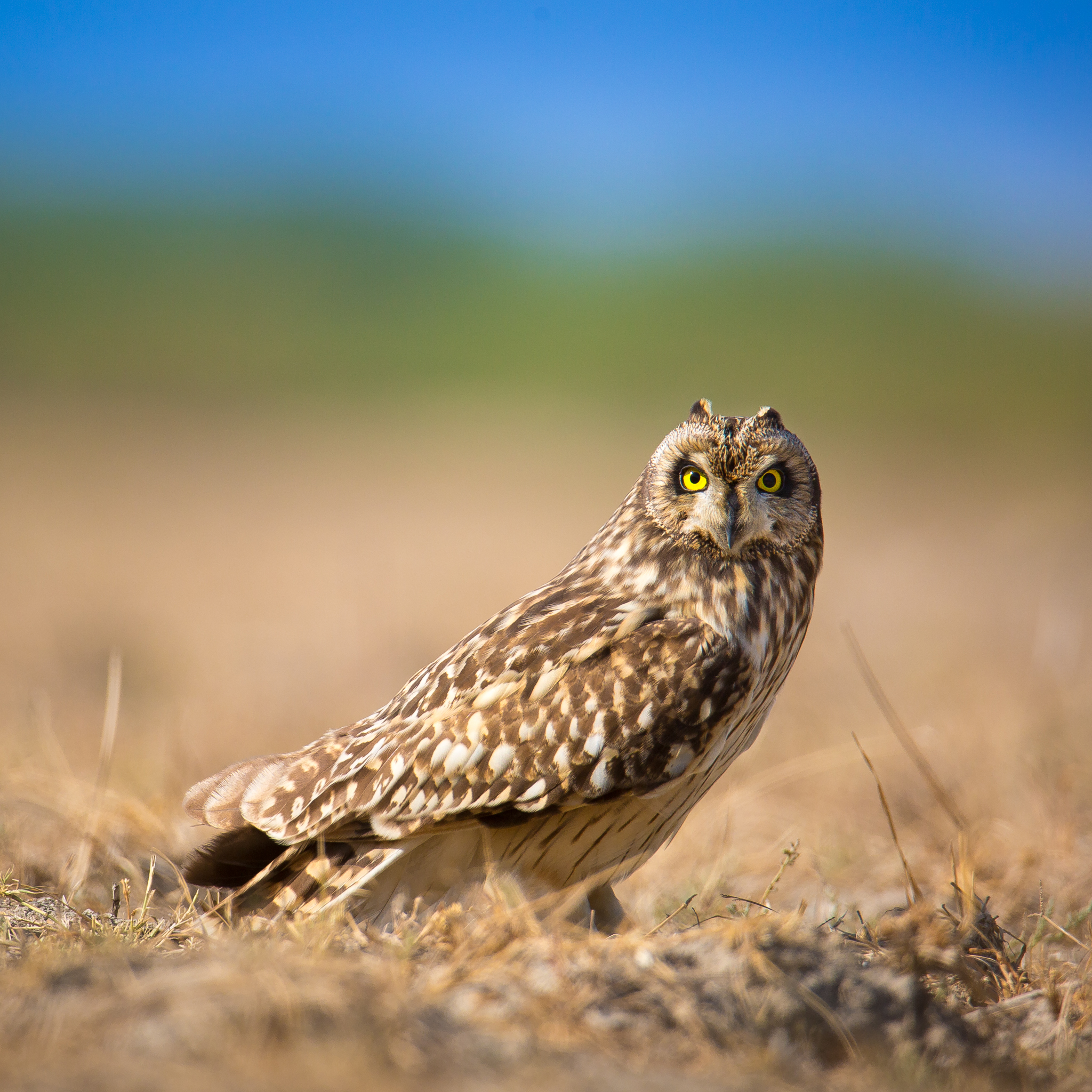
How to identify the Short-eared Owl
Asio flammeus
Spotted a bird? Identify it instantly with the Birdby app
Open the appTo correctly identify the Short-eared Owl (Asio flammeus), check each of these features. Birds can be tricky: habit, habitat, and call often confirm a sighting that a single photo cannot.
Size at a glance
- Length
- 34-43 cm (13-17 in)
- Wingspan
- 90-110 cm (35-43 in)
- Weight
- 200-475 g (7.1-16.8 oz)
Physical features to check
- 1
Plumage
Overall feather coloration and pattern.
Overall buffy-brown and streaky. Upperparts are mottled brown with darker streaks, while underparts are pale buff to whitish with prominent dark brown streaking on the breast and flanks. The facial disc is pale, often whitish, with dark patches around the eyes, giving a 'masked' appearance. The wings have a distinctive dark carpal patch (wrist mark) on the underside, and dark tips to the primary feathers. The 'ear' tufts are very small and often not visible.
- 2
Beak shape
Shape and color of the bill: a key field mark.
Small, sharply hooked, dark grey to black.
- 3
Eye color
Iris color and any distinctive eye markings.
Bright yellow, often appearing intense.
- 4
Leg color
Leg and foot color.
Feathered legs and feet, yellowish-brown to greyish-brown.
- 5
Distinguishing features
Standout features that separate this species.
Small ear tufts (often not visible), pale facial disc with dark eye patches, dark carpal patches on underwings, buoyant, moth-like flight, often seen hunting during the day.
- 6
Juvenile appearance
How young birds differ from adults.
Juveniles resemble adults but are often darker and more uniformly rufous-brown, especially on the underparts, with less distinct streaking. The facial disc may be less defined.
- 7
Seasonal changes
Plumage variation between breeding and non-breeding seasons.
No significant seasonal plumage changes. Plumage may appear slightly worn or faded towards the end of the breeding season before molting.
- 8
Sexual dimorphism
How males and females differ.
Females are generally slightly larger and heavier than males, but plumage differences are subtle and not reliably used for field identification. Males may be slightly paler overall.
Key field marks
- Habitat and Activity. Look for them in open grasslands, marshes, and fields, especially at dawn, dusk, or even during the day. If you see an owl flying low over open ground during daylight, it's likely a Short-eared Owl.
- Flight Style. Observe their flight: it's often described as buoyant, erratic, or moth-like, with deep, slow wing beats and frequent glides. They may hover briefly.
- Plumage and Markings. Note the streaky brown upperparts and pale, heavily streaked underparts. Crucially, look for the dark carpal patches (wrist marks) on the underside of the wings, which are very prominent in flight. The dark patches around the bright yellow eyes on a pale facial disc are also key.
- Ear Tuft Size. While their name suggests 'short ears,' these tufts are often so small they are not visible, especially when the bird is relaxed. Do not rely on seeing ear tufts for identification; rather, the *absence* of prominent ear tufts helps distinguish them from Long-eared Owls.
- Vocalizations. Listen for the male's 'toot-toot-toot' hooting song during breeding season display flights, or the harsh 'kee-ow' alarm calls.
Explore the Short-eared Owl
Identify birds anywhere
Free on iOS, Android, and Web. Photo & sound identification, full species database, and your personal life list.