
Spotted a bird? Identify it instantly with the Birdby app
Open the appAbout
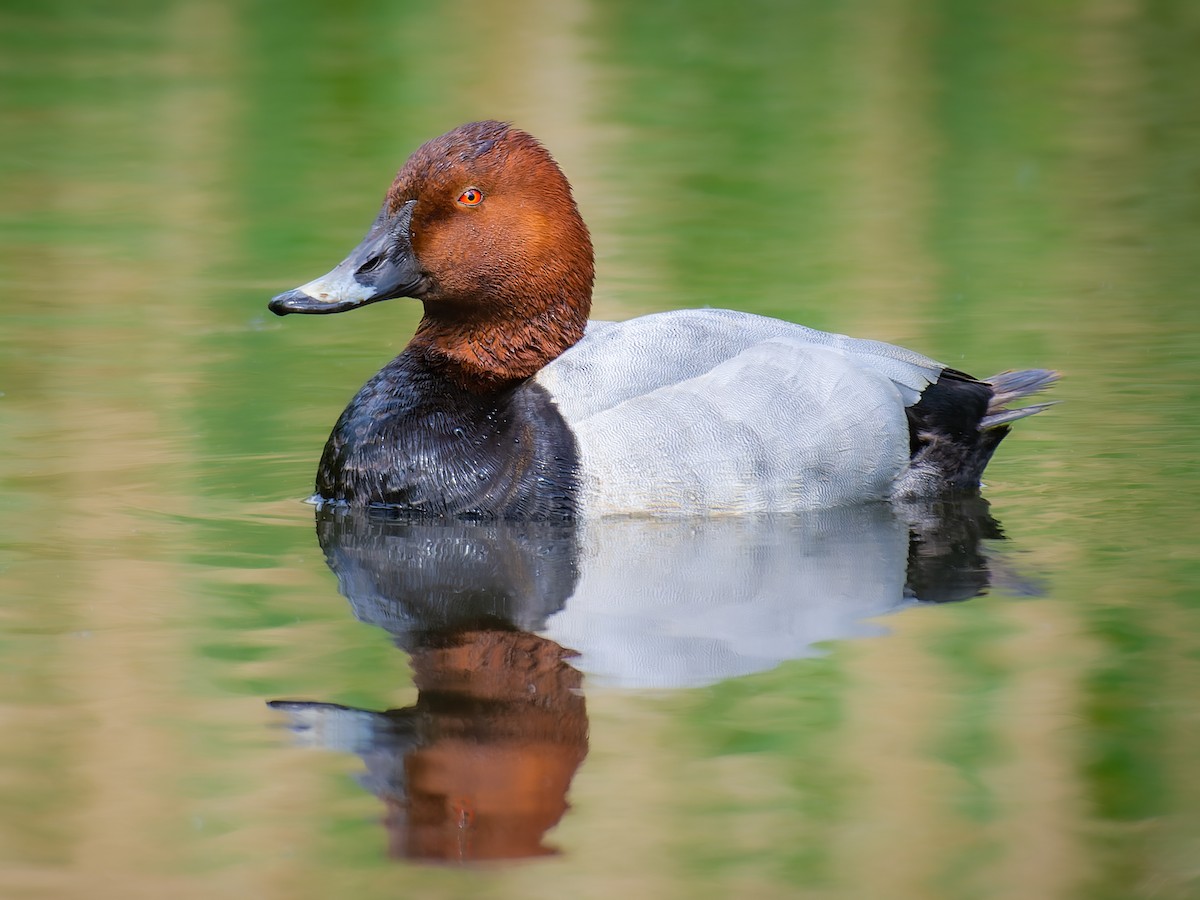
The Common Pochard is a medium-sized diving duck with a distinctive silhouette and head shape. Males are particularly striking with their reddish-chestnut head and neck, grey body, and black breast and tail. Females are more subdued in coloration, generally grey-brown. They are expert divers, often seen foraging for aquatic vegetation and invertebrates in freshwater habitats.
Size & lifespan
- Length
- 42-49 cm (17-19 in)
- Wingspan
- 70-82 cm (28-32 in)
- Weight
- 0.7-1.1 kg (1.5-2.4 lbs)
- Lifespan
- Typically 5-10 years in the wild, with records up to 20 years in captivity.
- Diet
- Primarily herbivorous, feeding on aquatic plants, seeds, roots, and tubers. Also consumes aquatic invertebrates such as insect larvae, molluscs, and small crustaceans, especially during breeding season.
Physical characteristics
- Plumage
- Adult male: Head and upper neck are rich reddish-chestnut. Breast and upper back are black. Flanks and belly are pale grey, contrasting with the black rear. Back and upperwing are pale grey. Undertail coverts are black. Bill is black with a distinctive broad blue-grey band near the tip. Eyes are red. Adult female: Head and body are duller brown. The crown and lines through the eye are often darker brown, sometimes with an indistinct paler patch between the eye and bill. Flanks are grey-brown. Bill is similar to male but often duller, with a less distinct blue-grey band. Eyes are brown. In flight, both sexes show a uniform pale grey upperwing bar.
- Beak shape
- Relatively long and broad bill with a slightly dished profile, black with a prominent blue-grey band across the middle.
- Eye color
- Adult male: Bright red. Adult female: Brown.
- Leg color
- Dull dark grey or greenish-grey with dark webbing.
- Distinguishing features
- The combination of the male's reddish head, grey body, and black breast, along with the distinctive bill pattern (black with a blue-grey band), are key. The steeply rising crown of the head forms a noticeable peak.
- Juvenile appearance
- Juveniles resemble adult females but are generally duller and more uniformly brown, with less distinct head markings and browner eyes. The bill pattern is less developed.
- Seasonal changes
- Males undergo an eclipse plumage after breeding (July-September), becoming duller and more female-like, but can be distinguished by the red eye and retain some darker markings. They regain their breeding plumage by late autumn/early winter.
- Sexual dimorphism
- Pronounced. Males are distinctly colored with reddish heads and grey bodies, while females are duller brown overall. Eye color also differs.
How to identify
- 1
Male Head/Body Coloration
Look for the distinctive reddish-chestnut head and neck, contrasting with the black breast and mostly pale grey body. This combination is unique among European diving ducks.
- 2
Bill Pattern
Observe the bill: it is black with a broad, prominent blue-grey band in the middle. This 'tricolour' bill pattern is a key field mark for both sexes, though less distinct in females and immatures.
- 3
Head Shape
Note the distinctive head profile with a steeply rising forehead and peaked crown, especially noticeable on males. Gives the head a somewhat triangular appearance.
- 4
Eye Color
Adult males have striking bright red eyes, which are visible even at a distance in good light. Females have brown eyes.
- 5
Flight Pattern
In flight, look for the uniform pale grey bar on the upperwing of both sexes, which distinguishes it from species like Tufted Duck (white wing bar) or Ferruginous Duck (no prominent wing bar).
- 6
Female Plumage
Females are primarily brown-grey, often with a darker crown and a paler area between the eye and bill. The bill pattern remains important for identification.
- 7
Diving Behavior
Observe its behavior; Common Pochards are classic diving ducks, disappearing completely underwater for extended periods to feed.
Habitat & range
- Biomes
- Temperate grasslands, wetlands, and open water bodies.
- Geographic range
- Breeds across the Palearctic from Western Europe to Central Asia. Winters in Western and Southern Europe, North Africa, the Middle East, and South and Southeast Asia. Some populations are resident.
- Elevation range
- Primarily lowland species, typically found below 500 meters, but occasionally up to 1000 meters in some parts of its range.
- Preferred environments
- Large, shallow freshwater bodies with abundant submerged vegetation, such as lakes, reservoirs, slow-flowing rivers, and gravel pits. Also uses coastal lagoons and estuaries during winter. Prefers open water for feeding and safety, with reeds or other emergent vegetation for nesting cover.
Behavior
- Activity time
- Diurnal and nocturnal, actively feeding during both day and night, especially during clear moonlit nights.
- Feeding habits
- Diving duck, typically dives for food, staying underwater for 10-20 seconds. Uses its broad bill to dabble and scoop vegetation and invertebrates from the bottom. Feeds both during the day and night.
- Social behavior
- Highly gregarious, especially outside the breeding season, forming large flocks, sometimes mixed with other diving duck species. Males display to females in groups during courtship.
- Flight pattern
- Strong, direct, and fast flight with rapid wing beats. Takes off from water with difficulty, often running across the surface first. Typically flies in V-formations or lines during migration.
- Migration pattern
- Migratory over much of its range, moving from colder northern breeding grounds to milder southern wintering areas. Some southern populations are resident. Migration typically occurs in broad fronts.
- Territoriality
- Males are not strongly territorial on breeding grounds, but defend their mate. Nests are often placed in loose colonies or individually within suitable vegetation.
Song & calls
- Song
- Males have a soft, wheezing 'whooo-oo' or 'whirr-harr' sound, mostly during courtship. It's a rather quiet species for a duck.
- Call
- Males give a soft, guttural 'kr-r-r-r' or 'kuck-kuck.' Females have a harsh, grating 'karrr' or 'gharrr' call, especially when disturbed or with young, and a quieter 'gh-gh-gh.'
- When they vocalize
- Mainly vocal during the breeding season and courtship displays. Less vocal during winter.
Breeding & reproduction
- Breeding season
- April to July, depending on latitude.
- Nesting habits
- Nests are typically built in dense emergent vegetation near water, such as reeds, sedges, or rushes. The nest is a substantial bowl of plant material, lined with down. Nests are often well concealed.
- Clutch size
- Typically 8-10 eggs, but can range from 6 to 14. Larger clutches may result from 'dump nesting' by multiple females.
- Egg description
- 8-10 (sometimes 6-14) smooth, glossy, pale greenish-grey to buff eggs.
- Incubation period
- 24-28 days, primarily by the female.
- Fledging period
- 50-55 days. Young fledge and become independent.
- Parental care
- Mainly by the female, who leads the ducklings to feeding grounds and protects them. Males typically desert the female during incubation.
Where to find
Large Freshwater Lakes and Reservoirs
These are prime habitats, especially those with clear water that allows for submerged vegetation, and moderate depth for diving.
Gravel Pits and Quarries
Often colonize these artificial water bodies, particularly if they are established with some aquatic plant life.
Slow-flowing Rivers and Wide Canals
Can be found on wider, slower sections of rivers with suitable riparian vegetation. Avoid fast-flowing waters.
Coastal Lagoons and Estuaries
During winter months, smaller numbers may be found in brackish or saline habitats, though freshwater is preferred.
Wetlands and Marshes
Breeding pairs often utilize areas with extensive reedbeds or other emergent vegetation for nesting cover.
Field tips
- Scan Open Water. Pochards spend most of their time on open water. Use binoculars or a scope to scan large expanses of lakes for their characteristic diving behavior and distinctive male plumage.
- Look for Mixed Flocks. Outside of breeding, Common Pochards often associate with other diving ducks like Tufted Ducks or Greater Scaup. Carefully examine each bird in a mixed flock.
- Observe Diving. Watch their diving pattern. They typically make small, head-first dives, disappearing completely and resurfacing a short distance away.
- Check Bill and Eye Color. These are crucial identification features, especially for distinguishing between similar species and sexes. The blue-grey bill band and red male eye are key.
- Visit During Winter. Numbers often peak in wintering grounds, making them easier to find and observe in larger flocks.
- Consider Time of Day. They can be active at any time, but early morning or late afternoon might offer calmer conditions for observation.
Similar species
Red-crested Pochard
Netta rufina
Male Red-crested Pochard has a brighter orange head, pinkish-red bill, and a white flank patch contrasting with a black back. It also rides higher in the water due to buoyant feeding. Female Red-crested Pochard has a dark crown, pale cheeks, and a reddish-tipped bill, along with a distinct white wing bar in flight, unlike the uniform grey wing bar of Common Pochard.
Canvasback
Aythya valisineria
The Canvasback, found in North America, is larger and has a distinctive long, sloping profile from the forehead to the bill tip. Its bill is entirely black. Male Canvasback has a white body compared to the grey of Common Pochard.
Ring-necked Duck
Aythya collaris
Male Ring-necked Duck (North American) has a black back and white flank patch, with a white ring near the tip of its bill. Its head is angular. Female is dark brown with a white patch at the base of the bill, and lacks the Common Pochard's distinctive bill band.
Tufted Duck
Aythya fuligula
Male Tufted Duck is all black with white flanks and a prominent crest, and yellow eyes. Female is dark brown with a smaller crest. Common Pochard lacks a crest, and males have grey flanks and red eyes.
Quick facts
- Taxonomic Status:
- Monotypic species, no widely recognized subspecies.
- Feeding Method:
- Diving duck, primarily obtains food by submerging underwater.
- Nest Type:
- Well-concealed bowl of vegetation lined with down, built near water.
- Distinctive Feature (Male):
- Reddish-chestnut head, grey body, black breast, and red eyes.
- Bill Mark:
- Black with a prominent blue-grey central band.
- Flight Speed:
- Fast and direct, with rapid wingbeats.
- Conservation Threat:
- Habitat loss, degradation of wetlands, hunting pressure, and lead poisoning from spent shot.
Fun facts
- The name 'Pochard' is derived from the Old French 'pochard,' meaning 'to poach' or 'to poke,' referring to its diving and bottom-feeding habits.
- Common Pochards can dive to depths of several meters to find food, staying submerged for up to 30 seconds, though typically less than 20.
- They are known to hybridize occasionally with other Aythya species, such as Tufted Ducks and Ferruginous Ducks.
- During their post-breeding eclipse plumage, males can be quite challenging to identify, often resembling females or even juvenile birds.
- Their strong, direct flight makes them appear quite robust in the air, a contrast to their somewhat clunky appearance when taking off from water.
Scientific classification
- Kingdom
- Animalia
- Phylum
- Chordata
- Class
- Aves
- Order
- Anseriformes
- Family
- Anatidae
- Genus
- Aythya
- Species
- Aythya ferina
Explore the Common Pochard
Identify birds anywhere
Free on iOS, Android, and Web. Photo & sound identification, full species database, and your personal life list.