
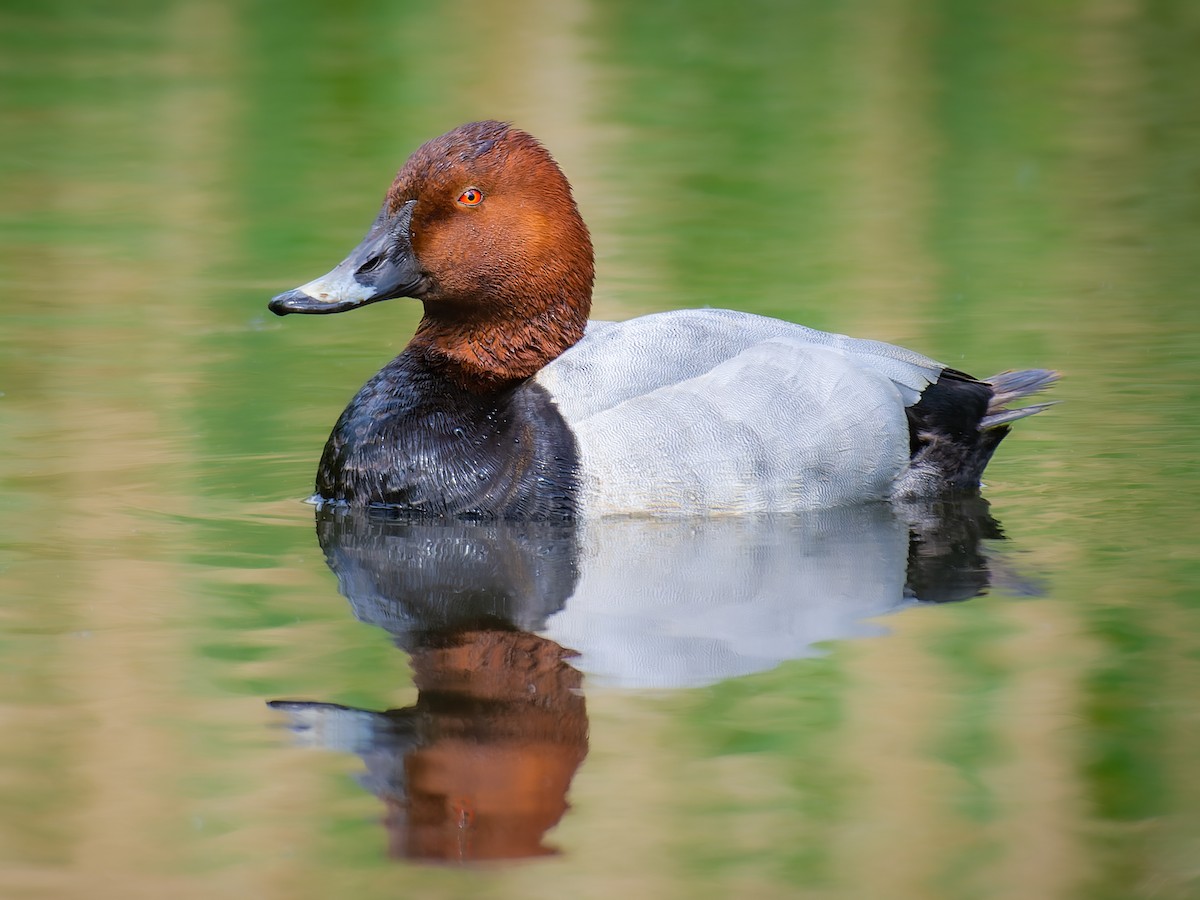
How to identify the Common Pochard
Aythya ferina
Spotted a bird? Identify it instantly with the Birdby app
Open the appTo correctly identify the Common Pochard (Aythya ferina), check each of these features. Birds can be tricky: habit, habitat, and call often confirm a sighting that a single photo cannot.
Size at a glance
- Length
- 42-49 cm (17-19 in)
- Wingspan
- 70-82 cm (28-32 in)
- Weight
- 0.7-1.1 kg (1.5-2.4 lbs)
Physical features to check
- 1
Plumage
Overall feather coloration and pattern.
Adult male: Head and upper neck are rich reddish-chestnut. Breast and upper back are black. Flanks and belly are pale grey, contrasting with the black rear. Back and upperwing are pale grey. Undertail coverts are black. Bill is black with a distinctive broad blue-grey band near the tip. Eyes are red. Adult female: Head and body are duller brown. The crown and lines through the eye are often darker brown, sometimes with an indistinct paler patch between the eye and bill. Flanks are grey-brown. Bill is similar to male but often duller, with a less distinct blue-grey band. Eyes are brown. In flight, both sexes show a uniform pale grey upperwing bar.
- 2
Beak shape
Shape and color of the bill: a key field mark.
Relatively long and broad bill with a slightly dished profile, black with a prominent blue-grey band across the middle.
- 3
Eye color
Iris color and any distinctive eye markings.
Adult male: Bright red. Adult female: Brown.
- 4
Leg color
Leg and foot color.
Dull dark grey or greenish-grey with dark webbing.
- 5
Distinguishing features
Standout features that separate this species.
The combination of the male's reddish head, grey body, and black breast, along with the distinctive bill pattern (black with a blue-grey band), are key. The steeply rising crown of the head forms a noticeable peak.
- 6
Juvenile appearance
How young birds differ from adults.
Juveniles resemble adult females but are generally duller and more uniformly brown, with less distinct head markings and browner eyes. The bill pattern is less developed.
- 7
Seasonal changes
Plumage variation between breeding and non-breeding seasons.
Males undergo an eclipse plumage after breeding (July-September), becoming duller and more female-like, but can be distinguished by the red eye and retain some darker markings. They regain their breeding plumage by late autumn/early winter.
- 8
Sexual dimorphism
How males and females differ.
Pronounced. Males are distinctly colored with reddish heads and grey bodies, while females are duller brown overall. Eye color also differs.
Key field marks
- Male Head/Body Coloration. Look for the distinctive reddish-chestnut head and neck, contrasting with the black breast and mostly pale grey body. This combination is unique among European diving ducks.
- Bill Pattern. Observe the bill: it is black with a broad, prominent blue-grey band in the middle. This 'tricolour' bill pattern is a key field mark for both sexes, though less distinct in females and immatures.
- Head Shape. Note the distinctive head profile with a steeply rising forehead and peaked crown, especially noticeable on males. Gives the head a somewhat triangular appearance.
- Eye Color. Adult males have striking bright red eyes, which are visible even at a distance in good light. Females have brown eyes.
- Flight Pattern. In flight, look for the uniform pale grey bar on the upperwing of both sexes, which distinguishes it from species like Tufted Duck (white wing bar) or Ferruginous Duck (no prominent wing bar).
- Female Plumage. Females are primarily brown-grey, often with a darker crown and a paler area between the eye and bill. The bill pattern remains important for identification.
- Diving Behavior. Observe its behavior; Common Pochards are classic diving ducks, disappearing completely underwater for extended periods to feed.
Explore the Common Pochard
Identify birds anywhere
Free on iOS, Android, and Web. Photo & sound identification, full species database, and your personal life list.