
Spotted a bird? Identify it instantly with the Birdby app
Open the appAbout
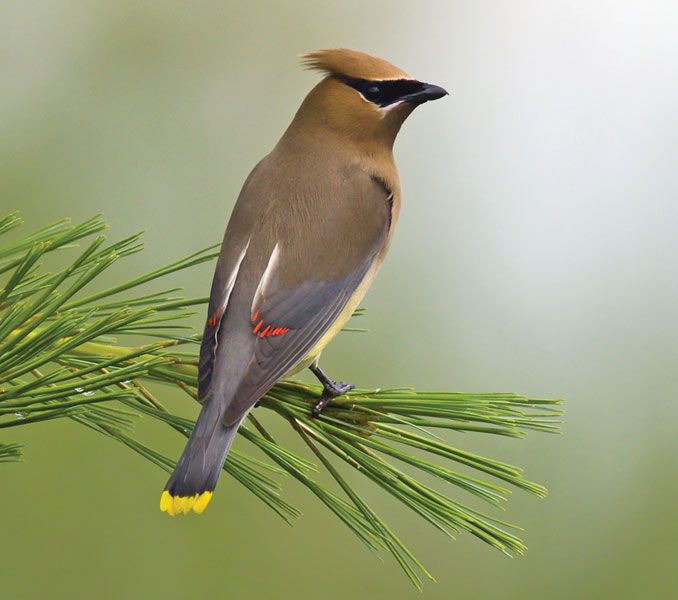
The Cedar Waxwing is a sleek, medium-sized passerine bird characterized by its silky, fawn-brown plumage, a prominent crest, and a black mask. It is primarily frugivorous, known for its nomadic movements in search of fruit, and often seen in large, cohesive flocks. Its name derives from its fondness for cedar berries and the waxy red tips on its secondary flight feathers.
Size & lifespan
- Length
- 14-17 cm (5.5-6.7 in)
- Wingspan
- 28-32 cm (11-12.6 in)
- Weight
- 30-34 g (1.1-1.2 oz)
- Lifespan
- 5-8 years (up to 10 years recorded)
- Diet
- Frugivore (primarily), Insectivore (especially during breeding season)
Physical characteristics
- Plumage
- Overall silky, fawn-brown plumage, fading to pale yellow on the belly. The back is grayish-brown, and the rump is gray. The undertail coverts are white. The tail is medium-length, gray, and tipped with a distinctive bright yellow band. Secondary flight feathers often have small, waxy red tips, which are more prominent in older individuals.
- Beak shape
- Short, stout, and slightly hooked bill, black in color.
- Eye color
- Dark brown, almost black.
- Leg color
- Dark gray to black.
- Distinguishing features
- Prominent, sleek crest that can be raised or lowered; black mask extending from the bill through the eye; bright yellow tail tip; waxy red tips on secondary flight feathers (not always visible or present on all individuals, especially younger ones).
- Juvenile appearance
- Juveniles are streaky brown on the back and heavily streaked on the underparts, particularly on the breast and flanks. They have a less defined crest and mask, and their yellow tail tip is duller or absent. Waxy red wing tips are typically absent.
- Seasonal changes
- No significant seasonal plumage changes. Plumage remains consistent year-round, though wear and fading can occur.
- Sexual dimorphism
- Males and females are virtually identical in plumage. Males may average slightly larger and have more prominent waxy red tips on their wings, but this is not a reliable field mark for sexing.
How to identify
- 1
Crest and Mask
Look for the distinctive, sleek crest on the head and the black mask across the eyes. These are key features for all waxwings.
- 2
Plumage Color
Note the silky, fawn-brown body plumage, fading to pale yellow on the belly. The back is grayish-brown.
- 3
Tail Tip
Observe the bright yellow band at the tip of the tail. This is a consistent and reliable field mark for adults.
- 4
Waxy Wing Tips
Check for small, waxy red tips on the secondary flight feathers. While not always present or easy to see, especially on younger birds, they are diagnostic when visible.
- 5
Vocalizations
Listen for their high-pitched, reedy 'szeee' or 'seee-seee' calls, often given in flight or by a flock.
- 6
Behavior
Look for flocks feeding on berries, often passing fruit from bill to bill. They are often seen perched in fruit trees or hawking insects from a perch.
Habitat & range
- Biomes
- Temperate forests, woodlands, open woodlands, orchards, suburban parks, gardens, riparian areas.
- Geographic range
- Breeds across southern Canada and the northern United States. Winters throughout much of the United States, Mexico, Central America, and the Caribbean. Some populations are resident in parts of the Pacific Northwest and the Great Lakes region.
- Elevation range
- Sea level up to 2,000 meters (6,500 feet), occasionally higher in migration.
- Preferred environments
- Areas with abundant fruit-bearing trees and shrubs, especially those with small, soft berries. Also requires access to water for drinking and bathing.
Behavior
- Activity time
- Diurnal.
- Feeding habits
- Highly frugivorous, consuming a wide variety of berries and small fruits (e.g., cedar, juniper, dogwood, hawthorn, serviceberry, cherry). During the breeding season and when fruit is scarce, they supplement their diet with insects, often caught in aerial sallies. They can become intoxicated from fermented berries.
- Social behavior
- Highly social, especially outside the breeding season, forming large flocks that can number in the hundreds. They often feed communally, passing berries along a line of birds. During breeding, they are found in pairs or small groups.
- Flight pattern
- Strong, direct, and undulating flight. Often fly in tight, cohesive flocks, especially outside the breeding season. They are agile fliers when hawking insects.
- Migration pattern
- Irregular and nomadic migrant, driven primarily by the availability of fruit. Northern populations are generally migratory, moving south for winter. Southern populations may be resident or undertake shorter, localized movements. Their migration is often described as irruptive, with large numbers appearing in areas where fruit is abundant.
- Territoriality
- Not strongly territorial, especially outside the breeding season. Breeding pairs defend a small area around the nest, but feeding flocks are generally tolerant of each other.
Song & calls
- Song
- Cedar Waxwings do not have a complex song. Their vocalizations are typically high-pitched, thin, and reedy calls.
- Call
- A distinctive, high-pitched, trilled 'szeee' or 'seee-seee' call, often given in flight or while perched. Also a shorter, sharper 'tsit' call. These calls are often given in unison by a flock, creating a characteristic buzzing sound.
- When they vocalize
- Vocalize year-round, but particularly noticeable when flocks are moving or feeding.
Breeding & reproduction
- Breeding season
- Late spring to late summer (May to August), later than most North American passerines, coinciding with the availability of summer fruits and insects.
- Nesting habits
- Nests are typically built in horizontal forks of trees or shrubs, 2-20 meters (6-65 feet) above the ground. The nest is a bulky, cup-shaped structure made of twigs, grasses, bark strips, moss, and often lined with fine grasses, hair, and sometimes spider silk. Both sexes participate in nest building.
- Clutch size
- 3-6 eggs, typically 4-5.
- Egg description
- 3-6 eggs, pale gray or bluish-gray, speckled with dark brown or black spots, especially at the larger end. Eggs measure approximately 21 x 15 mm.
- Incubation period
- 11-13 days, primarily by the female, though the male may occasionally assist.
- Fledging period
- 14-18 days after hatching. Young are fed by both parents.
- Parental care
- Both parents feed the nestlings and fledglings. Young are dependent on parents for several weeks after fledging.
Where to find
Orchards and Vineyards
Areas with cultivated fruit trees are prime locations, especially during migration and winter.
Suburban Parks and Gardens
Often found in residential areas with ornamental fruit-bearing shrubs and trees.
Riparian Areas
Along rivers and streams where berry-producing plants are common.
Open Woodlands and Forest Edges
Areas with a mix of trees and shrubs that provide both fruit and insect foraging opportunities.
Field tips
- Look for Fruit Sources. Cedar Waxwings are highly nomadic and will appear wherever there is an abundance of ripe berries. Focus your search on trees and shrubs laden with fruit.
- Listen for Calls. Their high-pitched, reedy calls are often the first indication of their presence, especially when a flock is moving or feeding.
- Observe Flocking Behavior. Outside the breeding season, they are almost always found in flocks. Look for groups of birds moving together, often perching in a line.
- Check Water Sources. Waxwings are fond of bathing and drinking, so checking near ponds, bird baths, or streams can be productive.
- Be Patient. Their movements are unpredictable. If you know they are in an area, patience will often be rewarded as they move through.
Similar species
Bohemian Waxwing
Bombycilla garrulus
Bohemian Waxwings are larger and grayer overall, with rufous (reddish-brown) undertail coverts (Cedar Waxwings have white undertail coverts). They also have yellow and white markings on the wings, which Cedar Waxwings lack. Bohemian Waxwings have a more restricted northern breeding range and are primarily winter visitors to the northern US.
Phainopepla
Phainopepla nitens
Phainopeplas are found in the southwestern US and Mexico. Males are glossy black with a prominent crest and a white wing patch visible in flight. Females are duller gray. They lack the yellow tail tip and waxy red wing tips of Cedar Waxwings. Their calls are also distinct.
Quick facts
- Diet:
- Primarily fruit, especially berries
- Sociality:
- Highly social, forms large flocks
- Migration:
- Nomadic, irruptive, driven by fruit availability
- Distinctive Feature:
- Yellow tail tip, black mask, crest
- Vocalization:
- High-pitched, reedy 'szeee' call
Fun facts
- Cedar Waxwings are one of the few bird species that can survive almost entirely on fruit for extended periods.
- They are known to become intoxicated from eating fermented berries, sometimes appearing disoriented or unable to fly straight.
- The waxy red tips on their secondary feathers are thought to be a sign of age or health, becoming more prominent with maturity.
- They have a unique feeding behavior where they pass berries down a line of birds, often from bill to bill, until one bird swallows it.
- Their breeding season is unusually late, timed to coincide with the ripening of summer fruits and the peak abundance of insects.
Scientific classification
- Kingdom
- Animalia
- Phylum
- Chordata
- Class
- Aves
- Order
- Passeriformes
- Family
- Bombycillidae
- Genus
- Bombycilla
- Species
- Bombycilla cedrorum
Explore the Cedar Waxwing
Identify birds anywhere
Free on iOS, Android, and Web. Photo & sound identification, full species database, and your personal life list.