
Spotted a bird? Identify it instantly with the Birdby app
Open the appAbout
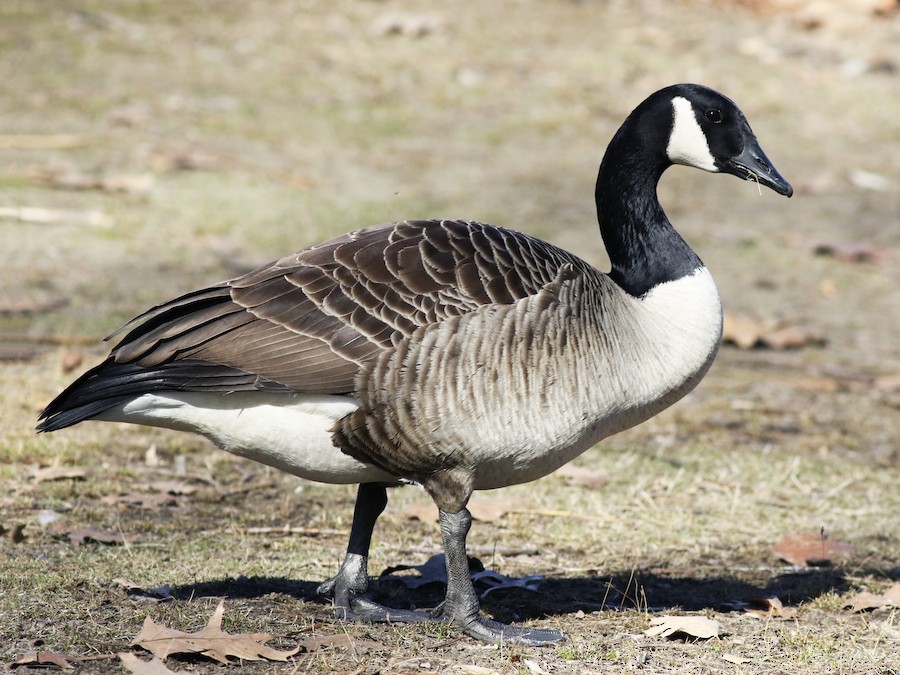
The Canada Goose is a large wild goose species with a distinctive black head and neck, white cheek patches, a light tan to brown body, and a white undertail. It is native to arctic and temperate regions of North America, though it has been introduced to other areas. Known for its V-shaped migratory flights and loud honking calls, it is a highly adaptable species found in a wide range of aquatic and terrestrial habitats.
Size & lifespan
- Length
- 75-110 cm (30-43 in)
- Wingspan
- 127-180 cm (50-71 in)
- Weight
- 2.6-6.5 kg (5.7-14.3 lbs), with some subspecies reaching up to 9 kg (20 lbs)
- Lifespan
- 10-24 years in the wild, with records up to 30 years
- Diet
- Herbivore
Physical characteristics
- Plumage
- Adults have a black head and neck with a prominent white 'chinstrap' or cheek patch that extends from behind the eye to under the throat. The body plumage varies from light tan to dark brown, with lighter flanks and a white undertail coverts. The breast is typically paler, often a creamy white or light gray. Flight feathers are dark brown to black.
- Beak shape
- Short, stout, and black.
- Eye color
- Dark brown
- Leg color
- Black
- Distinguishing features
- The most distinctive feature is the black head and neck with the contrasting white chinstrap. Its large size and characteristic honking call are also key identifiers.
- Juvenile appearance
- Juveniles resemble adults but have duller plumage, often with a more mottled or grayish-brown body. The white chinstrap may be less distinct or slightly smudged, and their overall appearance is less crisp than adults.
- Seasonal changes
- No significant seasonal plumage changes. Plumage may appear slightly worn or faded towards the end of the breeding season before molting.
- Sexual dimorphism
- Males (ganders) and females (geese) are outwardly similar in plumage. Males are generally larger and heavier than females, but this can be difficult to discern without direct comparison.
How to identify
- 1
Head and Neck Pattern
Look for the unmistakable black head and neck with a prominent white 'chinstrap' that wraps around the throat and extends behind the eye. This is the most reliable field mark.
- 2
Size
Canada Geese are large waterfowl. If seen alongside other geese, note their substantial size, which helps distinguish them from smaller Cackling Geese.
- 3
Vocalizations
Listen for their characteristic loud, resonant 'honk'. This call is distinct from the higher-pitched 'cackle' of Cackling Geese or the varied calls of other waterfowl.
- 4
Body Plumage
Observe the body color, which is typically a medium to dark brown, often with a paler breast and flanks, and white undertail coverts. The overall impression is a brown body contrasting with the black and white head/neck.
- 5
Flight Formation
During migration, look for large flocks flying in classic V-formations, often accompanied by their loud honking calls.
Habitat & range
- Biomes
- Wetlands, grasslands, agricultural fields, urban parks, suburban areas, tundra, boreal forests, temperate forests.
- Geographic range
- Native to North America, breeding from the Arctic to the southern United States. Winters across much of the United States and northern Mexico. Introduced populations exist in Europe (e.g., UK, Scandinavia), New Zealand, and other regions.
- Elevation range
- Sea level to several thousand meters, particularly during migration over mountain ranges.
- Preferred environments
- Prefers open grassy areas near freshwater or brackish water bodies such as lakes, ponds, rivers, marshes, and estuaries. Highly adaptable to human-modified landscapes including golf courses, parks, and agricultural fields.
Behavior
- Activity time
- Diurnal, though they may fly and feed during moonlit nights, especially during migration.
- Feeding habits
- Primarily grazers, feeding on a variety of plant material including grasses, sedges, clover, alfalfa, aquatic vegetation, and agricultural crops (e.g., corn, wheat, rice). They also consume berries and some insects, especially during breeding season. They forage by grazing on land or dabbling in shallow water.
- Social behavior
- Highly social, especially outside the breeding season, forming large flocks. During breeding, they are territorial and form monogamous pairs. Family groups often stay together for the first year.
- Flight pattern
- Strong, direct flight, often in V-formations or straight lines during migration. They can achieve considerable speeds and altitudes. Their wingbeats are powerful and relatively slow.
- Migration pattern
- Most populations are migratory, breeding in northern latitudes and wintering further south. However, many urban and suburban populations have become resident due to abundant food and lack of predation. Migratory flights are often spectacular, involving large V-formations and loud vocalizations.
- Territoriality
- Highly territorial during the nesting season, with pairs aggressively defending their nest site and immediate surroundings from other geese and potential predators. Outside of breeding, they are less territorial and form large, often communal, flocks.
Song & calls
- Song
- Canada Geese do not have a song in the traditional sense. Their vocalizations are primarily calls.
- Call
- The most characteristic call is a loud, resonant 'honk' or 'ah-honk', often given in a series. This call varies in pitch and intensity depending on the context (e.g., alarm, contact, territorial display). Goslings emit soft peeping calls.
- When they vocalize
- Vocalize year-round, but particularly frequently during migration, when flying in flocks, and during territorial disputes in the breeding season.
Breeding & reproduction
- Breeding season
- Typically begins in late March to April in temperate regions, extending into May and June in Arctic areas.
- Nesting habits
- Nests are usually built on elevated ground near water, often on islands, muskrat lodges, or artificial platforms, to provide protection from predators. The nest is a shallow depression lined with plant material and down feathers plucked from the female's breast.
- Clutch size
- Typically 2-8 eggs, most commonly 5-6.
- Egg description
- Eggs are oval, smooth, and dull white to creamy white, sometimes stained brown. They measure approximately 8.5 x 5.8 cm (3.3 x 2.3 in).
- Incubation period
- 25-30 days, primarily by the female.
- Fledging period
- Goslings are precocial and leave the nest within 24 hours of hatching. They are able to fly at 40-70 days old, depending on subspecies and food availability.
- Parental care
- Both parents care for the goslings, leading them to food and protecting them from predators. Family groups remain together for several months, often until the next breeding season.
Where to find
Urban and Suburban Parks
Common in parks with ponds, lakes, or open grassy areas, especially where they are fed by people.
Agricultural Fields
Often found grazing in fields of corn, wheat, or other crops, particularly during migration and winter.
Wetlands and Water Bodies
Lakes, rivers, marshes, estuaries, and reservoirs are prime habitats, especially those with adjacent grassy banks.
Golf Courses
The manicured lawns and water features of golf courses provide ideal feeding and resting grounds.
Field tips
- Listen for Calls. Their loud honking calls are often heard before the birds are seen, especially when flocks are flying overhead or communicating on the water.
- Scan Open Water and Grassy Areas. Look for them grazing on lawns, golf courses, or agricultural fields, and swimming or resting on open water bodies.
- Observe Flight Patterns. During migratory seasons (spring and fall), look to the sky for V-formations of geese. They often fly at considerable altitudes.
- Check for Family Groups. In spring and summer, look for adults with their goslings near water sources. Family groups are often quite protective.
Similar species
Cackling Goose
Branta hutchinsii
Cackling Geese are significantly smaller than Canada Geese, with a shorter neck and a smaller, stubbier bill. Their calls are higher-pitched and more squeaky ('cackling') compared to the deep honk of the Canada Goose. Some subspecies of Cackling Goose have a white neck ring, which is absent in Canada Geese.
Barnacle Goose
Branta leucopsis
Barnacle Geese have a white face with a black cap and neck, contrasting with the Canada Goose's black head and white chinstrap. Their body is also more distinctly black and white.
Greater White-fronted Goose
Anser albifrons
Greater White-fronted Geese lack the black neck and white chinstrap. They have an orange bill, orange legs, and a distinctive white patch at the base of the bill (the 'white front'). Adults also have black bars on their belly.
Quick facts
- Distinctive Mark:
- White chinstrap on black head and neck
- Flight Pattern:
- V-formation during migration
- Primary Diet:
- Grasses and aquatic vegetation
- Vocalization:
- Loud 'honk'
- Social Structure:
- Monogamous pairs, large flocks outside breeding
Fun facts
- Canada Geese mate for life, and pairs typically stay together year-round. If one mate dies, the survivor may find a new partner.
- The V-formation used during migration helps conserve energy. Each bird flies in the updraft created by the wingtip of the bird in front of it.
- Canada Geese are one of the most successful waterfowl species in adapting to human-altered landscapes, leading to increased populations in urban and suburban areas.
- There are several subspecies of Canada Goose, which vary significantly in size and plumage shade, from the very large 'Giant Canada Goose' to smaller forms that were once considered part of the Cackling Goose complex.
- Goslings are precocial, meaning they are born with open eyes, covered in down, and able to walk and feed themselves within hours of hatching.
Scientific classification
- Kingdom
- Animalia
- Phylum
- Chordata
- Class
- Aves
- Order
- Anseriformes
- Family
- Anatidae
- Genus
- Branta
- Species
- Branta canadensis
Explore the Canada Goose
Identify birds anywhere
Free on iOS, Android, and Web. Photo & sound identification, full species database, and your personal life list.