
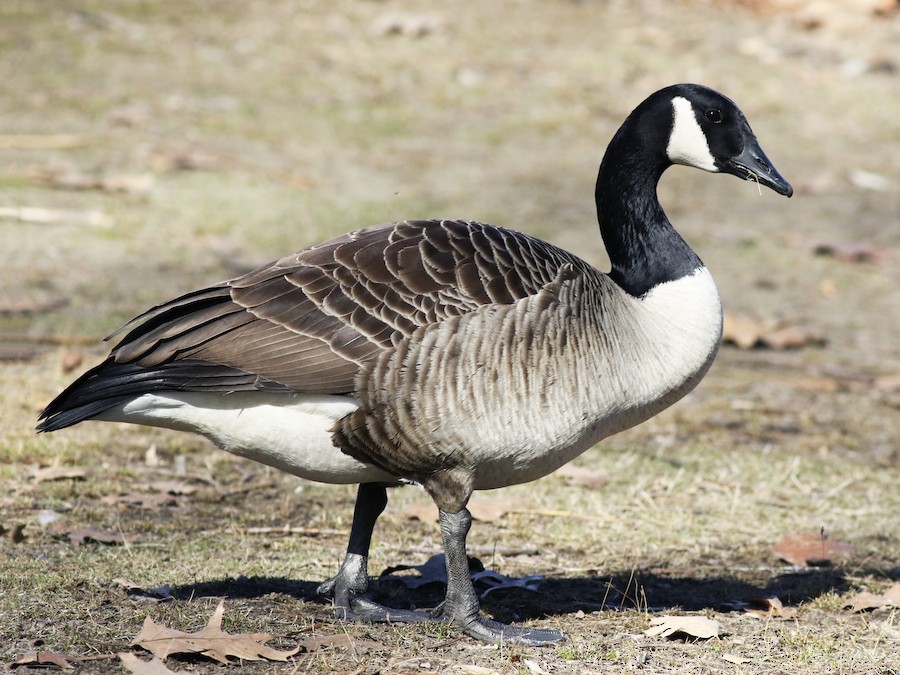
How to identify the Canada Goose
Branta canadensis
Spotted a bird? Identify it instantly with the Birdby app
Open the appTo correctly identify the Canada Goose (Branta canadensis), check each of these features. Birds can be tricky: habit, habitat, and call often confirm a sighting that a single photo cannot.
Size at a glance
- Length
- 75-110 cm (30-43 in)
- Wingspan
- 127-180 cm (50-71 in)
- Weight
- 2.6-6.5 kg (5.7-14.3 lbs), with some subspecies reaching up to 9 kg (20 lbs)
Physical features to check
- 1
Plumage
Overall feather coloration and pattern.
Adults have a black head and neck with a prominent white 'chinstrap' or cheek patch that extends from behind the eye to under the throat. The body plumage varies from light tan to dark brown, with lighter flanks and a white undertail coverts. The breast is typically paler, often a creamy white or light gray. Flight feathers are dark brown to black.
- 2
Beak shape
Shape and color of the bill: a key field mark.
Short, stout, and black.
- 3
Eye color
Iris color and any distinctive eye markings.
Dark brown
- 4
Leg color
Leg and foot color.
Black
- 5
Distinguishing features
Standout features that separate this species.
The most distinctive feature is the black head and neck with the contrasting white chinstrap. Its large size and characteristic honking call are also key identifiers.
- 6
Juvenile appearance
How young birds differ from adults.
Juveniles resemble adults but have duller plumage, often with a more mottled or grayish-brown body. The white chinstrap may be less distinct or slightly smudged, and their overall appearance is less crisp than adults.
- 7
Seasonal changes
Plumage variation between breeding and non-breeding seasons.
No significant seasonal plumage changes. Plumage may appear slightly worn or faded towards the end of the breeding season before molting.
- 8
Sexual dimorphism
How males and females differ.
Males (ganders) and females (geese) are outwardly similar in plumage. Males are generally larger and heavier than females, but this can be difficult to discern without direct comparison.
Key field marks
- Head and Neck Pattern. Look for the unmistakable black head and neck with a prominent white 'chinstrap' that wraps around the throat and extends behind the eye. This is the most reliable field mark.
- Size. Canada Geese are large waterfowl. If seen alongside other geese, note their substantial size, which helps distinguish them from smaller Cackling Geese.
- Vocalizations. Listen for their characteristic loud, resonant 'honk'. This call is distinct from the higher-pitched 'cackle' of Cackling Geese or the varied calls of other waterfowl.
- Body Plumage. Observe the body color, which is typically a medium to dark brown, often with a paler breast and flanks, and white undertail coverts. The overall impression is a brown body contrasting with the black and white head/neck.
- Flight Formation. During migration, look for large flocks flying in classic V-formations, often accompanied by their loud honking calls.
Explore the Canada Goose
Identify birds anywhere
Free on iOS, Android, and Web. Photo & sound identification, full species database, and your personal life list.