
Spotted a bird? Identify it instantly with the Birdby app
Open the appAbout
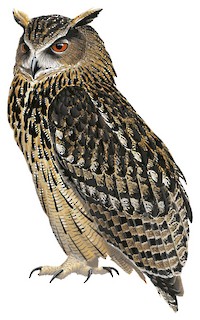
The Eurasian Eagle-Owl (Bubo bubo) is one of the largest and most powerful owls in the world, renowned for its striking appearance, formidable hunting prowess, and deep hooting calls. It is a nocturnal predator found across a vast range in Eurasia and North Africa, inhabiting diverse environments from dense forests to rocky mountainsides. Its large size, prominent ear tufts, and intense orange eyes make it unmistakable in its natural habitat.
Size & lifespan
- Length
- 58-75 cm (23-30 in)
- Wingspan
- 138-190 cm (54-75 in)
- Weight
- 1.5-4.2 kg (3.3-9.3 lbs)
- Lifespan
- Up to 20 years in the wild, over 60 years in captivity
- Diet
- Carnivore, primarily preying on medium-sized mammals (e.g., rabbits, hares, hedgehogs, rodents) and birds (e.g., crows, pigeons, ducks, even other raptors). Also takes reptiles, amphibians, fish, and large insects.
Physical characteristics
- Plumage
- Overall mottled and streaked with dark brown, black, and rufous-buff, providing excellent camouflage against tree bark and rocky outcrops. The underparts are paler, buffy-white to yellowish-buff, with prominent dark streaking on the breast and finer barring on the belly. The back and wings are darker, heavily barred and mottled. Distinctive facial disc is well-defined, with dark streaks radiating from the eyes.
- Beak shape
- Strong, sharply hooked, and blackish-grey.
- Eye color
- Intense, piercing orange to reddish-orange.
- Leg color
- Feathered down to the talons, appearing buffy-brown, with black talons.
- Distinguishing features
- Very large size, prominent ear tufts (often held erect), intense orange eyes, and heavily streaked and barred plumage. The facial disc is well-defined.
- Juvenile appearance
- Juveniles resemble adults but have softer, fluffier plumage, often appearing paler and less distinctly marked. Their ear tufts may be shorter and less prominent, and their eyes may be a duller yellow-orange, gradually intensifying with age.
- Seasonal changes
- No significant seasonal plumage changes. Plumage remains consistent year-round, optimized for camouflage in its varied habitats.
- Sexual dimorphism
- Females are generally larger and heavier than males, though plumage is identical. This size difference can be significant, with females often being 10-20% larger.
How to identify
- 1
Size and Shape
Look for a very large, bulky owl with a powerful build. When perched, it appears broad-shouldered and robust. Its large head and prominent ear tufts are key.
- 2
Ear Tufts
The long, erect ear tufts are a primary identification feature. They are often held up, giving the owl a distinctive 'horned' appearance. Note that these are not ears but feather tufts.
- 3
Eye Color
The intense, piercing orange to reddish-orange eyes are highly distinctive and stand out against the mottled facial disc.
- 4
Plumage Pattern
Observe the heavily streaked and barred plumage, particularly the dark streaks on the buffy-white breast and the intricate mottling on the back and wings. This provides excellent camouflage.
- 5
Vocalization
Listen for the deep, resonant 'hoo-hoo-hoo' call, especially at night. This distinctive hoot is a reliable indicator of its presence.
Habitat & range
- Biomes
- Forests (coniferous, deciduous, mixed), rocky areas, mountains, cliffs, ravines, steppes, semi-deserts, and even suburban areas with suitable nesting and hunting grounds.
- Geographic range
- Widespread across Eurasia and North Africa. From Western Europe (e.g., Spain, France, Scandinavia) eastward through Central Asia, Siberia, and into East Asia (e.g., China, Korea). Also found in parts of the Middle East and North Africa.
- Elevation range
- Sea level up to 4,500 meters (14,800 ft) in mountainous regions, though typically found at lower to mid-elevations.
- Preferred environments
- Prefers areas with a mix of open hunting grounds and secluded nesting sites, such as rocky cliffs, old growth forests, or abandoned buildings. Requires access to water sources.
Behavior
- Activity time
- Strictly nocturnal, becoming active at dusk and hunting throughout the night until dawn. Roosts in secluded spots during the day.
- Feeding habits
- A highly opportunistic and powerful nocturnal predator. Hunts primarily at night, using its keen hearing and excellent night vision. It typically hunts from a perch, swooping down silently to capture prey with its powerful talons. It can take prey much larger than itself, including small deer fawns. Pellets (regurgitated indigestible parts) are often found below roosts.
- Social behavior
- Generally solitary and highly territorial, especially during the breeding season. Pairs form strong bonds and often remain together for life, defending a large territory.
- Flight pattern
- Powerful, silent, and direct flight with deep, deliberate wing beats. Can glide for considerable distances. Often flies low over the ground when hunting.
- Migration pattern
- Mostly sedentary and resident throughout its range. Juveniles may disperse some distance from their natal territory, but adults rarely undertake long-distance migrations. Some altitudinal movements may occur in mountainous regions during harsh winters.
- Territoriality
- Highly territorial, especially around nesting and roosting sites. Territories are defended through vocalizations and occasional aggressive displays. The size of the territory varies depending on prey availability.
Song & calls
- Song
- The primary song is a deep, resonant 'hoo-hoo-hoo' or 'oo-hoo-hoo' with the second syllable often lower in pitch. It can be heard over long distances, especially on calm nights. Males typically sing more frequently and with a deeper voice than females.
- Call
- Various calls include sharp 'kew-kew-kew' alarm calls, hisses, claps of the beak, and shrieks, particularly when agitated or defending the nest. Young birds have a begging call that sounds like a harsh 'pschiiih'.
- When they vocalize
- Most vocal during the breeding season (late autumn to early spring), primarily at night, especially around dusk and dawn. Calls can also be heard sporadically throughout the year.
Breeding & reproduction
- Breeding season
- Varies geographically, typically from late winter (February-March) to early summer (May-June). Courtship begins in late autumn/early winter.
- Nesting habits
- Does not build a nest. Typically uses natural depressions on cliff ledges, rocky outcrops, caves, abandoned raptor nests (e.g., Golden Eagle), or sometimes on the ground under dense cover. In some areas, they may use old buildings or tree hollows.
- Clutch size
- Usually 2-4 eggs, but can range from 1 to 6, depending on food availability.
- Egg description
- Eggs are dull white, oval to sub-elliptical, and unspotted. They have a slightly rough texture.
- Incubation period
- 31-36 days, primarily by the female.
- Fledging period
- Young leave the nest (branch) at about 5-7 weeks of age, but are not fully capable of flight until 8-10 weeks. They remain dependent on parents for several months.
- Parental care
- Both parents participate in raising the young. The female incubates and broods, while the male provides food. Once the young hatch, both parents hunt to feed them. Parental care extends for several months after fledging.
Where to find
Rocky Cliffs and Ravines
These provide ideal nesting sites and vantage points for hunting. Look for them perched on ledges or flying along cliff faces at dusk.
Dense Forests with Openings
Areas with mature trees for roosting and adjacent open areas (clearings, fields) for hunting are preferred. Look for large, dark shapes perched silently in trees.
Mountainous Regions
They inhabit a wide range of altitudes in mountains, utilizing rocky terrain and forests. Scan slopes and valleys, especially at dawn and dusk.
Abandoned Quarries or Buildings
In some areas, they adapt to human-modified landscapes, using disused structures or quarries for nesting and roosting.
Field tips
- Go at Night. As a strictly nocturnal species, the best time to find a Eurasian Eagle-Owl is from dusk through dawn. Listen for their calls.
- Look for Pellets. Below potential roosting or nesting sites (cliffs, large trees), look for large, dark, oval pellets (regurgitated indigestible prey remains). This indicates recent owl activity.
- Use a Spotlight (responsibly). A low-intensity red-filtered spotlight can help locate owls at night without disturbing them. Avoid shining bright white lights directly at them.
- Scan Silhouettes. At dusk or dawn, scan the tops of trees, cliff edges, or prominent perches for their large, distinctive silhouette against the sky.
- Learn Their Calls. Familiarize yourself with their deep hooting calls. Hearing them is often the first indication of their presence, especially in dense cover.
Similar species
Great Horned Owl
Bubo virginianus
The Great Horned Owl, found in the Americas, is very similar in appearance but generally smaller than the Eurasian Eagle-Owl. Its facial disc is typically more reddish-brown, and its eyes are usually yellow (not orange). The hooting call of the Great Horned Owl is a more rhythmic 'hoo-hoo-hooo-hoo-hoo'.
Snowy Owl
Bubo scandiacus
While also a large owl in the genus Bubo, the Snowy Owl is almost entirely white (especially males) with varying degrees of dark barring, adapted for Arctic environments. It lacks prominent ear tufts and has yellow eyes, making it easily distinguishable from the mottled, ear-tufted Eurasian Eagle-Owl.
Long-eared Owl
Asio otus
The Long-eared Owl also has prominent ear tufts and orange eyes, but it is significantly smaller (length 31-37 cm) and much more slender. Its plumage is finer and more intricately patterned, and its flight is more buoyant. The ear tufts are typically closer together and more vertical.
Quick facts
- Status:
- Least Concern
- Diet:
- Carnivore
- Activity:
- Nocturnal
- Key Feature:
- Large size, prominent ear tufts, orange eyes
- Habitat:
- Diverse, from forests to mountains and cliffs
Fun facts
- The Eurasian Eagle-Owl is one of the largest and most powerful owls in the world, capable of taking down prey as large as small deer fawns or foxes.
- Its ear tufts are not ears but feather extensions that help break up its outline, aiding in camouflage, and may also play a role in communication.
- Despite its formidable size, its flight is almost completely silent due to specialized feather structures that muffle sound.
- Eurasian Eagle-Owls have been known to live for over 60 years in captivity, making them one of the longest-lived raptors.
- They have an incredibly wide diet, adapting to whatever prey is most abundant in their local environment, showcasing their opportunistic nature.
Scientific classification
- Kingdom
- Animalia
- Phylum
- Chordata
- Class
- Aves
- Order
- Strigiformes
- Family
- Strigidae
- Genus
- Bubo
- Species
- Bubo bubo
Explore the Eurasian Eagle-Owl
Identify birds anywhere
Free on iOS, Android, and Web. Photo & sound identification, full species database, and your personal life list.