
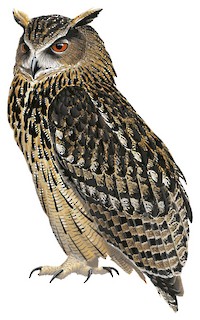
Where does the Eurasian Eagle-Owl live?
Bubo bubo
Spotted a bird? Identify it instantly with the Birdby app
Open the appThe Eurasian Eagle-Owl lives in specific habitats and regions. Knowing where, and when, to look improves your chances of a successful sighting.
Biomes
Forests (coniferous, deciduous, mixed), rocky areas, mountains, cliffs, ravines, steppes, semi-deserts, and even suburban areas with suitable nesting and hunting grounds.
Geographic range
Widespread across Eurasia and North Africa. From Western Europe (e.g., Spain, France, Scandinavia) eastward through Central Asia, Siberia, and into East Asia (e.g., China, Korea). Also found in parts of the Middle East and North Africa.
Preferred environments
Prefers areas with a mix of open hunting grounds and secluded nesting sites, such as rocky cliffs, old growth forests, or abandoned buildings. Requires access to water sources.
Elevation range
Sea level up to 4,500 meters (14,800 ft) in mountainous regions, though typically found at lower to mid-elevations.
Where to look
Rocky Cliffs and Ravines
These provide ideal nesting sites and vantage points for hunting. Look for them perched on ledges or flying along cliff faces at dusk.
Dense Forests with Openings
Areas with mature trees for roosting and adjacent open areas (clearings, fields) for hunting are preferred. Look for large, dark shapes perched silently in trees.
Mountainous Regions
They inhabit a wide range of altitudes in mountains, utilizing rocky terrain and forests. Scan slopes and valleys, especially at dawn and dusk.
Abandoned Quarries or Buildings
In some areas, they adapt to human-modified landscapes, using disused structures or quarries for nesting and roosting.
Field tips
- Go at Night. As a strictly nocturnal species, the best time to find a Eurasian Eagle-Owl is from dusk through dawn. Listen for their calls.
- Look for Pellets. Below potential roosting or nesting sites (cliffs, large trees), look for large, dark, oval pellets (regurgitated indigestible prey remains). This indicates recent owl activity.
- Use a Spotlight (responsibly). A low-intensity red-filtered spotlight can help locate owls at night without disturbing them. Avoid shining bright white lights directly at them.
- Scan Silhouettes. At dusk or dawn, scan the tops of trees, cliff edges, or prominent perches for their large, distinctive silhouette against the sky.
- Learn Their Calls. Familiarize yourself with their deep hooting calls. Hearing them is often the first indication of their presence, especially in dense cover.
Migration
Mostly sedentary and resident throughout its range. Juveniles may disperse some distance from their natal territory, but adults rarely undertake long-distance migrations. Some altitudinal movements may occur in mountainous regions during harsh winters.
Explore the Eurasian Eagle-Owl
Identify birds anywhere
Free on iOS, Android, and Web. Photo & sound identification, full species database, and your personal life list.