
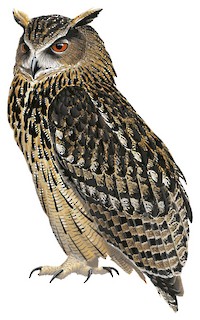
How to identify the Eurasian Eagle-Owl
Bubo bubo
Spotted a bird? Identify it instantly with the Birdby app
Open the appTo correctly identify the Eurasian Eagle-Owl (Bubo bubo), check each of these features. Birds can be tricky: habit, habitat, and call often confirm a sighting that a single photo cannot.
Size at a glance
- Length
- 58-75 cm (23-30 in)
- Wingspan
- 138-190 cm (54-75 in)
- Weight
- 1.5-4.2 kg (3.3-9.3 lbs)
Physical features to check
- 1
Plumage
Overall feather coloration and pattern.
Overall mottled and streaked with dark brown, black, and rufous-buff, providing excellent camouflage against tree bark and rocky outcrops. The underparts are paler, buffy-white to yellowish-buff, with prominent dark streaking on the breast and finer barring on the belly. The back and wings are darker, heavily barred and mottled. Distinctive facial disc is well-defined, with dark streaks radiating from the eyes.
- 2
Beak shape
Shape and color of the bill: a key field mark.
Strong, sharply hooked, and blackish-grey.
- 3
Eye color
Iris color and any distinctive eye markings.
Intense, piercing orange to reddish-orange.
- 4
Leg color
Leg and foot color.
Feathered down to the talons, appearing buffy-brown, with black talons.
- 5
Distinguishing features
Standout features that separate this species.
Very large size, prominent ear tufts (often held erect), intense orange eyes, and heavily streaked and barred plumage. The facial disc is well-defined.
- 6
Juvenile appearance
How young birds differ from adults.
Juveniles resemble adults but have softer, fluffier plumage, often appearing paler and less distinctly marked. Their ear tufts may be shorter and less prominent, and their eyes may be a duller yellow-orange, gradually intensifying with age.
- 7
Seasonal changes
Plumage variation between breeding and non-breeding seasons.
No significant seasonal plumage changes. Plumage remains consistent year-round, optimized for camouflage in its varied habitats.
- 8
Sexual dimorphism
How males and females differ.
Females are generally larger and heavier than males, though plumage is identical. This size difference can be significant, with females often being 10-20% larger.
Key field marks
- Size and Shape. Look for a very large, bulky owl with a powerful build. When perched, it appears broad-shouldered and robust. Its large head and prominent ear tufts are key.
- Ear Tufts. The long, erect ear tufts are a primary identification feature. They are often held up, giving the owl a distinctive 'horned' appearance. Note that these are not ears but feather tufts.
- Eye Color. The intense, piercing orange to reddish-orange eyes are highly distinctive and stand out against the mottled facial disc.
- Plumage Pattern. Observe the heavily streaked and barred plumage, particularly the dark streaks on the buffy-white breast and the intricate mottling on the back and wings. This provides excellent camouflage.
- Vocalization. Listen for the deep, resonant 'hoo-hoo-hoo' call, especially at night. This distinctive hoot is a reliable indicator of its presence.
Explore the Eurasian Eagle-Owl
Identify birds anywhere
Free on iOS, Android, and Web. Photo & sound identification, full species database, and your personal life list.