
Spotted a bird? Identify it instantly with the Birdby app
Open the appAbout
The Snowy Owl is a large, distinctive owl species native to the Arctic regions. Known for its striking white plumage, it is well-adapted to cold, open environments. It is a powerful predator, primarily hunting small mammals and birds, and is often active during the day in its Arctic breeding grounds.
Size & lifespan
- Length
- 53-70 cm (20.9-27.6 in)
- Wingspan
- 126-145 cm (49.6-57.1 in)
- Weight
- 1.3-2.5 kg (2.9-5.5 lbs), with females generally larger and heavier than males
- Lifespan
- Up to 10 years in the wild, potentially longer in captivity (up to 28 years)
- Diet
- Carnivore (primarily lemmings, voles, and other small mammals; also birds, especially ptarmigan and waterfowl)
Physical characteristics
- Plumage
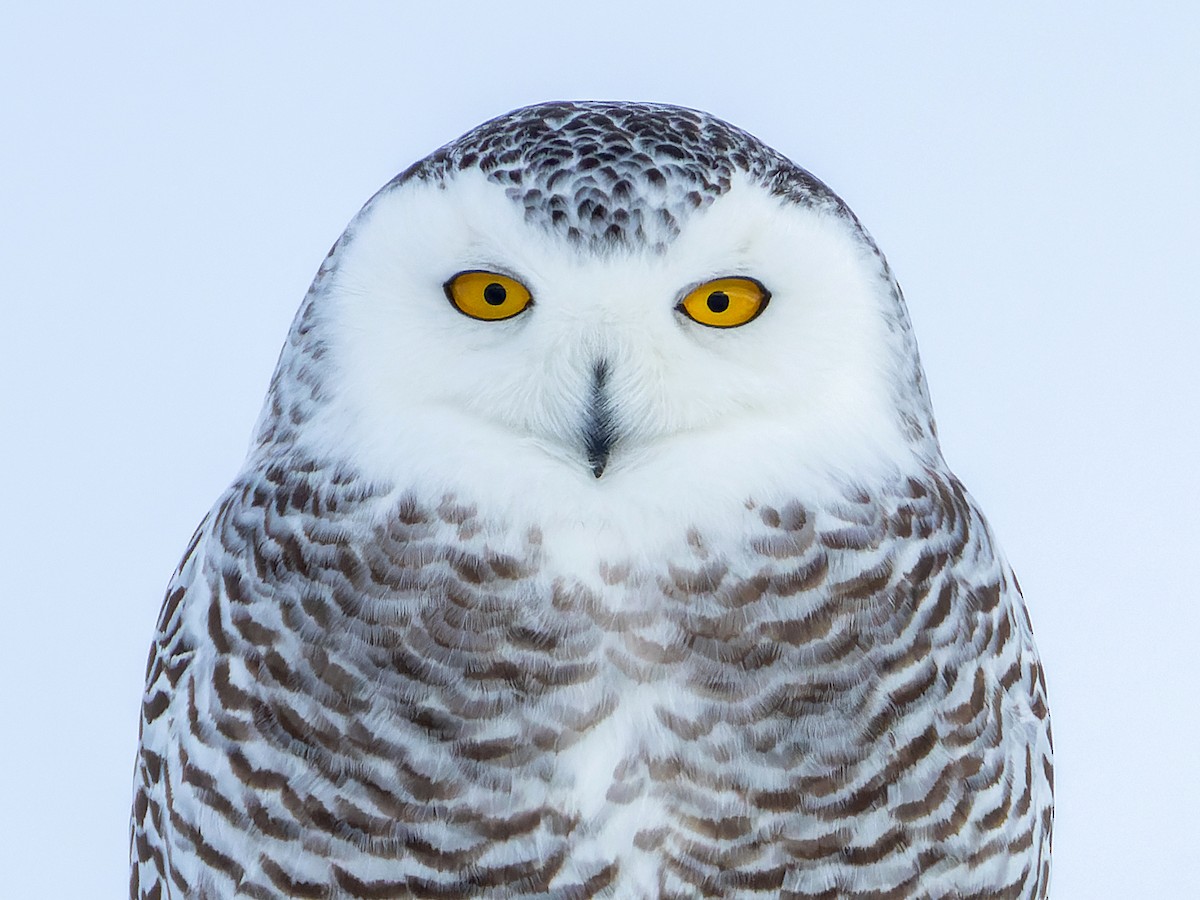
- Adult males are almost pure white, often with minimal to no dark barring. Adult females and younger birds have more extensive dark barring, ranging from sparse to heavy, particularly on the crown, back, and wings. The overall impression is a large, white owl.
- Beak shape
- Small, black, strongly hooked beak, mostly obscured by facial feathers.
- Eye color
- Bright yellow, large, and forward-facing, giving an intense stare.
- Leg color
- Legs and feet are heavily feathered (ptilopody) with dense white feathers, giving them a 'muffed' appearance, providing insulation against cold. Claws are black.
- Distinguishing features
- Large size, predominantly white plumage, bright yellow eyes, and a rounded head without ear tufts. The heavily feathered legs and feet are also distinctive.
- Juvenile appearance
- Juveniles are heavily barred with dark brown or black markings across their entire body, appearing much darker than adult females. They gradually lighten with successive molts.
- Seasonal changes
- No significant seasonal plumage changes. Plumage variations are primarily age and sex-related.
- Sexual dimorphism
- Pronounced. Adult males are typically whiter, often pure white. Adult females are larger and retain more dark barring throughout their lives, especially on the crown, back, and wings. Juvenile birds resemble heavily barred females.
How to identify
- 1
Plumage Color
Look for the predominantly white plumage. Adult males are almost pure white, while females and immatures have varying degrees of dark barring. No other large owl in its range is primarily white.
- 2
Eye Color
The bright yellow eyes are a key feature, contrasting sharply with the white facial disc. This distinguishes it from other owls with dark eyes.
- 3
Head Shape
Snowy Owls have a rounded head with no ear tufts, unlike many other owl species (e.g., Great Horned Owl).
- 4
Size and Build
It is a large, bulky owl. Its substantial size, combined with its white color, makes it unmistakable in most settings.
- 5
Habitat and Behavior
Often seen perched conspicuously on the ground, a fence post, or a small rise in open, treeless areas. Unlike most owls, it is frequently active during daylight hours, especially in winter.
Habitat & range
- Biomes
- Tundra, open grasslands, coastal dunes, agricultural fields (during winter irruptions)
- Geographic range
- Circumpolar Arctic tundra of North America, Europe, and Asia. Winters irregularly south into southern Canada, northern United States, and central Europe/Asia during irruption years.
- Elevation range
- Typically low elevations, from sea level up to approximately 1,000 meters (3,300 feet) in mountainous tundra.
- Preferred environments
- Open, treeless landscapes with good visibility for hunting, such as Arctic tundra, coastal areas, and open fields. Requires elevated perches (e.g., hummocks, rocks, fence posts) for hunting and observation.
Behavior
- Activity time
- Diurnal during the Arctic summer (24-hour daylight). Can be crepuscular or nocturnal during the darker winter months, especially when hunting in more temperate latitudes.
- Feeding habits
- Primarily a diurnal hunter in the continuous daylight of the Arctic summer, but can be crepuscular or nocturnal during winter. Hunts from a perch or in low, coursing flight. Diet consists mainly of lemmings and voles; when these populations crash, they switch to other prey like ptarmigan, ducks, geese, hares, and other small mammals. Swallows small prey whole, larger prey are torn apart.
- Social behavior
- Generally solitary outside of the breeding season. During breeding, they form monogamous pairs. Not typically social, though multiple individuals may be seen in good wintering grounds during irruptions.
- Flight pattern
- Powerful, silent flight with deep, steady wing beats. Often flies low to the ground when hunting, or soars on updrafts. Can hover briefly.
- Migration pattern
- Partial migrant. Many individuals remain on the breeding grounds year-round if prey is abundant. Others undertake irregular, irruptive migrations south during periods of low prey availability (especially lemmings) in the Arctic. These irruptions can bring them far south of their typical winter range.
- Territoriality
- Highly territorial during the breeding season, defending nesting sites and hunting grounds. Males perform aerial displays to establish territory and attract mates.
Song & calls
- Song
- Males produce a deep, resonant, booming 'hoo, hoo, hoo, hoo' series, often 2-6 hoots, used for territorial defense and attracting mates. Can be heard over long distances.
- Call
- Various calls include harsh 'kree-kree-kree' alarm calls, hisses, clacks, and shrieks, especially when disturbed or defending the nest. Females may give a softer 'whee-oo' call.
- When they vocalize
- Most vocal during the breeding season (late spring to early summer). Alarm calls and defensive vocalizations can occur year-round if threatened.
Breeding & reproduction
- Breeding season
- Late May to early September, with egg-laying typically in late May to early June, depending on snowmelt and prey availability.
- Nesting habits
- Nests are simple scrapes on the ground, usually on an elevated hummock, ridge, or rock outcrop in the open tundra, providing good visibility. No nest material is added beyond a slight depression.
- Clutch size
- 3-11 eggs (average 5-8)
- Egg description
- Typically 3-11 (average 5-8) dull white, unspotted, oval eggs. Clutch size is highly variable and directly correlated with lemming abundance; in years of high lemming populations, clutches can be much larger.
- Incubation period
- 32-34 days, primarily by the female.
- Fledging period
- Young leave the nest and begin to wander at 14-26 days old, but are not capable of flight until 45-50 days. They remain dependent on parents for food for several weeks after fledging.
- Parental care
- Both parents participate. The female incubates and broods, while the male provides all food for the female and young during incubation and early brooding. Both parents hunt and feed the young after they fledge.
Where to find
Arctic Tundra
During the breeding season, the circumpolar Arctic tundra is the primary habitat. Look for them on elevated hummocks or ridges.
Open Fields and Coastal Areas
During winter irruptions, they can be found in open agricultural fields, coastal dunes, marshes, and prairies in southern Canada and the northern United States. Look for them perched on fence posts, hay bales, or ground mounds.
Airports and Industrial Areas
Surprisingly, during irruptions, they are sometimes found in open, treeless areas around airports or industrial sites, which mimic their open tundra habitat.
Field tips
- Scan Open Landscapes. Snowy Owls prefer open areas. Use binoculars or a spotting scope to scan fields, dunes, and flat expanses for white lumps that might be a perched owl.
- Look for Elevated Perches. They often perch on the highest available point in their environment – a fence post, telephone pole, hay bale, rock, or even a small rise in the ground.
- Check during Winter Irruptions. The best chance to see them outside the Arctic is during winter irruption years. Monitor local birding reports and news for their presence.
- Respect Their Space. Snowy Owls are easily stressed, especially during winter when food is scarce. Maintain a respectful distance (at least 100 meters/yards) and avoid flushing them, as this expends valuable energy. Do not approach for photos.
- Diurnal Activity. Unlike many owls, Snowy Owls are often active during the day, making them easier to spot. Look for them hunting or perching at any time of day.
Quick facts
- Primary Prey:
- Lemmings
- Hunting Style:
- Perch-and-pounce or low coursing flight
- Unique Feature:
- Heavily feathered feet (ptilopody)
- Migration Type:
- Irruptive migrant
- Nesting Site:
- Ground scrape on tundra hummock
Fun facts
- Snowy Owls can turn their heads up to 270 degrees in either direction, allowing them to scan their surroundings without moving their bodies.
- Their hearing is incredibly acute, allowing them to detect prey moving beneath snow cover.
- The number of eggs laid by a female Snowy Owl is directly linked to the abundance of lemmings in a given year. More lemmings mean more eggs.
- They are one of the few owl species that are primarily diurnal, especially during the continuous daylight of the Arctic summer.
- Snowy Owls have been observed hunting fish, using their talons to snatch them from shallow water.
Scientific classification
- Kingdom
- Animalia
- Phylum
- Chordata
- Class
- Aves
- Order
- Strigiformes
- Family
- Strigidae
- Genus
- Bubo
- Species
- Bubo scandiacus
Explore the Snowy Owl
Identify birds anywhere
Free on iOS, Android, and Web. Photo & sound identification, full species database, and your personal life list.