
How to identify the Snowy Owl
Bubo scandiacus
Spotted a bird? Identify it instantly with the Birdby app
Open the appTo correctly identify the Snowy Owl (Bubo scandiacus), check each of these features. Birds can be tricky: habit, habitat, and call often confirm a sighting that a single photo cannot.
Size at a glance
- Length
- 53-70 cm (20.9-27.6 in)
- Wingspan
- 126-145 cm (49.6-57.1 in)
- Weight
- 1.3-2.5 kg (2.9-5.5 lbs), with females generally larger and heavier than males
Physical features to check
- 1
Plumage
Overall feather coloration and pattern.
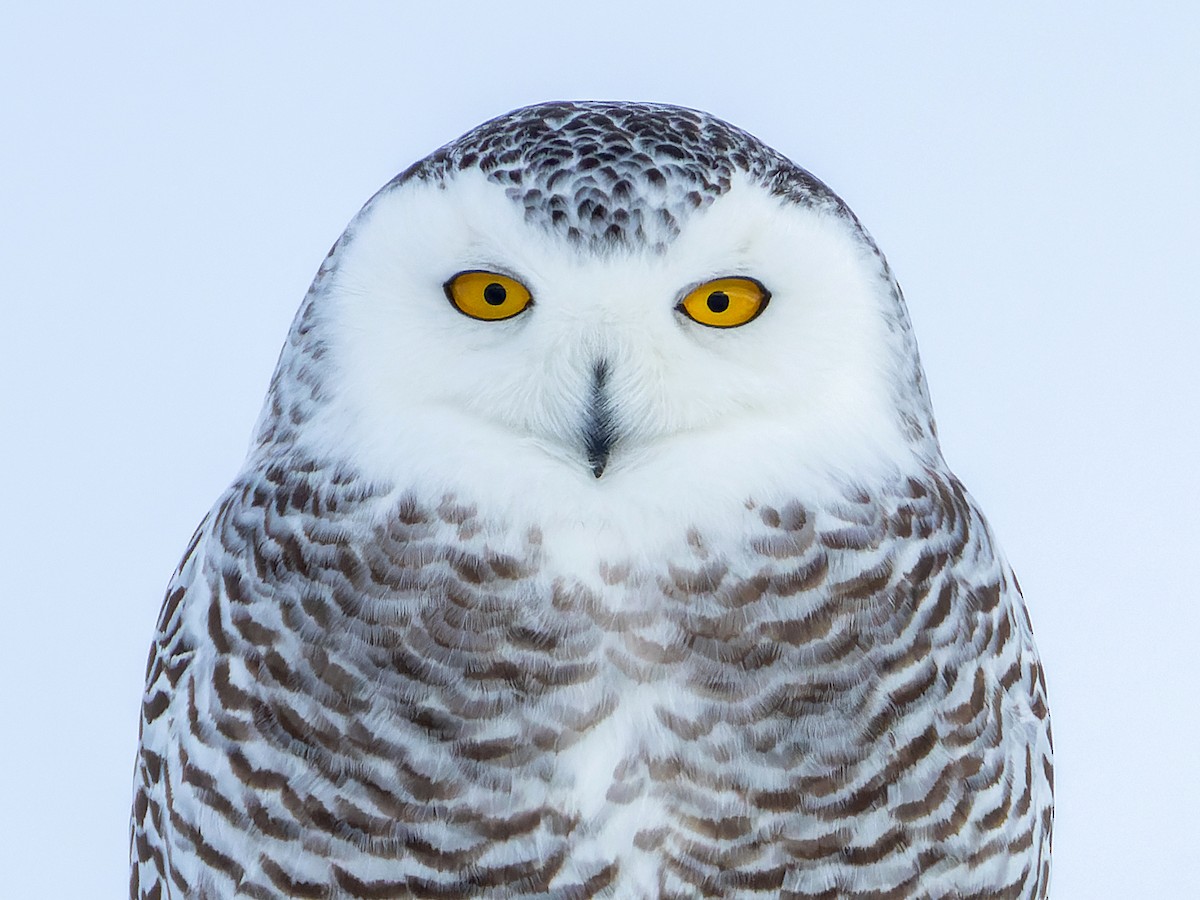
Adult males are almost pure white, often with minimal to no dark barring. Adult females and younger birds have more extensive dark barring, ranging from sparse to heavy, particularly on the crown, back, and wings. The overall impression is a large, white owl.
- 2
Beak shape
Shape and color of the bill: a key field mark.
Small, black, strongly hooked beak, mostly obscured by facial feathers.
- 3
Eye color
Iris color and any distinctive eye markings.
Bright yellow, large, and forward-facing, giving an intense stare.
- 4
Leg color
Leg and foot color.
Legs and feet are heavily feathered (ptilopody) with dense white feathers, giving them a 'muffed' appearance, providing insulation against cold. Claws are black.
- 5
Distinguishing features
Standout features that separate this species.
Large size, predominantly white plumage, bright yellow eyes, and a rounded head without ear tufts. The heavily feathered legs and feet are also distinctive.
- 6
Juvenile appearance
How young birds differ from adults.
Juveniles are heavily barred with dark brown or black markings across their entire body, appearing much darker than adult females. They gradually lighten with successive molts.
- 7
Seasonal changes
Plumage variation between breeding and non-breeding seasons.
No significant seasonal plumage changes. Plumage variations are primarily age and sex-related.
- 8
Sexual dimorphism
How males and females differ.
Pronounced. Adult males are typically whiter, often pure white. Adult females are larger and retain more dark barring throughout their lives, especially on the crown, back, and wings. Juvenile birds resemble heavily barred females.
Key field marks
- Plumage Color. Look for the predominantly white plumage. Adult males are almost pure white, while females and immatures have varying degrees of dark barring. No other large owl in its range is primarily white.
- Eye Color. The bright yellow eyes are a key feature, contrasting sharply with the white facial disc. This distinguishes it from other owls with dark eyes.
- Head Shape. Snowy Owls have a rounded head with no ear tufts, unlike many other owl species (e.g., Great Horned Owl).
- Size and Build. It is a large, bulky owl. Its substantial size, combined with its white color, makes it unmistakable in most settings.
- Habitat and Behavior. Often seen perched conspicuously on the ground, a fence post, or a small rise in open, treeless areas. Unlike most owls, it is frequently active during daylight hours, especially in winter.
Explore the Snowy Owl
Identify birds anywhere
Free on iOS, Android, and Web. Photo & sound identification, full species database, and your personal life list.