
Spotted a bird? Identify it instantly with the Birdby app
Open the appAbout
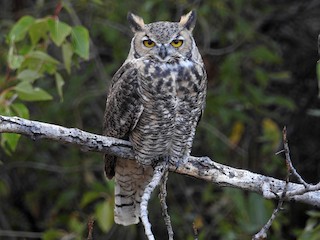
The Great Horned Owl is a large, powerful, and widespread owl species native to the Americas. Renowned for its distinctive ear tufts (often mistaken for horns), deep hooting call, and formidable predatory skills, it is an apex nocturnal predator in most of its range. Its adaptability allows it to thrive in diverse habitats, making it one of the most recognizable and successful owl species.
Size & lifespan
- Length
- 46-63 cm (18-25 in)
- Wingspan
- 101-152 cm (40-60 in)
- Weight
- 900-2500 g (2-5.5 lbs)
- Lifespan
- 13 years (wild), up to 29 years (captivity)
- Diet
- Carnivore (primarily mammals and birds, but highly opportunistic)
Physical characteristics
- Plumage
- Highly variable, generally mottled grayish-brown to reddish-brown on the upperparts, with fine barring on the underparts. A prominent white throat patch (bib) is usually visible. Facial disc is rufous or grayish, bordered by black. Ear tufts are prominent and widely spaced, varying in length and color depending on subspecies and individual.
- Beak shape
- Short, strongly hooked, and dark (blackish) in color.
- Eye color
- Large, piercing yellow eyes.
- Leg color
- Feathered down to the talons, appearing grayish-brown.
- Distinguishing features
- Large size, prominent ear tufts, white throat bib, and yellow eyes. The overall robust build and powerful talons are also characteristic.
- Juvenile appearance
- Young owls are covered in soft, downy plumage, initially whitish, gradually replaced by a mottled grayish-brown juvenile plumage similar to adults but often fluffier and less distinctly patterned. Ear tufts are present but may be less developed.
- Seasonal changes
- No significant seasonal plumage changes. Plumage coloration can vary geographically, with paler, grayer individuals in arid regions and darker, more rufous individuals in humid or forested areas.
- Sexual dimorphism
- Females are typically larger and heavier than males, though plumage is similar. Size difference can be noticeable when a pair is observed together.
How to identify
- 1
Size and Shape
Look for a very large, bulky owl with a powerful build. When perched, it appears broad-shouldered and often somewhat hunched.
- 2
Ear Tufts
The most distinctive feature. Two prominent, widely spaced feather tufts on top of the head, which are not ears but rather display feathers. These can be flattened or raised depending on the owl's mood.
- 3
Facial Disc and Eyes
A rufous or grayish facial disc, often outlined in black, framing large, bright yellow eyes. The white throat patch (bib) is usually visible below the beak.
- 4
Plumage Coloration
Mottled brown and gray overall, providing excellent camouflage against tree bark. Look for fine barring on the belly and chest.
- 5
Vocalization
Listen for its characteristic deep, resonant 'hoo-hoo-hooo-hoo-hoo' hooting call, especially at dusk or dawn. This is often the first indication of its presence.
- 6
Behavior
Observe its nocturnal habits. Look for it roosting silently in dense trees during the day, often near the trunk. Its powerful, silent flight is also a key identifier.
Habitat & range
- Biomes
- Forests (deciduous, coniferous, mixed), woodlands, deserts, grasslands, urban and suburban areas, agricultural lands, swamps, tundra edges.
- Geographic range
- Throughout North and South America, from the Arctic tree line south to Tierra del Fuego. Absent from the Caribbean islands and parts of Central America.
- Elevation range
- Sea level up to 3,300 meters (10,800 feet) in mountainous regions.
- Preferred environments
- Highly adaptable, preferring areas with a mix of open hunting grounds and dense cover for roosting and nesting. Often found near human habitation due to abundant prey.
Behavior
- Activity time
- Nocturnal, most active from dusk to dawn. May hunt during the day, especially when food is scarce or during nesting season.
- Feeding habits
- Nocturnal ambush predator. Hunts from a perch, swooping down silently on prey. Diet is incredibly diverse, including rabbits, hares, rodents, squirrels, skunks, opossums, ducks, geese, other owls, hawks, snakes, and even insects. Known for its ability to take prey larger than itself.
- Social behavior
- Primarily solitary, except during the breeding season when pairs form. Pairs are monogamous and often maintain territories year-round.
- Flight pattern
- Powerful, silent flight with deep, deliberate wingbeats. Can glide for considerable distances. Often flies low to the ground when hunting.
- Migration pattern
- Generally resident throughout its range. Northern populations may undertake short-distance, irregular movements (irruptions) in response to prey scarcity, but true long-distance migration is rare.
- Territoriality
- Highly territorial, especially during the breeding season. Pairs defend their nesting and hunting territories with vocalizations and occasional aggressive displays.
Song & calls
- Song
- The primary song is a series of deep, resonant hoots, typically five or six in number: 'hoo-hoo-hooo-hoo-hoo'. The male's hoots are lower pitched than the female's. The rhythm can vary, but it's generally a steady, somewhat mournful sound.
- Call
- Various calls include screeches, hisses (especially when threatened), barks, and squawks. Young owls make a persistent, raspy begging call.
- When they vocalize
- Most vocal during the breeding season (late fall through early spring) and primarily at night, especially around dusk and dawn. Can be heard year-round, though less frequently outside the breeding period.
Breeding & reproduction
- Breeding season
- Varies geographically, but generally late fall to early spring (December-May), making it one of the earliest nesting birds in North America.
- Nesting habits
- Does not build its own nest. Typically uses abandoned nests of other large birds (hawks, eagles, crows), tree cavities, cliff ledges, or even artificial structures like barn rafters or man-made platforms. Nests are often large and bulky.
- Clutch size
- 1-5 eggs (average 2-3)
- Egg description
- Typically 1-5 (usually 2-3) dull white, oval eggs, laid at intervals of 1-3 days.
- Incubation period
- 28-35 days, primarily by the female.
- Fledging period
- Young leave the nest (branch) at about 5-7 weeks, but are not capable of sustained flight until 9-10 weeks. They remain dependent on parents for several months.
- Parental care
- Both parents care for the young. The female incubates and broods, while the male provides food. Both parents feed the owlets after hatching.
Where to find
Wooded Areas
Look in mature forests, woodlots, and riparian areas along rivers and streams, especially where there are large trees for roosting and nesting.
Urban/Suburban Parks and Cemeteries
Surprisingly common in developed areas with mature trees, as they provide both cover and abundant prey like rodents and pigeons.
Agricultural Lands
Often found in farm country, utilizing isolated groves of trees, old barns, or silos for nesting and roosting, while hunting in open fields.
Canyons and Cliffs
In western regions, they frequently nest and roost on cliff ledges and in rocky outcrops.
Field tips
- Listen at Night. The Great Horned Owl's distinctive hoot is often the easiest way to locate it. Listen for it around dusk and dawn, particularly during the breeding season (winter to early spring).
- Look for Roost Sites. During the day, they often roost in dense trees, close to the trunk. Look for whitewash (droppings) on branches or the ground below, and regurgitated pellets (containing bones and fur) which indicate an owl's presence.
- Scan for Silhouettes. At dusk, scan the tops of trees or prominent perches against the fading light. Their large silhouette and ear tufts can be visible.
- Use Binoculars. Once you've spotted a potential roost, use binoculars to carefully scan the branches for the owl's camouflaged form. Look for the yellow eyes or the outline of the ear tufts.
- Respect Their Space. If you find an owl, observe from a distance to avoid disturbing it, especially during nesting season. Repeated disturbance can cause owls to abandon nests.
Similar species
Snowy Owl
Bubo scandiacus
Snowy Owls are almost entirely white (males) or white with dark barring (females/juveniles), lack prominent ear tufts, and have a rounder head. They are typically found in open tundra or fields, not forests.
Long-eared Owl
Asio otus
Long-eared Owls are much smaller and more slender, with very long, close-set ear tufts that are often held erect. Their facial disc is more elongated and orange-brown, and their eyes are orange. Their hooting call is softer and more drawn out.
Short-eared Owl
Asio flammeus
Short-eared Owls are medium-sized, lack prominent ear tufts (they have tiny ones often not visible), and are typically found in open grasslands or marshes. They are often crepuscular or diurnal and have a distinctive buoyant, moth-like flight.
Eurasian Eagle-Owl
Bubo bubo
The Eurasian Eagle-Owl is a close relative and looks very similar but is generally larger and more robust, with more prominent and widely spaced ear tufts. Its range is restricted to Eurasia and parts of North Africa, not the Americas.
Quick facts
- Top Predator:
- One of the most dominant avian predators in its range.
- Early Breeder:
- Often begins nesting in late winter, even when snow is on the ground.
- Dietary Generalist:
- Known for its incredibly varied diet, including skunks and other formidable prey.
- Silent Hunter:
- Specialized feather structure allows for virtually silent flight.
- Ear Tufts:
- Feather tufts are for camouflage and display, not hearing.
Fun facts
- Great Horned Owls are one of the few predators that regularly hunt skunks, seemingly unfazed by their defensive spray.
- They have incredibly powerful talons, capable of exerting over 500 pounds per square inch of crushing force.
- Their eyes are fixed in their sockets, so they must turn their heads up to 270 degrees to see.
- They are known to take other raptors, including other owls and even Red-tailed Hawks, from their nests.
- The 'horns' or ear tufts are not ears, but rather feather tufts that help break up the owl's outline, aiding in camouflage, and may also be used for communication.
Scientific classification
- Kingdom
- Animalia
- Phylum
- Chordata
- Class
- Aves
- Order
- Strigiformes
- Family
- Strigidae
- Genus
- Bubo
- Species
- Bubo virginianus
Explore the Great Horned Owl
Identify birds anywhere
Free on iOS, Android, and Web. Photo & sound identification, full species database, and your personal life list.