
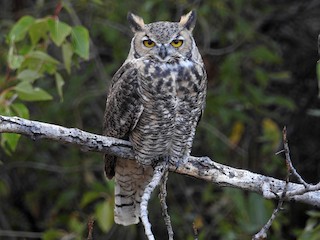
Where does the Great Horned Owl live?
Bubo virginianus
Spotted a bird? Identify it instantly with the Birdby app
Open the appThe Great Horned Owl lives in specific habitats and regions. Knowing where, and when, to look improves your chances of a successful sighting.
Biomes
Forests (deciduous, coniferous, mixed), woodlands, deserts, grasslands, urban and suburban areas, agricultural lands, swamps, tundra edges.
Geographic range
Throughout North and South America, from the Arctic tree line south to Tierra del Fuego. Absent from the Caribbean islands and parts of Central America.
Preferred environments
Highly adaptable, preferring areas with a mix of open hunting grounds and dense cover for roosting and nesting. Often found near human habitation due to abundant prey.
Elevation range
Sea level up to 3,300 meters (10,800 feet) in mountainous regions.
Where to look
Wooded Areas
Look in mature forests, woodlots, and riparian areas along rivers and streams, especially where there are large trees for roosting and nesting.
Urban/Suburban Parks and Cemeteries
Surprisingly common in developed areas with mature trees, as they provide both cover and abundant prey like rodents and pigeons.
Agricultural Lands
Often found in farm country, utilizing isolated groves of trees, old barns, or silos for nesting and roosting, while hunting in open fields.
Canyons and Cliffs
In western regions, they frequently nest and roost on cliff ledges and in rocky outcrops.
Field tips
- Listen at Night. The Great Horned Owl's distinctive hoot is often the easiest way to locate it. Listen for it around dusk and dawn, particularly during the breeding season (winter to early spring).
- Look for Roost Sites. During the day, they often roost in dense trees, close to the trunk. Look for whitewash (droppings) on branches or the ground below, and regurgitated pellets (containing bones and fur) which indicate an owl's presence.
- Scan for Silhouettes. At dusk, scan the tops of trees or prominent perches against the fading light. Their large silhouette and ear tufts can be visible.
- Use Binoculars. Once you've spotted a potential roost, use binoculars to carefully scan the branches for the owl's camouflaged form. Look for the yellow eyes or the outline of the ear tufts.
- Respect Their Space. If you find an owl, observe from a distance to avoid disturbing it, especially during nesting season. Repeated disturbance can cause owls to abandon nests.
Migration
Generally resident throughout its range. Northern populations may undertake short-distance, irregular movements (irruptions) in response to prey scarcity, but true long-distance migration is rare.
Explore the Great Horned Owl
Identify birds anywhere
Free on iOS, Android, and Web. Photo & sound identification, full species database, and your personal life list.