
Spotted a bird? Identify it instantly with the Birdby app
Open the appAbout
The Common Goldeneye is a medium-sized diving duck known for its distinctive golden eyes and, in males, a prominent white spot at the base of the bill. It is a migratory species, breeding in northern forested regions and wintering on coastal waters and large inland lakes and rivers.
Size & lifespan
- Length
- 40-51 cm (16-20 in)
- Wingspan
- 65-80 cm (26-31 in)
- Weight
- 800-1600 g (1.8-3.5 lbs)
- Lifespan
- Typically 10-12 years in the wild, with records up to 19 years.
- Diet
- Carnivore, primarily consuming aquatic invertebrates and small fish.
Physical characteristics
- Plumage
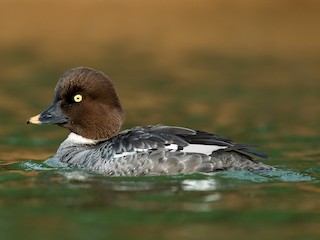
- Adult males have a striking iridescent green-black head with a circular white patch between the eye and the bill, a white neck, breast, and flanks, and a black back. The wings are black with a large white speculum. Adult females have a chocolate-brown head, a white collar, a grey body, and a white belly. Their wings are dark with a smaller white speculum. Juveniles resemble adult females but are duller with less distinct markings.
- Beak shape
- Short, triangular, and dark grey to black. Males have a black bill; females have a black bill with a yellow or orange band near the tip, especially during breeding season.
- Eye color
- Bright golden-yellow in adults, duller yellow or brownish in juveniles.
- Leg color
- Bright orange-yellow with dark webbing in both sexes.
- Distinguishing features
- The male's prominent white facial spot and golden eye are unmistakable. The female's brown head, white collar, and golden eye are key identifiers. Both sexes have a distinctive triangular head shape and a 'high-forehead' appearance.
- Juvenile appearance
- Juveniles resemble adult females but have a duller brown head, less distinct white collar, and often a brownish eye. Their plumage is generally more mottled grey-brown.
- Seasonal changes
- Males retain their striking breeding plumage year-round, though the iridescence may be less pronounced outside of breeding season. Females show little seasonal change, though the bill coloration may vary slightly in intensity.
- Sexual dimorphism
- Highly sexually dimorphic. Males are much more boldly patterned with iridescent black-green head and white body, while females have a brown head and grey body.
How to identify
- 1
Male Head Pattern
Look for the iridescent green-black head with a distinct, circular white spot between the eye and the bill. This is the most reliable field mark for males.
- 2
Female Head and Collar
Identify females by their chocolate-brown head and a clear white collar separating the head from the grey body. The bill often shows a yellow or orange band.
- 3
Eye Color
Both adult sexes have striking golden-yellow eyes, which are very noticeable, especially at close range.
- 4
Flight Sound
Listen for the characteristic high-pitched whistling sound produced by their wings in flight, particularly from males. This can often identify them before visual confirmation.
- 5
Body Shape and Posture
Observe their somewhat triangular head shape and 'high-forehead' profile. They are compact, medium-sized diving ducks that sit relatively low in the water.
Habitat & range
- Biomes
- Boreal forests, taiga, temperate forests, freshwater lakes, rivers, coastal estuaries, and sheltered marine bays.
- Geographic range
- Holarctic distribution. Breeds across northern North America (Alaska, Canada, northern USA) and northern Eurasia (Scandinavia, Russia, Siberia). Winters south to the southern USA, Mexico, central Europe, and East Asia.
- Elevation range
- Primarily lowlands, but can be found at moderate elevations on mountain lakes during breeding season.
- Preferred environments
- During breeding, prefers clear, shallow freshwater lakes and slow-moving rivers in forested areas, especially those with mature trees suitable for nesting cavities. In winter, found on larger, ice-free freshwater bodies and sheltered coastal marine environments.
Behavior
- Activity time
- Diurnal, actively foraging during daylight hours.
- Feeding habits
- Primarily a diving duck. Dives to forage for aquatic insects (larvae of caddisflies, dragonflies, midges), crustaceans, mollusks, and small fish. Will also consume some aquatic vegetation and seeds, especially in winter. Dives typically last 10-30 seconds.
- Social behavior
- During breeding season, typically found in pairs. In winter, forms flocks, sometimes numbering in the hundreds or thousands, often mixing with other diving duck species. Can be quite wary.
- Flight pattern
- Fast, direct flight with rapid wingbeats, often producing a distinctive whistling sound, especially from the males' wings. Takes off from water with a running start.
- Migration pattern
- Strongly migratory. Northern populations move south for winter, while some southern breeding populations may be resident. Migrates in small to large flocks, often following coastlines or major river systems. Arrives on breeding grounds in early spring and departs for wintering grounds in late autumn.
- Territoriality
- Males defend a small territory around the nest site during breeding season. Wintering flocks are not territorial.
Song & calls
- Song
- Males have a distinctive display call, a high-pitched, often nasal 'speer-speer' or 'ka-KAA' given during courtship displays. This is not a true song but a vocalization associated with breeding.
- Call
- Males produce a 'garr-garr' or 'rattle' call during courtship. Females have a low, guttural 'gack' or 'grrr' call, especially when disturbed or with young. The most characteristic sound is the whistling of the wings in flight, particularly noticeable from males.
- When they vocalize
- Most vocal during the breeding season and courtship displays. Calls are less frequent on wintering grounds, though alarm calls may be heard.
Breeding & reproduction
- Breeding season
- April to June, depending on latitude.
- Nesting habits
- Cavity nesters, primarily using old tree cavities excavated by Northern Flickers or Pileated Woodpeckers. Will also readily use artificial nest boxes. Nests are typically located near water, lined with wood chips and down feathers.
- Clutch size
- Typically 6-11 eggs, but can range from 4 to 14. Females may lay eggs in other goldeneye nests (brood parasitism).
- Egg description
- Pale green to bluish-green, smooth, and unspotted. Average size is 59 x 43 mm.
- Incubation period
- 28-32 days, incubated solely by the female.
- Fledging period
- Ducklings are precocial and leave the nest cavity within 24-36 hours of hatching, jumping to the ground. They are capable of flight at 55-65 days old.
- Parental care
- Only the female cares for the ducklings. She leads them to water shortly after hatching and protects them until they fledge. Males depart for molting grounds shortly after incubation begins.
Where to find
Forested Lakes and Rivers
During breeding season, search for them on clear, freshwater lakes and slow-moving rivers surrounded by mature forests, especially those with old-growth trees for nesting cavities.
Coastal Bays and Estuaries
In winter, look for large flocks on sheltered marine bays, estuaries, and large, ice-free inland lakes and reservoirs.
Artificial Nest Boxes
In areas where nest boxes are provided for cavity-nesting ducks, Common Goldeneyes are often attracted to them.
Field tips
- Scan Open Water. Goldeneyes are often found in open water, diving frequently. Use binoculars or a spotting scope to observe their diving patterns and resurfacing locations.
- Listen for Wing Whistle. Pay attention to the sounds of ducks flying overhead. The distinctive whistling of a goldeneye's wings can be a key identifier.
- Observe Courtship Displays. During early spring, observe males performing elaborate head-throwing and calling displays to attract females. This is a great opportunity to see their full plumage and hear their calls.
- Check for Mixed Flocks. On wintering grounds, Common Goldeneyes often associate with other diving ducks like scaup, Canvasbacks, and Redheads. Carefully scan these mixed flocks for goldeneyes.
Similar species
Barrow's Goldeneye
Bucephala islandica
Males of Barrow's Goldeneye have a crescent-shaped white facial patch (vs. circular in Common Goldeneye), a more purplish-black head (vs. green-black), and more white on the flanks. Females are very similar but Barrow's often have a steeper forehead and a more extensive yellow/orange bill patch that extends further onto the culmen.
Bufflehead
Bucephala albeola
Buffleheads are significantly smaller. Males have a large triangular white patch on the side of the head (vs. circular spot in Common Goldeneye). Females have a smaller white cheek patch. Both sexes have a smaller, more bulbous head shape.
Quick facts
- Diet:
- Aquatic invertebrates, small fish
- Nesting:
- Tree cavities, nest boxes
- Migration:
- Strongly migratory
- Flight Speed:
- Fast, direct with whistling wings
- Sociality:
- Pairs in breeding, flocks in winter
Fun facts
- The Common Goldeneye is one of the few duck species that regularly nests in tree cavities, often using old woodpecker holes.
- The 'goldeneye' name refers to their striking yellow irises, which are a prominent feature in both sexes.
- Male Common Goldeneyes perform an elaborate courtship display involving head-throwing, neck-stretching, and calling, often referred to as 'the head-throw-kick'.
- Ducklings are precocial and must jump from their tree cavity nest, sometimes from heights of over 10 meters, within a day of hatching.
- Their diet of aquatic invertebrates and fish gives their flesh a strong, 'fishy' taste, making them less desirable for hunting than some other duck species.
Scientific classification
- Kingdom
- Animalia
- Phylum
- Chordata
- Class
- Aves
- Order
- Anseriformes
- Family
- Anatidae
- Genus
- Bucephala
- Species
- Bucephala clangula
Explore the Common Goldeneye
Identify birds anywhere
Free on iOS, Android, and Web. Photo & sound identification, full species database, and your personal life list.