
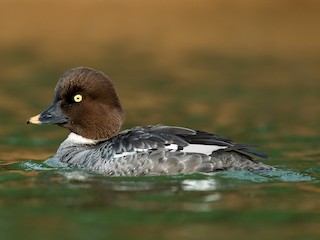
How to identify the Common Goldeneye
Bucephala clangula
Spotted a bird? Identify it instantly with the Birdby app
Open the appTo correctly identify the Common Goldeneye (Bucephala clangula), check each of these features. Birds can be tricky: habit, habitat, and call often confirm a sighting that a single photo cannot.
Size at a glance
- Length
- 40-51 cm (16-20 in)
- Wingspan
- 65-80 cm (26-31 in)
- Weight
- 800-1600 g (1.8-3.5 lbs)
Physical features to check
- 1
Plumage
Overall feather coloration and pattern.
Adult males have a striking iridescent green-black head with a circular white patch between the eye and the bill, a white neck, breast, and flanks, and a black back. The wings are black with a large white speculum. Adult females have a chocolate-brown head, a white collar, a grey body, and a white belly. Their wings are dark with a smaller white speculum. Juveniles resemble adult females but are duller with less distinct markings.
- 2
Beak shape
Shape and color of the bill: a key field mark.
Short, triangular, and dark grey to black. Males have a black bill; females have a black bill with a yellow or orange band near the tip, especially during breeding season.
- 3
Eye color
Iris color and any distinctive eye markings.
Bright golden-yellow in adults, duller yellow or brownish in juveniles.
- 4
Leg color
Leg and foot color.
Bright orange-yellow with dark webbing in both sexes.
- 5
Distinguishing features
Standout features that separate this species.
The male's prominent white facial spot and golden eye are unmistakable. The female's brown head, white collar, and golden eye are key identifiers. Both sexes have a distinctive triangular head shape and a 'high-forehead' appearance.
- 6
Juvenile appearance
How young birds differ from adults.
Juveniles resemble adult females but have a duller brown head, less distinct white collar, and often a brownish eye. Their plumage is generally more mottled grey-brown.
- 7
Seasonal changes
Plumage variation between breeding and non-breeding seasons.
Males retain their striking breeding plumage year-round, though the iridescence may be less pronounced outside of breeding season. Females show little seasonal change, though the bill coloration may vary slightly in intensity.
- 8
Sexual dimorphism
How males and females differ.
Highly sexually dimorphic. Males are much more boldly patterned with iridescent black-green head and white body, while females have a brown head and grey body.
Key field marks
- Male Head Pattern. Look for the iridescent green-black head with a distinct, circular white spot between the eye and the bill. This is the most reliable field mark for males.
- Female Head and Collar. Identify females by their chocolate-brown head and a clear white collar separating the head from the grey body. The bill often shows a yellow or orange band.
- Eye Color. Both adult sexes have striking golden-yellow eyes, which are very noticeable, especially at close range.
- Flight Sound. Listen for the characteristic high-pitched whistling sound produced by their wings in flight, particularly from males. This can often identify them before visual confirmation.
- Body Shape and Posture. Observe their somewhat triangular head shape and 'high-forehead' profile. They are compact, medium-sized diving ducks that sit relatively low in the water.
Explore the Common Goldeneye
Identify birds anywhere
Free on iOS, Android, and Web. Photo & sound identification, full species database, and your personal life list.