
Spotted a bird? Identify it instantly with the Birdby app
Open the appAbout
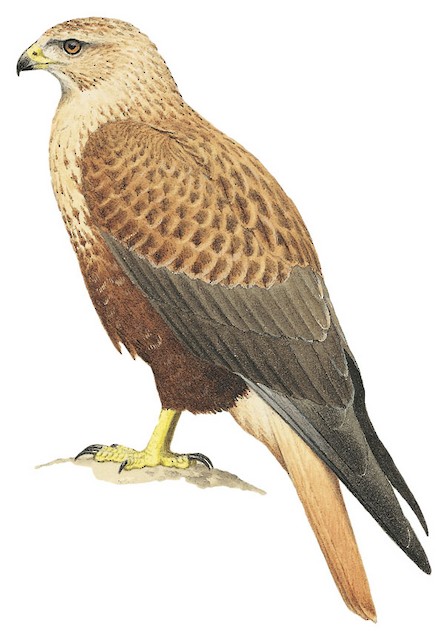
The Long-legged Buzzard (Buteo rufinus) is a large, powerful raptor belonging to the family Accipitridae. It is characterized by its robust build, broad wings, and often rufous (reddish-brown) plumage, particularly on the underparts and tail. It is a bird of open, arid, and semi-arid landscapes, often seen soaring high or perched conspicuously on elevated points.
Size & lifespan
- Length
- 50-66 cm
- Wingspan
- 120-160 cm
- Weight
- 800-1600 g
- Lifespan
- Up to 20 years in the wild
- Diet
- Carnivore
Physical characteristics
- Plumage
- Highly variable, ranging from pale sandy to dark rufous-brown. Common features include a pale head, dark carpal patches on the underwing, and a rufous tail, often unbarred or faintly barred. The underparts can be plain pale or streaked, with a variable amount of rufous wash. Upperparts are typically brown.
- Beak shape
- Strong, hooked beak, dark grey to black with a yellow cere.
- Eye color
- Yellow to amber in adults, darker in juveniles.
- Leg color
- Yellow, with feathered tarsi extending down to the toes, giving the 'long-legged' appearance.
- Distinguishing features
- Key features include the often unbarred rufous tail, feathered tarsi, pale head, and dark carpal patches. In flight, the broad wings and relatively long tail are noticeable. The overall impression is often of a large, pale-headed, rufous-tailed buzzard.
- Juvenile appearance
- Juveniles typically have paler plumage overall, with a less distinct rufous wash on the underparts and tail. The tail may be more distinctly barred than in adults. Eyes are darker, often brown. The feathered tarsi are present but may appear less dense.
- Seasonal changes
- No significant seasonal plumage changes. Plumage variation is primarily individual and age-related.
- Sexual dimorphism
- Minimal; females are generally slightly larger and heavier than males, but plumage differences are not pronounced.
How to identify
- 1
Size and Build
Look for a large, robust buzzard, noticeably larger than a Common Buzzard, with broad wings and a relatively long tail.
- 2
Plumage Coloration
Observe the overall color. Many individuals show a pale head, rufous wash on the underparts (especially belly and undertail coverts), and a distinctive rufous tail that is often unbarred or only faintly barred. Dark carpal patches on the underwing are usually prominent.
- 3
Legs
If perched, look for feathered tarsi (legs feathered down to the toes), a key diagnostic feature that gives it its common name.
- 4
Tail Pattern
In flight, the rufous tail, often lacking prominent barring, is a strong indicator. Compare to the more barred tails of other buzzards.
- 5
Flight Style
Note its powerful, buoyant soaring, often with wings held in a shallow dihedral. It can also hover effectively.
- 6
Habitat
Consider the habitat – open, arid, or semi-arid landscapes are preferred, which can help narrow down identification in its range.
Habitat & range
- Biomes
- Deserts, semi-deserts, steppes, open grasslands, rocky hillsides, and mountainous regions.
- Geographic range
- Southeastern Europe (e.g., Balkans, Turkey), North Africa, Middle East, Central Asia, extending east to Mongolia and China. Northern populations are migratory, while southern populations are often resident.
- Elevation range
- Sea level up to 3000 meters, occasionally higher in mountainous areas.
- Preferred environments
- Open country with scattered trees, cliffs, or rocky outcrops for nesting and perching. Avoids dense forests and heavily urbanized areas.
Behavior
- Activity time
- Diurnal, active during daylight hours.
- Feeding habits
- Primarily a predator of small to medium-sized mammals (e.g., rodents, pikas, hares), but also takes reptiles (lizards, snakes), birds, and large insects. Hunts by soaring and scanning the ground, or by perching on an elevated spot and swooping down on prey. Also capable of hovering.
- Social behavior
- Generally solitary or found in pairs during the breeding season. Not typically gregarious outside of migration, though multiple individuals may gather at abundant food sources.
- Flight pattern
- Characterized by powerful, buoyant soaring on broad wings, often holding wings in a shallow dihedral. Can also hover effectively against the wind. Direct flight involves strong, deliberate wing beats.
- Migration pattern
- Northern and eastern populations are migratory, moving south to wintering grounds in Africa, the Middle East, and South Asia. Southern populations are largely resident or undertake short-distance movements. Migration occurs in broad fronts, often utilizing thermals.
- Territoriality
- Territorial during the breeding season, defending nesting sites and hunting grounds from conspecifics and other raptors.
Song & calls
- Song
- Not known for a complex song. Vocalizations are typically calls.
- Call
- A variety of calls, often described as mewing, cat-like 'pee-oo' or 'kyaah' sounds, similar to Common Buzzard but often deeper and more drawn out. Also emits harsh 'kek-kek-kek' alarm calls.
- When they vocalize
- Most vocal during the breeding season, especially around the nest, and when interacting with mates or intruders.
Breeding & reproduction
- Breeding season
- Typically March to July, varying geographically.
- Nesting habits
- Nests are large structures made of sticks, often lined with wool, hair, or other soft materials. Built on cliffs, rocky ledges, or occasionally in trees (especially large, isolated ones). Both sexes contribute to nest building.
- Clutch size
- 2-4 eggs, rarely 1 or 5.
- Egg description
- Usually 2-4 eggs, dull white or pale bluish-white, often sparsely marked with reddish-brown or grey blotches.
- Incubation period
- Approximately 30-34 days, primarily by the female, with the male providing food.
- Fledging period
- Chicks fledge at around 45-50 days old, but remain dependent on parents for several weeks thereafter.
- Parental care
- Both parents are involved in raising the young. The female incubates and broods, while the male primarily hunts and brings food to the nest. Both feed the chicks.
Where to find
Steppes and Semi-deserts
Look in vast open grasslands, steppes, and semi-desert regions across its range in Eurasia and North Africa.
Rocky Hills and Mountains
Scan rocky outcrops, cliffs, and mountainous areas where they often nest and perch.
Agricultural Areas (sparse)
Can be found in open agricultural landscapes with scattered trees or power poles for perching, especially where rodent populations are high.
Field tips
- Scan the Sky. Long-legged Buzzards spend a lot of time soaring at altitude, so constantly scan the sky, especially during midday when thermals are strong.
- Check Elevated Perches. Look for them perched conspicuously on prominent rocks, cliffs, power poles, or isolated trees, from where they survey their hunting grounds.
- Learn Vocalizations. Familiarize yourself with their calls, which can help locate them, especially during the breeding season.
- Observe Flight. Pay attention to their flight style – the powerful, buoyant soaring and occasional hovering are characteristic.
Similar species
Common Buzzard
Buteo buteo
Long-legged Buzzard is generally larger and more robust. It typically has a paler head, more rufous underparts (especially the belly and undertail coverts), and a less barred, often plain rufous tail. The feathered tarsi are a key distinction. Common Buzzard often shows a dark trailing edge to the underwing, which is usually absent or less defined in Long-legged Buzzard. Flight is often more powerful and less 'flappy' than Common Buzzard.
Upland Buzzard
Buteo hemilasius
Upland Buzzard is also large and has feathered tarsi, but typically has a darker, more heavily marked plumage, often with a dark belly band and a more distinctly barred tail. Its range is generally further east in Central Asia. Long-legged Buzzard tends to be paler and more rufous overall.
Rough-legged Buzzard
Buteo lagopus
Rough-legged Buzzard also has feathered tarsi but is typically smaller and has a distinct dark carpal patch, a dark belly band, and a white tail with a broad dark terminal band. Its habitat is typically arctic/subarctic tundra and taiga, and it is a winter visitor to more temperate regions.
Quick facts
- Primary Prey:
- Small mammals (rodents, pikas)
- Distinctive Feature:
- Feathered tarsi (legs)
- Habitat Preference:
- Open, arid landscapes
- Migration Status:
- Partial migrant
- Nest Location:
- Cliffs, rocky ledges, large trees
Fun facts
- The 'long-legged' in its name refers to its feathered tarsi, which extend further down the leg than in most other buzzards, giving the appearance of longer legs.
- Despite its name, its legs are not actually proportionally longer than other buzzards; it's the feathering that creates this impression.
- It is one of the largest species within the Buteo genus, often appearing quite imposing in flight.
- Its diet can vary significantly depending on local prey availability, showcasing its adaptability as a predator.
Scientific classification
- Kingdom
- Animalia
- Phylum
- Chordata
- Class
- Aves
- Order
- Accipitriformes
- Family
- Accipitridae
- Genus
- Buteo
- Species
- Buteo rufinus
Explore the Long-legged Buzzard
Identify birds anywhere
Free on iOS, Android, and Web. Photo & sound identification, full species database, and your personal life list.