
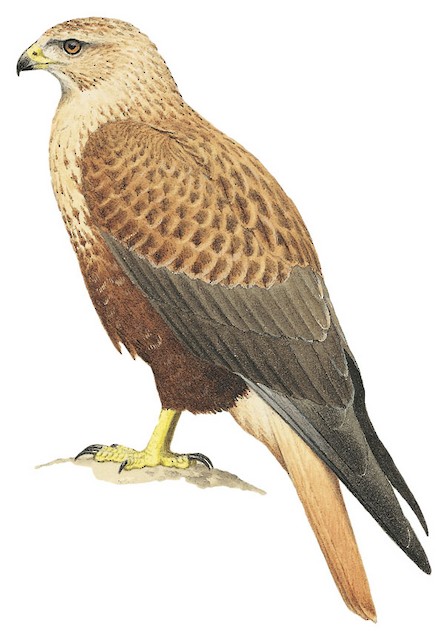
Where does the Long-legged Buzzard live?
Buteo rufinus
Spotted a bird? Identify it instantly with the Birdby app
Open the appThe Long-legged Buzzard lives in specific habitats and regions. Knowing where, and when, to look improves your chances of a successful sighting.
Biomes
Deserts, semi-deserts, steppes, open grasslands, rocky hillsides, and mountainous regions.
Geographic range
Southeastern Europe (e.g., Balkans, Turkey), North Africa, Middle East, Central Asia, extending east to Mongolia and China. Northern populations are migratory, while southern populations are often resident.
Preferred environments
Open country with scattered trees, cliffs, or rocky outcrops for nesting and perching. Avoids dense forests and heavily urbanized areas.
Elevation range
Sea level up to 3000 meters, occasionally higher in mountainous areas.
Where to look
Steppes and Semi-deserts
Look in vast open grasslands, steppes, and semi-desert regions across its range in Eurasia and North Africa.
Rocky Hills and Mountains
Scan rocky outcrops, cliffs, and mountainous areas where they often nest and perch.
Agricultural Areas (sparse)
Can be found in open agricultural landscapes with scattered trees or power poles for perching, especially where rodent populations are high.
Field tips
- Scan the Sky. Long-legged Buzzards spend a lot of time soaring at altitude, so constantly scan the sky, especially during midday when thermals are strong.
- Check Elevated Perches. Look for them perched conspicuously on prominent rocks, cliffs, power poles, or isolated trees, from where they survey their hunting grounds.
- Learn Vocalizations. Familiarize yourself with their calls, which can help locate them, especially during the breeding season.
- Observe Flight. Pay attention to their flight style – the powerful, buoyant soaring and occasional hovering are characteristic.
Migration
Northern and eastern populations are migratory, moving south to wintering grounds in Africa, the Middle East, and South Asia. Southern populations are largely resident or undertake short-distance movements. Migration occurs in broad fronts, often utilizing thermals.
Explore the Long-legged Buzzard
Identify birds anywhere
Free on iOS, Android, and Web. Photo & sound identification, full species database, and your personal life list.