
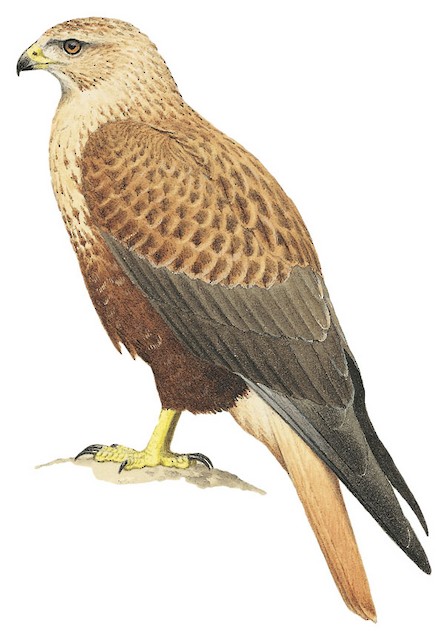
How to identify the Long-legged Buzzard
Buteo rufinus
Spotted a bird? Identify it instantly with the Birdby app
Open the appTo correctly identify the Long-legged Buzzard (Buteo rufinus), check each of these features. Birds can be tricky: habit, habitat, and call often confirm a sighting that a single photo cannot.
Size at a glance
- Length
- 50-66 cm
- Wingspan
- 120-160 cm
- Weight
- 800-1600 g
Physical features to check
- 1
Plumage
Overall feather coloration and pattern.
Highly variable, ranging from pale sandy to dark rufous-brown. Common features include a pale head, dark carpal patches on the underwing, and a rufous tail, often unbarred or faintly barred. The underparts can be plain pale or streaked, with a variable amount of rufous wash. Upperparts are typically brown.
- 2
Beak shape
Shape and color of the bill: a key field mark.
Strong, hooked beak, dark grey to black with a yellow cere.
- 3
Eye color
Iris color and any distinctive eye markings.
Yellow to amber in adults, darker in juveniles.
- 4
Leg color
Leg and foot color.
Yellow, with feathered tarsi extending down to the toes, giving the 'long-legged' appearance.
- 5
Distinguishing features
Standout features that separate this species.
Key features include the often unbarred rufous tail, feathered tarsi, pale head, and dark carpal patches. In flight, the broad wings and relatively long tail are noticeable. The overall impression is often of a large, pale-headed, rufous-tailed buzzard.
- 6
Juvenile appearance
How young birds differ from adults.
Juveniles typically have paler plumage overall, with a less distinct rufous wash on the underparts and tail. The tail may be more distinctly barred than in adults. Eyes are darker, often brown. The feathered tarsi are present but may appear less dense.
- 7
Seasonal changes
Plumage variation between breeding and non-breeding seasons.
No significant seasonal plumage changes. Plumage variation is primarily individual and age-related.
- 8
Sexual dimorphism
How males and females differ.
Minimal; females are generally slightly larger and heavier than males, but plumage differences are not pronounced.
Key field marks
- Size and Build. Look for a large, robust buzzard, noticeably larger than a Common Buzzard, with broad wings and a relatively long tail.
- Plumage Coloration. Observe the overall color. Many individuals show a pale head, rufous wash on the underparts (especially belly and undertail coverts), and a distinctive rufous tail that is often unbarred or only faintly barred. Dark carpal patches on the underwing are usually prominent.
- Legs. If perched, look for feathered tarsi (legs feathered down to the toes), a key diagnostic feature that gives it its common name.
- Tail Pattern. In flight, the rufous tail, often lacking prominent barring, is a strong indicator. Compare to the more barred tails of other buzzards.
- Flight Style. Note its powerful, buoyant soaring, often with wings held in a shallow dihedral. It can also hover effectively.
- Habitat. Consider the habitat – open, arid, or semi-arid landscapes are preferred, which can help narrow down identification in its range.
Explore the Long-legged Buzzard
Identify birds anywhere
Free on iOS, Android, and Web. Photo & sound identification, full species database, and your personal life list.