
Spotted a bird? Identify it instantly with the Birdby app
Open the appAbout
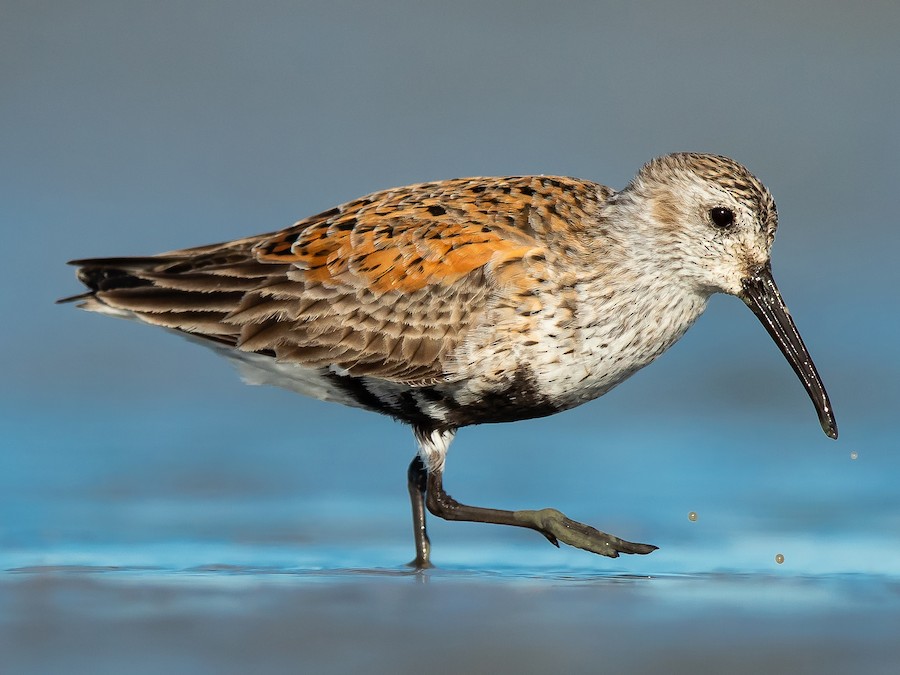
The Dunlin is a small, migratory shorebird belonging to the sandpiper family. It is characterized by its slightly downcurved bill and, in breeding plumage, a distinctive black belly patch. It is one of the most widespread and numerous shorebirds, found across Arctic and subarctic regions, migrating to temperate and tropical coasts for winter.
Size & lifespan
- Length
- 16-22 cm (6.3-8.7 in)
- Wingspan
- 32-39 cm (12.6-15.4 in)
- Weight
- 30-80 g (1.1-2.8 oz)
- Lifespan
- Up to 10-12 years in the wild
- Diet
- Carnivore (primarily invertebrates)
Physical characteristics
- Plumage
- Breeding plumage features a rufous back with black streaking, a white belly with a prominent black patch, and a white supercilium. Non-breeding plumage is duller, grayish-brown above, white below, with faint streaking on the breast. Juveniles resemble non-breeding adults but have more distinct streaking on the flanks and breast, and often a reddish wash on the back.
- Beak shape
- Medium-length, slender, and slightly downcurved black bill.
- Eye color
- Dark brown
- Leg color
- Black
- Distinguishing features
- The slightly downcurved bill is a key feature in all plumages. The black belly patch in breeding adults is diagnostic. In non-breeding plumage, its overall grayish tone and bill shape help distinguish it from other small sandpipers.
- Juvenile appearance
- Juveniles have a scaly-patterned rufous-brown back, a buffy wash on the breast with fine streaking, and often a faint blackish belly patch that is less defined than in adults. Their upperparts are often brighter and more patterned than non-breeding adults.
- Seasonal changes
- Dramatic change between breeding and non-breeding plumages. Breeding plumage (late spring to late summer) is characterized by the rufous back and black belly patch. Non-breeding plumage (late summer to early spring) is a drabber gray-brown above and white below, lacking the distinctive black belly.
- Sexual dimorphism
- Males and females are generally similar in plumage, though females tend to be slightly larger and have a slightly longer bill on average. The black belly patch in breeding plumage can be slightly larger in females.
How to identify
- 1
Bill Shape
Look for the medium-length, slender bill that is distinctly, though subtly, downcurved at the tip. This is a consistent feature across all ages and plumages.
- 2
Black Belly Patch (Breeding Plumage)
In late spring and summer, the prominent black patch on the lower belly is unmistakable and diagnostic for adult Dunlins.
- 3
Plumage Coloration
Breeding adults have a rich rufous back with black streaking. Non-breeding adults are uniformly grayish-brown above and white below, with faint streaking on the breast. Juveniles have a scaly back and often a buffy breast.
- 4
Leg Color
Always black legs and feet.
- 5
Behavior
Observe their feeding behavior – they often probe deeply into mud. Also, note their tendency to form large, cohesive flocks, especially during migration and winter.
- 6
Call
Listen for the distinctive, reedy, slightly descending 'kreep' call, often given in flight.
Habitat & range
- Biomes
- Tundra, coastal wetlands, estuaries, mudflats, sandy beaches, salt marshes, freshwater marshes, agricultural fields (during migration).
- Geographic range
- Breeds in Arctic and subarctic regions of Eurasia and North America. Winters along temperate and tropical coasts of Europe, Africa, Asia, and North America.
- Elevation range
- Primarily found at sea level, but can occur at higher elevations in tundra breeding grounds.
- Preferred environments
- During breeding, prefers wet tundra with sedges and mosses. During migration and winter, favors intertidal mudflats, sandy beaches, and shallow coastal waters rich in invertebrate prey.
Behavior
- Activity time
- Diurnal, but also forages at night during low tide, especially on moonlit nights.
- Feeding habits
- Forages by probing its bill into soft substrates (mud, sand) to extract invertebrates. Also picks prey from the surface. Often feeds in large, dense flocks, moving synchronously across mudflats. Diet includes marine worms, small crustaceans, mollusks, and insect larvae.
- Social behavior
- Highly social, especially outside the breeding season. Forms large, sometimes immense, flocks on migration and in wintering areas. These flocks can number in the tens of thousands. On breeding grounds, they are more territorial and solitary or in loose colonies.
- Flight pattern
- Flight is strong and direct, often in tightly packed, highly coordinated flocks during migration and winter. When flushed, they perform rapid, erratic maneuvers. On breeding grounds, display flights involve circling and hovering.
- Migration pattern
- Long-distance migrant. Breeds in the Arctic and subarctic and migrates south to temperate and tropical coastal areas. North American breeders winter along the Atlantic and Pacific coasts of North America, and occasionally further south. Eurasian breeders winter along coasts of Europe, Africa, and Asia.
- Territoriality
- During the breeding season, males establish and defend territories, often with aerial displays and vocalizations. Outside of breeding, they are not territorial and feed communally.
Song & calls
- Song
- The breeding song is a trilling, buzzing 'prrreee-prrreee-prrreee' or 'kree-kree-kree' given during display flights, often described as mechanical or insect-like.
- Call
- The most common call is a distinctive, slightly descending, reedy 'kreep' or 'chrrrp', often given in flight or when disturbed. Also a 'wit-wit-wit' alarm call.
- When they vocalize
- Most vocal during the breeding season, especially during courtship and territorial defense. Calls are also frequently heard during migration and on wintering grounds, particularly when flocks are disturbed or in flight.
Breeding & reproduction
- Breeding season
- Late May to August, peaking in June-July.
- Nesting habits
- Nests are shallow scrapes on the ground, typically in wet tundra, lined with leaves, moss, and lichens. Often concealed within dense vegetation.
- Clutch size
- Usually 4 eggs.
- Egg description
- Typically 4 eggs, pear-shaped, olive to buffy-brown with dark brown spots and blotches, concentrated at the larger end.
- Incubation period
- 20-22 days, shared by both parents.
- Fledging period
- Chicks are precocial and leave the nest shortly after hatching. They are capable of flight at about 19-21 days old.
- Parental care
- Both parents incubate and care for the young. Females often depart before the young fledge, leaving the male to complete parental duties.
Where to find
Coastal Mudflats and Estuaries
These are prime wintering and migratory stopover habitats, offering abundant invertebrate prey. Look for them at low tide.
Sandy Beaches
Can be found foraging along the water's edge, often mixed with other small shorebirds.
Salt Marshes
Utilize tidal creeks and pools within salt marshes for feeding and roosting.
Arctic Tundra
During the breeding season, they are found in wet, boggy tundra habitats across their northern range.
Field tips
- Scan large flocks. Dunlins often occur in large, mixed flocks with other shorebirds. Carefully scan these groups for the distinctive bill shape and, in breeding season, the black belly.
- Observe feeding behavior. Watch how they probe the mud. Their slightly downcurved bill is well-suited for this, and their methodical foraging can be a good identification clue.
- Check tides. Shorebirds are most active and visible during falling and low tides when mudflats are exposed. Plan your visits accordingly.
- Use a scope. For distant flocks on large mudflats, a spotting scope is invaluable for picking out individual features like bill shape and plumage details.
- Listen for calls. Their 'kreep' call is quite distinctive and can help locate them, especially in flight or when obscured by vegetation.
Similar species
Sanderling
Calidris alba
Sanderlings are paler overall, especially in non-breeding plumage, appearing almost pure white below. They lack the Dunlin's downcurved bill and black belly patch. Sanderlings also lack a hind toe, which Dunlins possess.
Curlew Sandpiper
Calidris ferruginea
Curlew Sandpipers have a more strongly decurved bill and a more rufous breeding plumage, lacking the distinct black belly patch of the Dunlin. In non-breeding plumage, they are very similar but the Curlew Sandpiper often shows a more prominent white supercilium and rump.
Baird's Sandpiper
Calidris bairdii
Baird's Sandpiper is typically browner overall, with a scaly appearance on the back and breast, and lacks the black belly patch. Its bill is straighter and shorter than the Dunlin's.
Western Sandpiper
Calidris mauri
Western Sandpipers are smaller, with a finer, slightly decurved bill. In breeding plumage, they have rufous scapulars and ear coverts, but lack the prominent black belly patch. Non-breeding Westerns are very similar to Dunlins but are smaller and have a more delicate bill.
Quick facts
- Global Population:
- Estimated 4.9-6.7 million individuals
- Migration Distance:
- Can migrate thousands of kilometers between breeding and wintering grounds.
- Subspecies:
- Recognized 10 subspecies (e.g., C. a. alpina, C. a. arctica, C. a. pacifica, C. a. hudsonia), varying slightly in size, bill length, and plumage tones.
- Ecological Role:
- Important consumer of intertidal invertebrates and a prey item for raptors and gulls.
Fun facts
- Dunlins are known for their spectacular synchronized flight displays in large flocks, often called 'murmurations,' which can be breathtaking to witness.
- The name 'Dunlin' is thought to derive from 'dun,' meaning dull brown, referring to its non-breeding plumage.
- Some Dunlins undertake one of the longest migrations of any shorebird, traveling from the high Arctic to tropical latitudes.
- The length and curvature of the Dunlin's bill can vary significantly between subspecies, which helps them exploit different food resources in their respective ranges.
Scientific classification
- Kingdom
- Animalia
- Phylum
- Chordata
- Class
- Aves
- Order
- Charadriiformes
- Family
- Scolopacidae
- Genus
- Calidris
- Species
- Calidris alpina
Explore the Dunlin
Identify birds anywhere
Free on iOS, Android, and Web. Photo & sound identification, full species database, and your personal life list.