
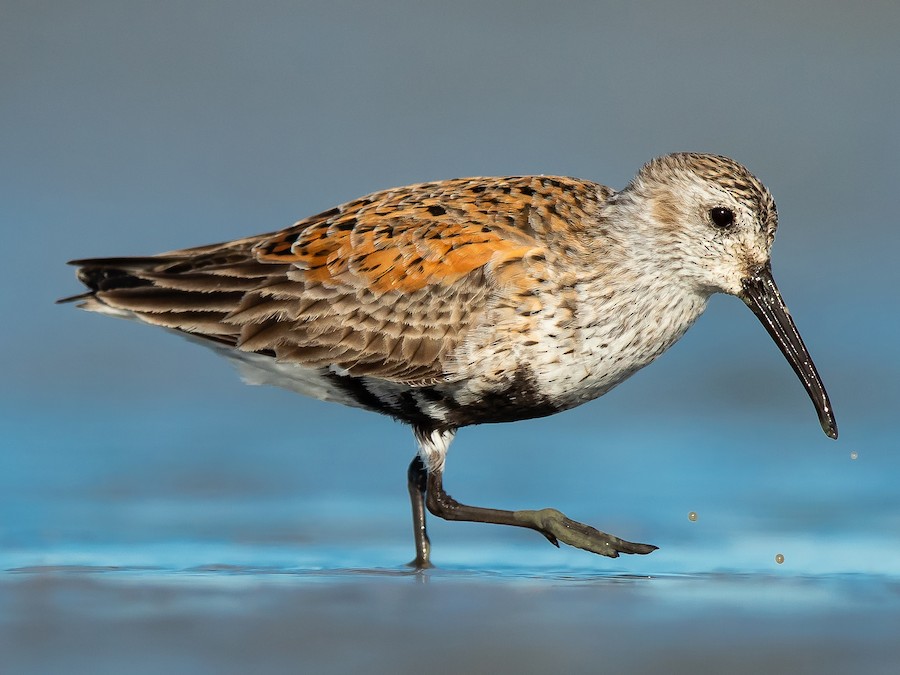
How to identify the Dunlin
Calidris alpina
Spotted a bird? Identify it instantly with the Birdby app
Open the appTo correctly identify the Dunlin (Calidris alpina), check each of these features. Birds can be tricky: habit, habitat, and call often confirm a sighting that a single photo cannot.
Size at a glance
- Length
- 16-22 cm (6.3-8.7 in)
- Wingspan
- 32-39 cm (12.6-15.4 in)
- Weight
- 30-80 g (1.1-2.8 oz)
Physical features to check
- 1
Plumage
Overall feather coloration and pattern.
Breeding plumage features a rufous back with black streaking, a white belly with a prominent black patch, and a white supercilium. Non-breeding plumage is duller, grayish-brown above, white below, with faint streaking on the breast. Juveniles resemble non-breeding adults but have more distinct streaking on the flanks and breast, and often a reddish wash on the back.
- 2
Beak shape
Shape and color of the bill: a key field mark.
Medium-length, slender, and slightly downcurved black bill.
- 3
Eye color
Iris color and any distinctive eye markings.
Dark brown
- 4
Leg color
Leg and foot color.
Black
- 5
Distinguishing features
Standout features that separate this species.
The slightly downcurved bill is a key feature in all plumages. The black belly patch in breeding adults is diagnostic. In non-breeding plumage, its overall grayish tone and bill shape help distinguish it from other small sandpipers.
- 6
Juvenile appearance
How young birds differ from adults.
Juveniles have a scaly-patterned rufous-brown back, a buffy wash on the breast with fine streaking, and often a faint blackish belly patch that is less defined than in adults. Their upperparts are often brighter and more patterned than non-breeding adults.
- 7
Seasonal changes
Plumage variation between breeding and non-breeding seasons.
Dramatic change between breeding and non-breeding plumages. Breeding plumage (late spring to late summer) is characterized by the rufous back and black belly patch. Non-breeding plumage (late summer to early spring) is a drabber gray-brown above and white below, lacking the distinctive black belly.
- 8
Sexual dimorphism
How males and females differ.
Males and females are generally similar in plumage, though females tend to be slightly larger and have a slightly longer bill on average. The black belly patch in breeding plumage can be slightly larger in females.
Key field marks
- Bill Shape. Look for the medium-length, slender bill that is distinctly, though subtly, downcurved at the tip. This is a consistent feature across all ages and plumages.
- Black Belly Patch (Breeding Plumage). In late spring and summer, the prominent black patch on the lower belly is unmistakable and diagnostic for adult Dunlins.
- Plumage Coloration. Breeding adults have a rich rufous back with black streaking. Non-breeding adults are uniformly grayish-brown above and white below, with faint streaking on the breast. Juveniles have a scaly back and often a buffy breast.
- Leg Color. Always black legs and feet.
- Behavior. Observe their feeding behavior – they often probe deeply into mud. Also, note their tendency to form large, cohesive flocks, especially during migration and winter.
- Call. Listen for the distinctive, reedy, slightly descending 'kreep' call, often given in flight.
Explore the Dunlin
Identify birds anywhere
Free on iOS, Android, and Web. Photo & sound identification, full species database, and your personal life list.