
Spotted a bird? Identify it instantly with the Birdby app
Open the appAbout
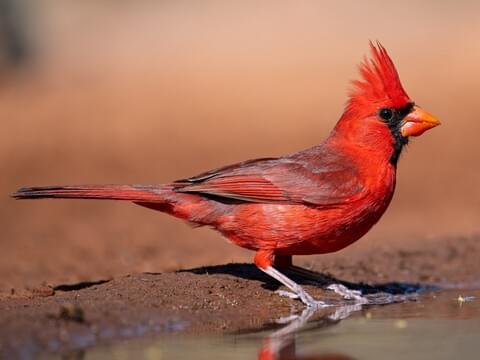
The Northern Cardinal is a medium-sized, seed-eating passerine bird in the family Cardinalidae. It is known for the striking red plumage of the male and its distinctive crest. It is a common and popular bird across eastern North America, often seen in suburban gardens and woodlands.
Size & lifespan
- Length
- 21-23 cm (8.3-9.1 in)
- Wingspan
- 25-31 cm (9.8-12.2 in)
- Weight
- 33-65 g (1.2-2.3 oz)
- Lifespan
- Up to 15 years in the wild, typically 3-5 years
- Diet
- Omnivore, primarily granivorous (seeds), but also insects and fruits
Physical characteristics
- Plumage
- Male: Brilliant crimson red over most of the body, with a black mask around the bill extending to the eyes. Wings and tail are slightly duller red. Female: Dull reddish-brown overall, with reddish tinges on the wings, tail, and crest. The face mask is grayish to blackish. Both sexes have a prominent crest and a thick, conical bill.
- Beak shape
- Thick, conical, and bright coral-red to orange-red in both sexes.
- Eye color
- Dark brown.
- Leg color
- Dark pinkish-brown to grayish-brown.
- Distinguishing features
- Prominent crest on the head, thick conical bill, and a black mask around the bill (more extensive in males).
- Juvenile appearance
- Juveniles are dull brown overall, with a dusky bill and a shorter crest. They gradually acquire adult plumage, with males showing patches of red as they mature.
- Seasonal changes
- No significant seasonal plumage changes; they retain their coloration year-round.
- Sexual dimorphism
- Highly sexually dimorphic. Males are almost entirely bright red, while females are predominantly reddish-brown with red accents.
How to identify
- 1
Coloration (Male)
Look for the unmistakable brilliant crimson red plumage covering almost the entire body, including the crest.
- 2
Coloration (Female)
Observe the reddish-brown body with reddish highlights on the wings, tail, and crest. The overall impression is warm brown with red accents.
- 3
Crest
Both sexes possess a prominent, pointed crest on their head, which can be raised or lowered depending on their mood.
- 4
Bill
Note the thick, conical, and bright coral-red to orange-red bill, adapted for cracking seeds. This is a key feature for both sexes.
- 5
Facial Mask
Identify the black mask around the bill and eyes, more extensive and contrasting in males, and grayish to blackish in females.
- 6
Song
Listen for the loud, clear, whistling song, often described with phrases like 'cheer-cheer-cheer' or 'birdie-birdie-birdie'.
Habitat & range
- Biomes
- Forest edges, woodlands, suburban gardens, parks, shrublands, wetlands, and desert washes.
- Geographic range
- Southeastern Canada, eastern and central United States, and south through Mexico to northern Guatemala and Belize.
- Elevation range
- Sea level up to approximately 2,700 meters (8,900 feet) in parts of Mexico.
- Preferred environments
- Dense shrubbery for nesting and cover, open areas for foraging, and access to water sources. They thrive in areas with a mix of dense vegetation and open ground.
Behavior
- Activity time
- Diurnal, most active during early morning and late afternoon.
- Feeding habits
- Forages on the ground or in low shrubs and trees. Primarily eats seeds (sunflower, safflower, thistle, corn), but also consumes insects (beetles, grasshoppers, cicadas, flies), spiders, and fruits (berries, grapes). They use their strong bills to crack open seeds.
- Social behavior
- Typically seen in pairs during the breeding season. In winter, they may form small flocks, sometimes mixed with other species, but often remain in pairs or small family groups. Males can be territorial, especially during breeding.
- Flight pattern
- Undulating flight pattern, often short and low between perches.
- Migration pattern
- Non-migratory (resident) throughout most of its range. Some northern populations may make short-distance movements in winter, but generally, they remain in their breeding territories year-round.
- Territoriality
- Males are highly territorial during the breeding season, defending their nesting area with songs and aggressive displays. Both sexes may defend feeding territories in winter.
Song & calls
- Song
- A loud, clear, whistling song, often described as 'cheer-cheer-cheer', 'birdie-birdie-birdie', or 'what-cheer, what-cheer'. Both males and females sing, with the female's song often more complex and used during nesting to communicate with the male.
- Call
- A sharp, metallic 'chip' note, often given when alarmed or as a contact call. Also a softer 'tew-tew-tew' call.
- When they vocalize
- Sings year-round, but most frequently and intensely during the breeding season (spring and summer). Calls are given throughout the day, especially when foraging or communicating with a mate.
Breeding & reproduction
- Breeding season
- Typically from March to September, with peak activity from April to July. Can raise 2-4 broods per year.
- Nesting habits
- Nests are built by the female, usually in dense shrubs, small trees, or vines, 1-3 meters (3-10 feet) above the ground. The nest is a cup-shaped structure made of twigs, bark strips, leaves, and grass, lined with fine grasses or hair.
- Clutch size
- 2-5 eggs, most commonly 3-4.
- Egg description
- Eggs are smooth, glossy, and white to pale greenish-white, often speckled with gray, brown, or purple spots, particularly at the larger end. Typically 2.5 x 1.8 cm (1.0 x 0.7 in).
- Incubation period
- 11-13 days, primarily by the female.
- Fledging period
- 9-11 days after hatching. Young are fed by both parents.
- Parental care
- Both parents feed the nestlings and fledglings. The male often continues to feed the first brood while the female begins incubating the next clutch.
Where to find
Suburban Gardens and Parks
Often found in backyards, especially those with bird feeders, dense shrubs, and trees. They are highly adaptable to human-modified landscapes.
Forest Edges and Woodlands
Common in the transitional zones between forests and open areas, providing both cover and foraging opportunities.
Shrublands and Thickets
Dense vegetation provides ideal nesting sites and protection from predators.
Riparian Areas
Found along streams and rivers, where dense vegetation and water sources are abundant.
Field tips
- Listen for their song. Their distinctive whistling song is often heard before the bird is seen, especially in dense foliage. Both sexes sing.
- Look in dense cover. Cardinals prefer to stay within or near dense shrubs and small trees for cover, even when foraging. Check the edges of thickets.
- Visit bird feeders. They are frequent visitors to bird feeders, especially those offering sunflower or safflower seeds. They are often among the first birds to arrive in the morning and the last in the evening.
- Be patient. While often conspicuous, they can be shy. Sit quietly near suitable habitat, and they may emerge.
- Look for movement. Their bright red color can be surprisingly camouflaged in dappled light. Look for subtle movements in the undergrowth.
Similar species
Summer Tanager
Piranga rubra
Male Summer Tanagers are entirely red with no crest and a paler, yellowish bill. Female Summer Tanagers are yellowish-orange and lack the cardinal's crest and thick bill.
Vermilion Flycatcher
Pyrocephalus rubinus
Male Vermilion Flycatchers are bright red but are much smaller, have a black mask and back, and lack a crest. They also have a thinner, black bill and a different foraging style (flycatching).
Pyrrhuloxia
Cardinalis sinuatus
Found in the southwestern US and Mexico. Pyrrhuloxias have a similar crest and shape but are primarily gray with red accents and a distinctive parrot-like, yellowish bill.
Quick facts
- State Bird:
- State bird of seven U.S. states: Illinois, Indiana, Kentucky, North Carolina, Ohio, Virginia, and West Virginia.
- Year-round Resident:
- Does not migrate, making it a familiar sight even in winter snow.
- Female Song:
- One of the few North American female songbirds that sings as often and as complexly as the male.
- Dietary Adaptations:
- Strong, conical bill is perfectly adapted for cracking open hard seeds.
- Color Source:
- Their red plumage comes from carotenoid pigments obtained from their diet.
Fun facts
- The Northern Cardinal is one of the most recognizable and beloved birds in North America, often associated with winter holidays due to its vibrant red color against snow.
- Male cardinals are known to attack their own reflection in windows, mistaking it for a rival male invading their territory.
- The female cardinal's song is often more elaborate than the male's and is used to communicate with her mate about food delivery to the nest.
- Cardinals are one of the few species where the female also sings, often while on the nest.
- Their population has expanded northward in recent decades, likely due to increased availability of bird feeders and ornamental plantings in suburban areas.
Scientific classification
- Kingdom
- Animalia
- Phylum
- Chordata
- Class
- Aves
- Order
- Passeriformes
- Family
- Cardinalidae
- Genus
- Cardinalis
- Species
- Cardinalis cardinalis
Explore the Northern Cardinal
Identify birds anywhere
Free on iOS, Android, and Web. Photo & sound identification, full species database, and your personal life list.