
Spotted a bird? Identify it instantly with the Birdby app
Open the appAbout
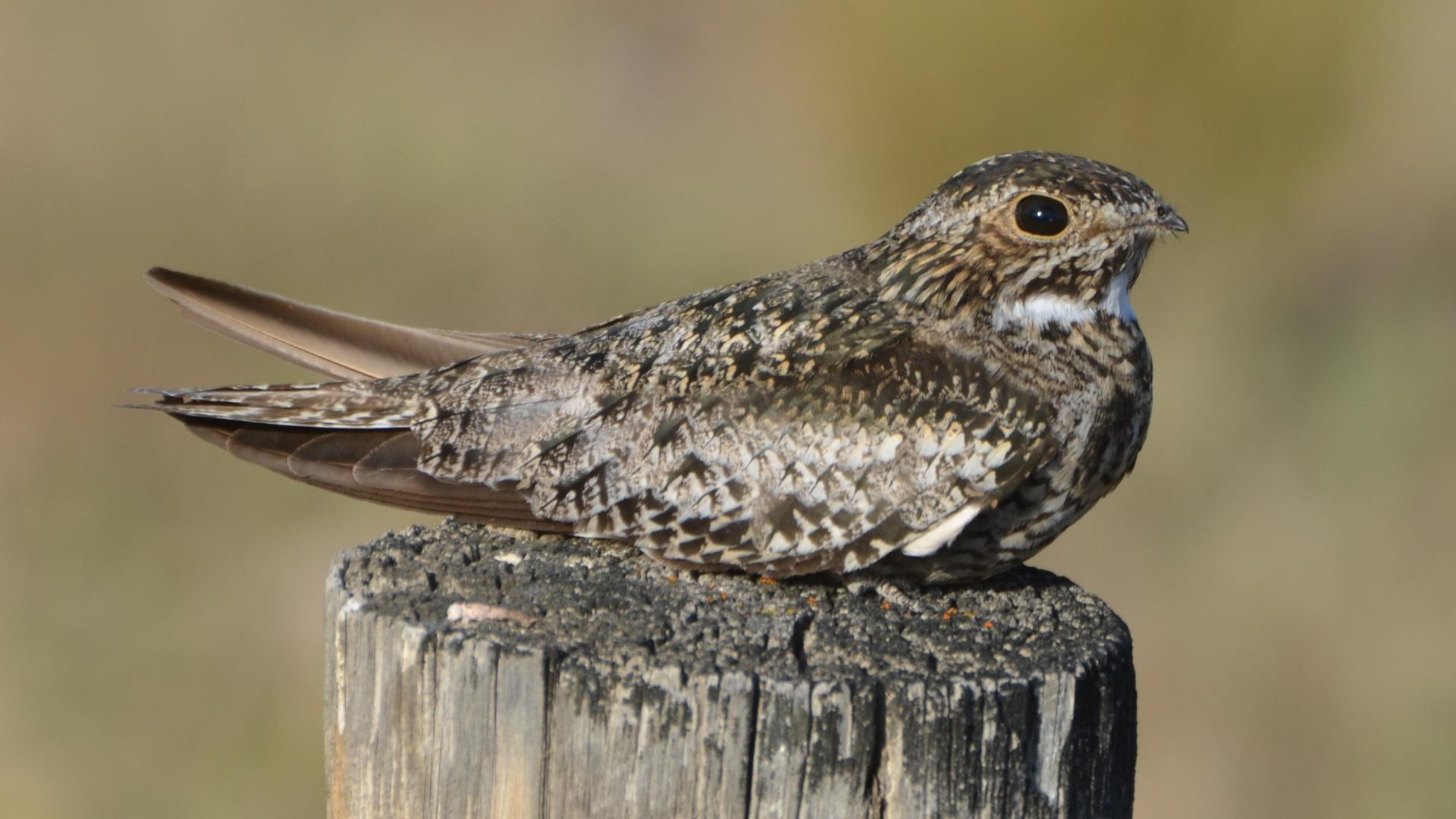
The Common Nighthawk is a medium-sized nocturnal or crepuscular bird characterized by its cryptic plumage, long pointed wings, and erratic flight. Despite its name, it is not a hawk but belongs to the nightjar family. It is migratory, breeding across North America and wintering in South America. Known for its aerial insectivory, it often feeds at dusk and dawn, and can be seen hunting over urban and rural areas.
Size & lifespan
- Length
- 22-26 cm (8.7-10.2 in)
- Wingspan
- 51-61 cm (20-24 in)
- Weight
- 55-98 g (1.9-3.5 oz)
- Lifespan
- Typically 4-5 years in the wild, with a maximum recorded lifespan of 9 years.
- Diet
- Strictly insectivorous, feeding primarily on flying insects caught on the wing. Diet includes moths, beetles, grasshoppers, ants, mosquitoes, and flies.
Physical characteristics
- Plumage
- Adults have cryptic, mottled plumage ranging from dark brown, gray, and black to buff and white, providing excellent camouflage against tree bark or ground. A distinctive white bar is present across the primary flight feathers on both upper and undersides of the wing, conspicuous in flight. The tail is slightly forked with a faint white subterminal band in males and some females.
- Beak shape
- Small, short, and slightly hooked, but capable of opening extremely wide to capture insects in flight, characteristic of Caprimulgids.
- Eye color
- Dark brown, appearing black.
- Leg color
- Dull, pale brownish-gray to blackish.
- Distinguishing features
- Long, pointed wings with a prominent white wing bar (visible on both upper and underside during flight); erratic, buoyant flight with deep, stiff wingbeats; relatively large head; flattened skull; absence of rictal bristles (unlike many other nightjars).
- Juvenile appearance
- Juveniles resemble adult females but are generally paler, more finely mottled, and duller overall. The white wing bar may be less distinct or tinged with buff. The throat patch is buffy.
- Seasonal changes
- No significant seasonal plumage changes occur, although fresh plumage after molt may appear slightly darker or more vibrant than worn plumage before molt.
- Sexual dimorphism
- Males possess a prominent white throat patch and a white subterminal band on the tail, which is often absent or much less pronounced in females. Females typically have a buffy or yellowish throat patch.
How to identify
- 1
Flight Pattern
Look for its distinctive erratic, buoyant, and somewhat jerky flight with deep, stiff wingbeats, often high in the sky. It frequently executes sharp turns and dives.
- 2
White Wing Bar
Crucial field mark: A prominent, rectangular white band across the primary flight feathers, visible on both the upper and underside of the wing, especially in flight. This is its most reliable visual identifier.
- 3
Vocalization ('Peent')
Listen for its unique, buzzy, nasal 'peent' or 'beer' call, often heard repeatedly during twilight hours. This call is highly distinctive and helps confirm identification, especially when the bird is high overhead.
- 4
Booming Dive
During courtship, males perform a steep dive, pulling up sharply to create a loud, rushing 'boom' sound with their wing feathers. This audible display is diagnostic.
- 5
Shape and Silhouette
In flight, it appears long-winged and slender-bodied with a relatively large head. Perched birds are cryptically camouflaged, often low to the ground or horizontally on branches.
- 6
Throat Patch
Adult males have a clear, bright white throat patch, while females and immatures have a buffy or yellowish throat patch.
Habitat & range
- Biomes
- Open woodlands, forest clearings, prairies, deserts, savannas, agricultural fields, urban and suburban areas, often above flat gravel roofs.
- Geographic range
- Breeds across most of North America, from northern Canada and Alaska south through much of the United States. Winters in South America, primarily in Brazil, Bolivia, Paraguay, Argentina, and Uruguay.
- Elevation range
- Sea level up to approximately 3,000 meters (9,800 feet), primarily dependent on availability of suitable open habitat and insect prey.
- Preferred environments
- Areas with open skies for hawking insects, such as clearings, river gravel bars, burned forests, open grasslands, and urban settings with flat, gravel-covered rooftops suitable for nesting.
Behavior
- Activity time
- Crepuscular (most active at dawn and dusk) and nocturnal. Rarely active during the brightest parts of the day, except when flushed from a roost or during intense foraging periods.
- Feeding habits
- Aerial insectivore, catching insects in flight using its wide gape. Hunts primarily during twilight hours (dusk and dawn) but also on moonlit nights or cloudy days. Shows agile, erratic flight patterns, frequently changing direction.
- Social behavior
- Generally solitary or found in loose flocks during the breeding season. During migration, they can form large, conspicuous flocks, sometimes numbering in the thousands, especially when concentrated at stopover sites.
- Flight pattern
- Distinctive, buoyant, and somewhat jerky flight. It often flies with deep, stiff wing beats, periodically gliding on bowed wings. When 'booming' during courtship, males perform a steep dive, pulling up abruptly to create a loud, rushing sound with their primary feathers.
- Migration pattern
- Long-distance Neotropical migrant. Breeds in North America and migrates to South America for the non-breeding season. Migration pathways are broad, often nocturnal, and can be seen moving over a wide front. One of the latest fall migrants.
- Territoriality
- Males display territorial behaviors, primarily through vocalizations and aerial displays like the 'boom'. Nests are typically solitary, though they may breed in loose aggregations in optimal habitat, especially on urban rooftops.
Song & calls
- Song
- The primary vocalization is a distinctive, buzzy, nasal 'peent' or 'beer' call, given both in flight and from a perch, often repeatedly. It serves as a contact call and a territorial advertisement.
- Call
- Aside from the 'peent' call, males produce a loud, hollow, rushing sound, often described as a 'boom,' made by air rushing through the primary wing feathers during a steep dive display (the 'booming dive'). Both sexes may give soft chuckles or hisses when disturbed at the nest.
- When they vocalize
- Most vocal during crepuscular periods (dawn and dusk) throughout the breeding season. Calls can also be heard during moonlit nights. The 'boom' is associated with courtship and territorial defense, primarily in spring and early summer.
Breeding & reproduction
- Breeding season
- May to August, with peak activity in June and July. Can extend later in southern parts of the range, and some pairs may attempt a second brood.
- Nesting habits
- No nest is built. Eggs are laid directly on bare ground, gravel, bedrock, or flat gravel-covered rooftops. Sites are typically chosen for camouflage and open access for flight, often among scattered vegetation, rocks, or debris.
- Clutch size
- Almost invariably 2 eggs.
- Egg description
- Typically 2 elliptical to oval eggs, creamy white or pale grayish-olive, heavily marked with brown, black, and purplish-gray blotches and speckles, providing excellent camouflage.
- Incubation period
- Approximately 18-20 days, primarily by the female, though the male may assist. Eggs are rarely left unattended.
- Fledging period
- Young nighthawks are precocial, leaving the immediate nest site within a few days of hatching but remain dependent on parents. They make their first flights around 20-23 days after hatching and become independent shortly thereafter.
- Parental care
- Both parents participate in brooding and feeding the young. Chicks are fed regurgitated insects. Parents are highly protective, often performing distraction displays if disturbed near the nest.
Where to find
Urban/Suburban Areas
Look for them hunting over well-lit sports fields, parks, or city centers at dusk, and nesting on gravel rooftops of commercial buildings.
Open Countryside
Seek them in clearings, pastures, open woodlands edges, and agricultural fields, especially where insects are abundant.
Burned Areas
Recently burned forests provide excellent open habitat and insect prey, attracting nighthawks.
River Gravel Bars/Sand Dunes
Natural nesting sites often include these open, sparsely vegetated areas.
Migration Stopovers
During migration, they can be seen in large flocks moving along coastlines, over mountains, or any open habitat. Look skyward at dusk.
Field tips
- Look at Dusk and Dawn. The best time to observe Common Nighthawks is during the crepuscular hours when they are actively foraging. They can be seen flying erratically high in the sky.
- Listen for their Call. Their distinctive 'peent' call is often heard before the bird is seen. Learning this call is key to locating them, especially in urban areas.
- Scan the Sky. They often fly high. Use binoculars to scan the sky overhead, especially if you hear their call. Look for the white wing bars against the fading light.
- Check Flat Rooftops. In urban environments, flat, gravel-covered roofs are prime nesting and roosting spots. They are remarkably camouflaged, so looking closely or listening for calls might be necessary.
- Observe Migratory Flocks. During fall migration (late August to September), thousands can gather and migrate in large, breathtaking groups at sunset. Find open areas with good sky views.
- Look for Booming Displays. During the breeding season, watch males perform their 'booming' dive. This is easiest to spot in open areas where they display over potential nesting sites.
Similar species
Lesser Nighthawk
Chordeiles acutipennis
Smaller than Common Nighthawk, with a shallower wingbeat, appears more consistently brown, and often has a pale, buffy-brown wing bar that is angled more towards the base of the wing rather than straight across. Its call is a lower-pitched, cooing 'wurp' or 'whurrr'. Lesser Nighthawks also tend to occur in warmer, more arid regions.
Chuck-will's-widow
Antrostomus carolinensis
Larger, more robust nightjar with a distinctive calls (its namesake 'chuck-will's-widow'). It typically has rictal bristles around its gape and lacks the prominent white wing bar of the nighthawk. Its flight is more buoyant, and it is usually found in forested habitats, often perched horizontally on branches.
Whip-poor-will
Antrostomus vociferus
Smaller than Common Nighthawk, with an unmistakable repetitive, whistled call. Lacks a prominent white wing bar. Similar to Chuck-will's-widow, it has well-developed rictal bristles and is primarily found in woodlands, with a more direct, moth-like flight path.
European Nightjar
Caprimulgus europaeus
While geographically distinct in breeding grounds, it shares the nightjar family characteristics. European Nightjar has a more mottled, browner plumage, lacks the prominent white wing bar of the Common Nighthawk, and has a distinctive churring song. Its tail is also shorter and less forked.
Quick facts
- Identification:
- Erratic flight, long pointed wings with prominent white bars, 'peent' call, male 'booming' dive.
- Diet:
- Flying insects caught in mid-air.
- Nesting:
- Lays eggs directly on ground or gravel rooftops, no traditional nest.
- Activity:
- Crepuscular and nocturnal.
- Migration:
- Long-distance Neotropical migrant, often in large flocks.
- Conservation:
- Least Concern, but declining populations noted.
Fun facts
- Despite its name, the Common Nighthawk is not related to hawks but is a type of nightjar, named for its nocturnal habits and hawk-like flight.
- The 'boom' sound made by the male during courtship is produced by air rushing through specialized primary wing feathers as it pulls out of a steep dive, not by vocalization.
- They are one of the last migratory species to depart from their breeding grounds in the fall, often lingering into October in some regions.
- Common Nighthawks are master camouflagers; their mottled plumage makes them incredibly difficult to spot when perched on the ground or a branch.
- These birds have a tiny beak but an enormous gape, allowing them to snap up large quantities of insects while flying.
- When feigning injury to distract predators from a nest, a nighthawk may flap its wings and hiss, appearing much larger and more threatening than it is.
Scientific classification
- Kingdom
- Animalia
- Phylum
- Chordata
- Class
- Aves
- Order
- Caprimulgiformes
- Family
- Caprimulgidae
- Genus
- Chordeiles
- Species
- minor
Explore the Common Nighthawk
Identify birds anywhere
Free on iOS, Android, and Web. Photo & sound identification, full species database, and your personal life list.