
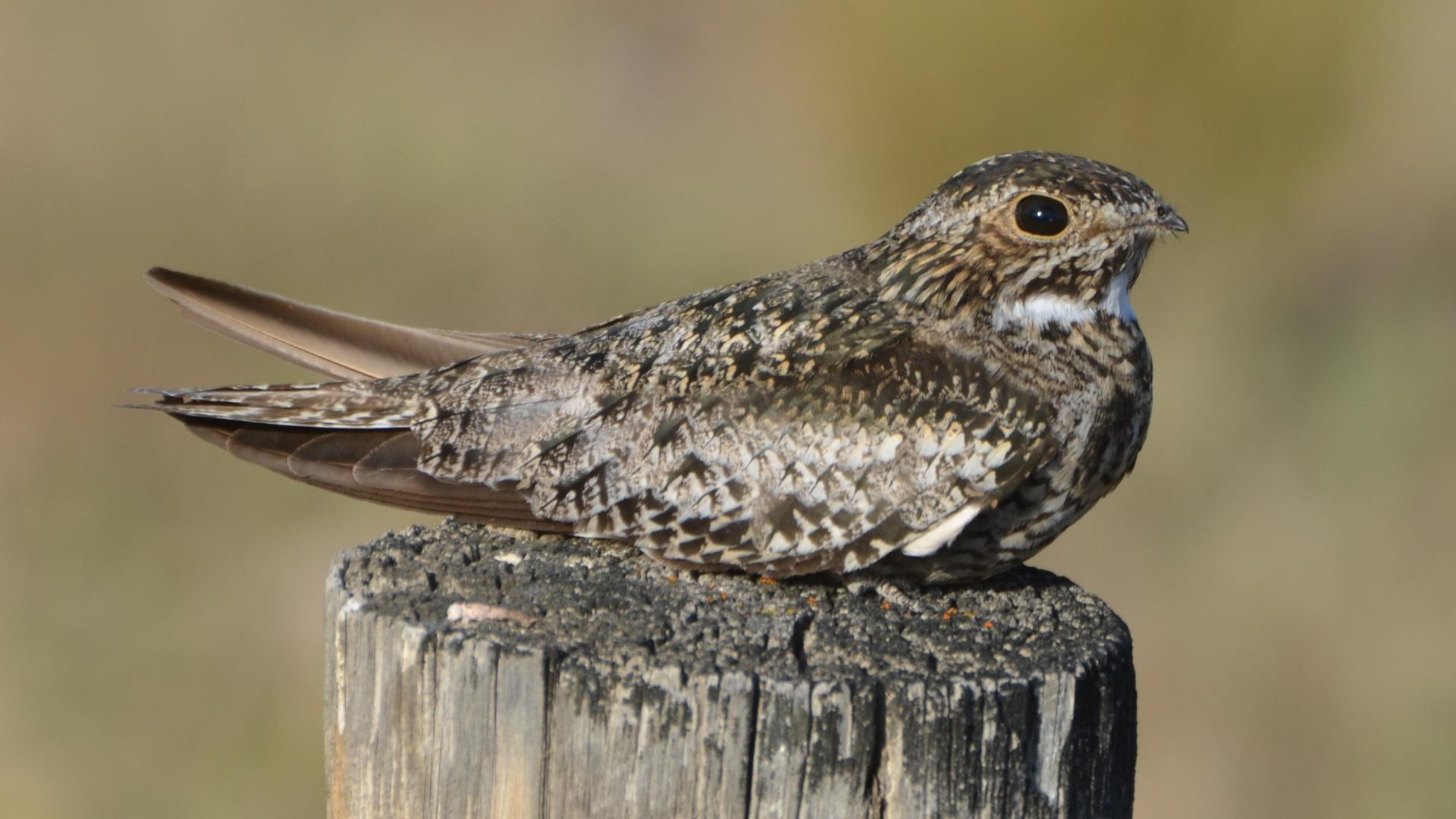
How to identify the Common Nighthawk
Chordeiles minor
Spotted a bird? Identify it instantly with the Birdby app
Open the appTo correctly identify the Common Nighthawk (Chordeiles minor), check each of these features. Birds can be tricky: habit, habitat, and call often confirm a sighting that a single photo cannot.
Size at a glance
- Length
- 22-26 cm (8.7-10.2 in)
- Wingspan
- 51-61 cm (20-24 in)
- Weight
- 55-98 g (1.9-3.5 oz)
Physical features to check
- 1
Plumage
Overall feather coloration and pattern.
Adults have cryptic, mottled plumage ranging from dark brown, gray, and black to buff and white, providing excellent camouflage against tree bark or ground. A distinctive white bar is present across the primary flight feathers on both upper and undersides of the wing, conspicuous in flight. The tail is slightly forked with a faint white subterminal band in males and some females.
- 2
Beak shape
Shape and color of the bill: a key field mark.
Small, short, and slightly hooked, but capable of opening extremely wide to capture insects in flight, characteristic of Caprimulgids.
- 3
Eye color
Iris color and any distinctive eye markings.
Dark brown, appearing black.
- 4
Leg color
Leg and foot color.
Dull, pale brownish-gray to blackish.
- 5
Distinguishing features
Standout features that separate this species.
Long, pointed wings with a prominent white wing bar (visible on both upper and underside during flight); erratic, buoyant flight with deep, stiff wingbeats; relatively large head; flattened skull; absence of rictal bristles (unlike many other nightjars).
- 6
Juvenile appearance
How young birds differ from adults.
Juveniles resemble adult females but are generally paler, more finely mottled, and duller overall. The white wing bar may be less distinct or tinged with buff. The throat patch is buffy.
- 7
Seasonal changes
Plumage variation between breeding and non-breeding seasons.
No significant seasonal plumage changes occur, although fresh plumage after molt may appear slightly darker or more vibrant than worn plumage before molt.
- 8
Sexual dimorphism
How males and females differ.
Males possess a prominent white throat patch and a white subterminal band on the tail, which is often absent or much less pronounced in females. Females typically have a buffy or yellowish throat patch.
Key field marks
- Flight Pattern. Look for its distinctive erratic, buoyant, and somewhat jerky flight with deep, stiff wingbeats, often high in the sky. It frequently executes sharp turns and dives.
- White Wing Bar. Crucial field mark: A prominent, rectangular white band across the primary flight feathers, visible on both the upper and underside of the wing, especially in flight. This is its most reliable visual identifier.
- Vocalization ('Peent'). Listen for its unique, buzzy, nasal 'peent' or 'beer' call, often heard repeatedly during twilight hours. This call is highly distinctive and helps confirm identification, especially when the bird is high overhead.
- Booming Dive. During courtship, males perform a steep dive, pulling up sharply to create a loud, rushing 'boom' sound with their wing feathers. This audible display is diagnostic.
- Shape and Silhouette. In flight, it appears long-winged and slender-bodied with a relatively large head. Perched birds are cryptically camouflaged, often low to the ground or horizontally on branches.
- Throat Patch. Adult males have a clear, bright white throat patch, while females and immatures have a buffy or yellowish throat patch.
Explore the Common Nighthawk
Identify birds anywhere
Free on iOS, Android, and Web. Photo & sound identification, full species database, and your personal life list.