
Spotted a bird? Identify it instantly with the Birdby app
Open the appAbout
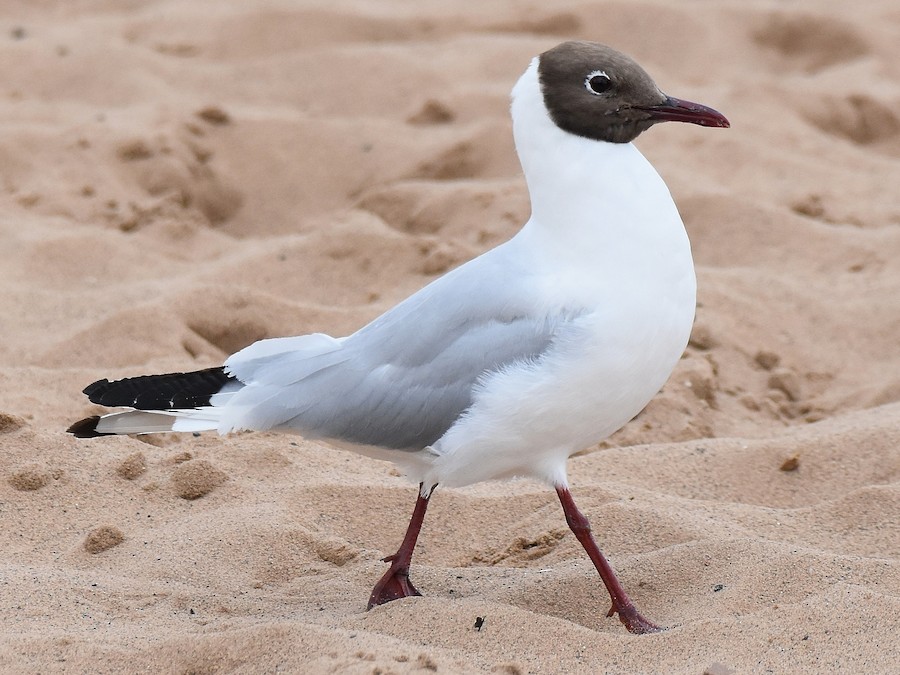
The Black-headed Gull is a small to medium-sized gull, widespread across the Palearctic region and increasingly colonizing North America. It is characterized by its distinctive chocolate-brown (not black) head during the breeding season and its relatively agile flight. It is highly adaptable and can be found in a variety of coastal and inland habitats, often associating with humans.
Size & lifespan
- Length
- 35-39 cm
- Wingspan
- 86-99 cm
- Weight
- 200-350 g
- Lifespan
- Typically 10-15 years, with records up to 30 years in the wild.
- Diet
- Omnivorous and opportunistic, consuming a wide variety of food items including insects (especially earthworms and larvae), small fish, crustaceans, mollusks, carrion, berries, seeds, and human refuse.
Physical characteristics
- Plumage
- Adult breeding plumage features a distinctive chocolate-brown head, white body, pale grey back and upper wings, and black primary flight feathers with white leading edges. Non-breeding adults have a white head with a dark spot behind the eye and a fainter dark smudge on the crown. Underwings are white. Juveniles are a mix of brown and grey, with a scaly brown back, a dark band on the tail, and a browner head pattern.
- Beak shape
- Slender, slightly down-curved, and dark red in breeding adults. In non-breeding adults, it is duller red with a dark tip. Juveniles have an orange-yellow bill with a black tip.
- Eye color
- Dark brown, with a prominent white eye-crescent in non-breeding and juvenile plumages.
- Leg color
- Dark red in breeding adults. Duller red or brownish-red in non-breeding adults and juveniles.
- Distinguishing features
- Breeding plumage: dark brown head (not black), red bill and legs, white leading edge to the primary feathers. Non-breeding plumage: white head with a dark ear spot and a smaller dark smudge. Distinctive 'laughing' call.
- Juvenile appearance
- First-winter birds have a brownish-grey wash to the head, a scaly brown back, pale grey upperwings with brown median coverts forming a dark bar, and a distinct black terminal band on the tail. The bill is orange with a black tip, and legs are pinkish-orange. This plumage gradually transitions to adult non-breeding by the second winter.
- Seasonal changes
- The most prominent seasonal change is the acquisition of the chocolate-brown head plumage in breeding adults from late winter through summer, which is then molted into the white-headed non-breeding plumage with a dark ear spot and crown smudge from late summer through autumn.
- Sexual dimorphism
- Minimal sexual dimorphism; males and females are generally identical in plumage and size.
How to identify
- 1
Breeding Plumage Head
Look for the distinctive chocolate-brown head (not black) that covers the entire head and neck.
- 2
Non-breeding Plumage Head
Observe the white head with a distinct dark spot behind the eye (ear covert spot) and often a faint smudge on the crown.
- 3
Wing Pattern (Adult)
Note the pale grey back and upper wings. Crucially, look for the black tips to the primary feathers with a prominent white leading edge/panel. Underwings are entirely white.
- 4
Bill and Leg Color
In adults, the bill and legs are dark red (brighter in breeding, duller in non-breeding).
- 5
Juvenile Plumage
Identify by the scaly brown back, pale grey wings with a dark 'carpal bar' (brown median coverts), orange bill with a black tip, and a black terminal band on the tail.
- 6
Call
Listen for the characteristic loud, 'laughing' 'kwa-kwa-kwa' call, a key identifier even when not seen clearly.
- 7
Flight Style
Observe its light, buoyant, and agile flight compared to larger, heavier gulls.
Habitat & range
- Biomes
- Temperate grasslands, wetlands, coastlines, agricultural lands, urban and suburban areas.
- Geographic range
- Breeds across most of Europe and Asia, from the Atlantic coast east to Siberia and Japan. Winters in southern parts of its breeding range, the Mediterranean, North Africa, the Middle East, Indian subcontinent, and parts of Southeast Asia. Has established breeding populations in eastern North America.
- Elevation range
- Primarily lowlands, but can be found at higher elevations during migration or foraging, typically below 2000 meters.
- Preferred environments
- Breeds in colonies in freshwater marshes, peat bogs, and coastal lagoons with dense vegetation. Outside the breeding season, it frequents coasts, estuaries, rivers, lakes, reservoirs, agricultural fields, parks, rubbish dumps, and urban areas.
Behavior
- Activity time
- Diurnal, active during daylight hours for foraging and social interactions. Roosts communally at night, often on water or safe ground.
- Feeding habits
- Highly opportunistic and adaptable. Forages by walking on the ground, probing with its bill, picking items from the surface, hawking insects in flight, and dabbling on the water's surface. Often follows ploughs to catch invertebrates. Known to steal food from other birds (kleptoparasitism).
- Social behavior
- Highly social, particularly outside the breeding season, forming large flocks for roosting and foraging. Breeds colonially, often in very dense concentrations. Known to be vocal and somewhat aggressive, especially during breeding.
- Flight pattern
- Light and buoyant flight, often appearing agile and graceful. Flaps with relatively shallow wingbeats and can glide effectively. Often seen soaring in thermals.
- Migration pattern
- Largely migratory, with northern and eastern populations moving south and west for the winter. Many central European birds are resident or undertake shorter migrations. Post-breeding dispersal can be extensive, with juveniles often moving furthest. Some European birds migrate to North Africa, while Asian populations move to warmer parts of Asia. Has shown expansion westwards, with increasing numbers wintering in western Europe and colonizing North America.
- Territoriality
- Colonial breeders, defending a small territory around the nest site. Outside the breeding season, they are gregarious and non-territorial in foraging and roosting areas.
Song & calls
- Song
- Does not have a complex song. Its vocalizations are primarily calls.
- Call
- The most characteristic call is a loud, laughing 'kwa-kwa-kwa-kwa-kwa', which can vary in intensity and speed. Also produces a sharper 'kweek' or 'keeah' call, alarm calls, and various contact notes within the colony. Juveniles have a higher-pitched, squeakier call.
- When they vocalize
- Most vocal during the breeding season, particularly when establishing territories, during pair-bonding, and when defending nests. Also vocal during disputes in foraging flocks and at roosts.
Breeding & reproduction
- Breeding season
- Typically starts from March to April and extends through July.
- Nesting habits
- Nests colonially, often in large, dense colonies of hundreds or thousands of pairs. Nests are built on the ground, often in reedbeds, tussocks of vegetation in marshes, or on small islands, usually close to water. The nest is a bulky structure of vegetation (reeds, grasses, moss, twigs) lined with finer materials.
- Clutch size
- 2-3 eggs, typically.
- Egg description
- Usually 2-3 (occasionally 1-4) eggs. Eggs are olive-brown, greenish-blue, or buff, heavily marked with dark spots, blotches, and streaks of blackish-brown or reddish-brown.
- Incubation period
- 22-26 days, primarily by the female, but both parents participate.
- Fledging period
- Chicks fledge at 25-30 days old. They are semiprecocial, leaving the nest shortly after hatching but remaining dependent on parents.
- Parental care
- Both parents participate in incubation, brooding, and feeding the young. Chicks are fed regurgitated food and guarded until they are able to fly and forage independently.
Where to find
Coastal Areas
Look along beaches, estuaries, harbors, and tidal mudflats, especially outside the breeding season.
Inland Water Bodies
Found frequently around lakes, reservoirs, rivers, and large ponds, both in rural and urban settings.
Agricultural Land
Often seen in fields, especially when ploughing is underway, where they follow machinery to feed on exposed invertebrates.
Urban/Suburban Parks and Gardens
Common in human-modified landscapes, where they will feed on scraps and insects, often in large numbers.
Wetlands and Marshes
Prime breeding habitat, particularly areas with dense reedbeds or tussocks of vegetation.
Field tips
- Listen for their distinctive call. Their loud, 'laughing' call is often heard before the bird is seen, especially in larger flocks.
- Observe flock behavior. Black-headed Gulls are highly social. Look for groups foraging, roosting, or flying together, particularly near food sources.
- Check plumage carefully for seasonality. Remember the brown head is only present during the breeding season. The dark ear spot is key for non-breeding identification.
- Look at the primary feather pattern. The black primary tips with a prominent white leading edge are crucial for distinguishing adults from similar species.
- Consider bill and leg color. The red bill and legs are good field marks, especially when trying to differentiate from gulls with black or yellowish bills/legs.
Similar species
Little Gull
Hydrocoloeus minutus
Smaller size (much smaller, about the size of a swift), entirely black underwings (Black-headed has white underwings), a short, fine black bill, and a faster, more fluttery flight. Breeding Little Gulls have a solid black head, not chocolate-brown, and no white leading edge on primaries. Juveniles have a distinct 'W' pattern on the upperwings and a narrower tail band.
Mediterranean Gull
Ichthyaetus melanocephalus
Slightly larger, stouter, and bulkier. Breeding adults have a truly black head (not brown), a thicker, brighter red bill with a black subterminal band, and entirely white primary feathers (Black-headed has black primaries with white leading edge). The underwings are also entirely white in Mediterranean Gull. Non-breeding Mediterranean Gulls have a cleaner white head with only a faint smudged eye mask, lacking the distinct dark ear spot of the Black-headed Gull. Calls are also distinctly different, less 'laughing'.
Bonaparte's Gull
Chroicocephalus philadelphia
Primarily North American. Similar in size, but breeding Bonaparte's has a solid black head, not brown, and a slender, all-black bill. It also shows a white crescent behind the eye and a distinctive white triangular patch on the outer primaries (visible from above). Underwings are pale but often appear darker than Black-headed due to grey flight feathers.
Relict Gull
Ichthyaetus relictus
Rare, found in Central Asia. Superficially similar but larger, with a heavier bill and distinctive facial markings in breeding plumage, including extensive black on the head that extends down the neck, and prominent white crescents around the eye, giving a 'spectacled' appearance. Non-breeding plumage is cleaner white on the head than Black-headed.
Quick facts
- Head Color (Breeding):
- Chocolate-brown
- Head Color (Non-breeding):
- White with dark ear spot
- Bill Color (Adult):
- Dark red
- Leg Color (Adult):
- Dark red
- Wing Pattern (Adult):
- Black primary tips with white leading edge
- Habitat:
- Coastal and inland wetlands, urban areas, farmlands
- Diet:
- Omnivorous (insects, fish, scraps)
- Conservation Status:
- Least Concern
- Sociality:
- Highly social, colonial breeder
Fun facts
- Despite its common name, the Black-headed Gull's breeding head plumage is actually chocolate-brown, not black.
- These gulls are incredibly adaptable and can be found far inland, often feeding in agricultural fields or even city parks.
- The Black-headed Gull has been observed following ploughs for centuries, capitalizing on disturbed soil to find invertebrates.
- It is one of the most common and widespread gull species in Europe and parts of Asia, sometimes forming colonies with thousands of pairs.
- In recent decades, the species has successfully established breeding populations in eastern North America, demonstrating its impressive colonizing ability.
- The distinctive 'laughing' call is a familiar sound in many European urban areas and coastal regions.
Scientific classification
- Kingdom
- Animalia
- Phylum
- Chordata
- Class
- Aves
- Order
- Charadriiformes
- Family
- Laridae
- Genus
- Chroicocephalus
- Species
- ridibundus
Explore the Black-headed Gull
Identify birds anywhere
Free on iOS, Android, and Web. Photo & sound identification, full species database, and your personal life list.