
Where does the Black-headed Gull live?
Chroicocephalus ridibundus
Spotted a bird? Identify it instantly with the Birdby app
Open the appThe Black-headed Gull lives in specific habitats and regions. Knowing where, and when, to look improves your chances of a successful sighting.
Biomes
Temperate grasslands, wetlands, coastlines, agricultural lands, urban and suburban areas.
Geographic range
Breeds across most of Europe and Asia, from the Atlantic coast east to Siberia and Japan. Winters in southern parts of its breeding range, the Mediterranean, North Africa, the Middle East, Indian subcontinent, and parts of Southeast Asia. Has established breeding populations in eastern North America.
Preferred environments
Breeds in colonies in freshwater marshes, peat bogs, and coastal lagoons with dense vegetation. Outside the breeding season, it frequents coasts, estuaries, rivers, lakes, reservoirs, agricultural fields, parks, rubbish dumps, and urban areas.
Elevation range
Primarily lowlands, but can be found at higher elevations during migration or foraging, typically below 2000 meters.
Where to look
Coastal Areas
Look along beaches, estuaries, harbors, and tidal mudflats, especially outside the breeding season.
Inland Water Bodies
Found frequently around lakes, reservoirs, rivers, and large ponds, both in rural and urban settings.
Agricultural Land
Often seen in fields, especially when ploughing is underway, where they follow machinery to feed on exposed invertebrates.
Urban/Suburban Parks and Gardens
Common in human-modified landscapes, where they will feed on scraps and insects, often in large numbers.
Wetlands and Marshes
Prime breeding habitat, particularly areas with dense reedbeds or tussocks of vegetation.
Field tips
- Listen for their distinctive call. Their loud, 'laughing' call is often heard before the bird is seen, especially in larger flocks.
- Observe flock behavior. Black-headed Gulls are highly social. Look for groups foraging, roosting, or flying together, particularly near food sources.
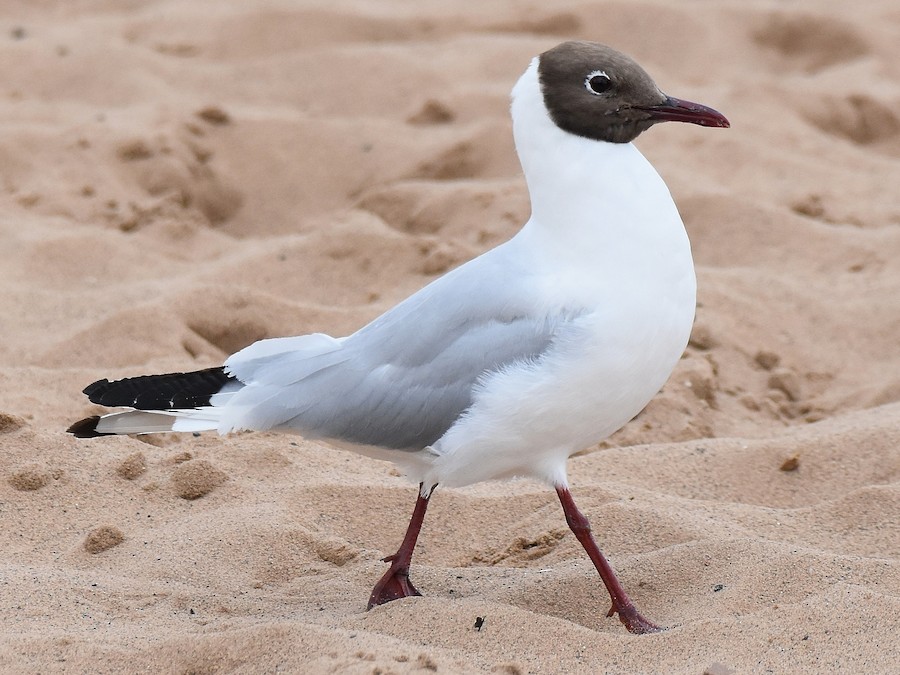
- Check plumage carefully for seasonality. Remember the brown head is only present during the breeding season. The dark ear spot is key for non-breeding identification.
- Look at the primary feather pattern. The black primary tips with a prominent white leading edge are crucial for distinguishing adults from similar species.
- Consider bill and leg color. The red bill and legs are good field marks, especially when trying to differentiate from gulls with black or yellowish bills/legs.
Migration
Largely migratory, with northern and eastern populations moving south and west for the winter. Many central European birds are resident or undertake shorter migrations. Post-breeding dispersal can be extensive, with juveniles often moving furthest. Some European birds migrate to North Africa, while Asian populations move to warmer parts of Asia. Has shown expansion westwards, with increasing numbers wintering in western Europe and colonizing North America.
Explore the Black-headed Gull
Identify birds anywhere
Free on iOS, Android, and Web. Photo & sound identification, full species database, and your personal life list.