
How to identify the Black-headed Gull
Chroicocephalus ridibundus
Spotted a bird? Identify it instantly with the Birdby app
Open the appTo correctly identify the Black-headed Gull (Chroicocephalus ridibundus), check each of these features. Birds can be tricky: habit, habitat, and call often confirm a sighting that a single photo cannot.
Size at a glance
- Length
- 35-39 cm
- Wingspan
- 86-99 cm
- Weight
- 200-350 g
Physical features to check
- 1
Plumage
Overall feather coloration and pattern.
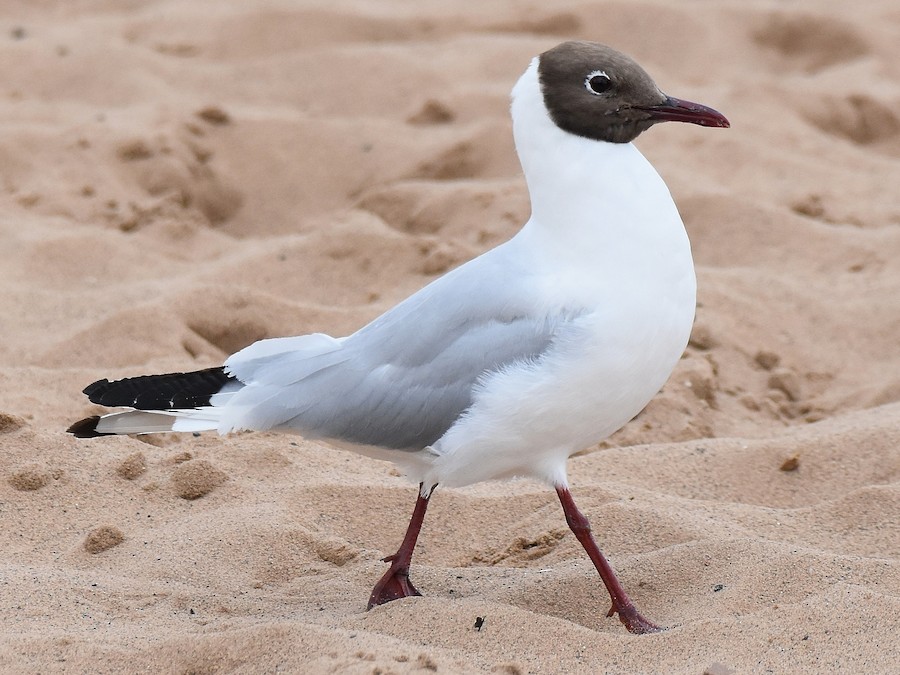
Adult breeding plumage features a distinctive chocolate-brown head, white body, pale grey back and upper wings, and black primary flight feathers with white leading edges. Non-breeding adults have a white head with a dark spot behind the eye and a fainter dark smudge on the crown. Underwings are white. Juveniles are a mix of brown and grey, with a scaly brown back, a dark band on the tail, and a browner head pattern.
- 2
Beak shape
Shape and color of the bill: a key field mark.
Slender, slightly down-curved, and dark red in breeding adults. In non-breeding adults, it is duller red with a dark tip. Juveniles have an orange-yellow bill with a black tip.
- 3
Eye color
Iris color and any distinctive eye markings.
Dark brown, with a prominent white eye-crescent in non-breeding and juvenile plumages.
- 4
Leg color
Leg and foot color.
Dark red in breeding adults. Duller red or brownish-red in non-breeding adults and juveniles.
- 5
Distinguishing features
Standout features that separate this species.
Breeding plumage: dark brown head (not black), red bill and legs, white leading edge to the primary feathers. Non-breeding plumage: white head with a dark ear spot and a smaller dark smudge. Distinctive 'laughing' call.
- 6
Juvenile appearance
How young birds differ from adults.
First-winter birds have a brownish-grey wash to the head, a scaly brown back, pale grey upperwings with brown median coverts forming a dark bar, and a distinct black terminal band on the tail. The bill is orange with a black tip, and legs are pinkish-orange. This plumage gradually transitions to adult non-breeding by the second winter.
- 7
Seasonal changes
Plumage variation between breeding and non-breeding seasons.
The most prominent seasonal change is the acquisition of the chocolate-brown head plumage in breeding adults from late winter through summer, which is then molted into the white-headed non-breeding plumage with a dark ear spot and crown smudge from late summer through autumn.
- 8
Sexual dimorphism
How males and females differ.
Minimal sexual dimorphism; males and females are generally identical in plumage and size.
Key field marks
- Breeding Plumage Head. Look for the distinctive chocolate-brown head (not black) that covers the entire head and neck.
- Non-breeding Plumage Head. Observe the white head with a distinct dark spot behind the eye (ear covert spot) and often a faint smudge on the crown.
- Wing Pattern (Adult). Note the pale grey back and upper wings. Crucially, look for the black tips to the primary feathers with a prominent white leading edge/panel. Underwings are entirely white.
- Bill and Leg Color. In adults, the bill and legs are dark red (brighter in breeding, duller in non-breeding).
- Juvenile Plumage. Identify by the scaly brown back, pale grey wings with a dark 'carpal bar' (brown median coverts), orange bill with a black tip, and a black terminal band on the tail.
- Call. Listen for the characteristic loud, 'laughing' 'kwa-kwa-kwa' call, a key identifier even when not seen clearly.
- Flight Style. Observe its light, buoyant, and agile flight compared to larger, heavier gulls.
Explore the Black-headed Gull
Identify birds anywhere
Free on iOS, Android, and Web. Photo & sound identification, full species database, and your personal life list.