
Spotted a bird? Identify it instantly with the Birdby app
Open the appAbout
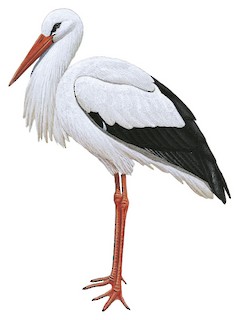
The White Stork is a large, majestic wading bird recognized by its predominantly white plumage with black flight feathers, long red legs, and a long pointed red beak. It is a migratory species known for its impressive soaring abilities and distinctive nest-building habits on elevated structures.
Size & lifespan
- Length
- 100-115 cm
- Wingspan
- 155-215 cm
- Weight
- 2.3-4.5 kg
- Lifespan
- Typically 20-30 years in the wild, with records up to 39 years.
- Diet
- Carnivorous, primarily feeding on a wide variety of small vertebrates and invertebrates such as insects (especially grasshoppers, crickets), frogs, toads, snakes, lizards, small mammals (rodents, shrews), fish, and sometimes bird eggs and chicks.
Physical characteristics
- Plumage
- Adults have brilliant white body plumage, contrasting sharply with glossy black primary and secondary flight feathers (remiges). The black is iridescent, sometimes showing green or purple sheen in good light. Juveniles have duller white plumage and a greyer, less vibrant red beak and legs, which gradually brighten with age.
- Beak shape
- Long, stout, and pointed; bright red in adults, duller reddish-brown or greyish-orange in juveniles.
- Eye color
- Dark, typically black-brown.
- Leg color
- Long, slender legs that are bright red in adults, duller greyish-red or pinkish-grey in juveniles.
- Distinguishing features
- Large size, predominantly white plumage with black wingtips, long red beak, and red legs. In flight, the straight neck and extended legs are characteristic. Known for its 'clattering' vocalization produced by snapping the mandibles together.
- Juvenile appearance
- Juveniles resemble adults but have a duller, sometimes buff-tinged white plumage, particularly on the head and neck. Their beak is dark brown, greyish, or dull reddish-brown, and their legs are greyish-pink to dull red, gradually acquiring the adult's bright red coloration over their first year.
- Seasonal changes
- No significant seasonal plumage changes. The intensity of beak and leg coloration can vary slightly with health and breeding condition, being brightest during the breeding season.
- Sexual dimorphism
- Males and females are visually similar in plumage and size, though males may be slightly larger on average.
How to identify
- 1
Plumage
Look for the stark white body with contrasting black primary and secondary flight feathers (wingtips and trailing edge of wings).
- 2
Beak and Legs
Bright red, long, pointed beak and long red legs are distinctive in adults.
- 3
Flight Silhouette
Observe its flight with a straight neck and extended legs, often soaring in thermals. The black and white pattern is very clear against the sky.
- 4
Behavior
Listen for bill-clattering, especially near nests. Watch for its deliberate walking and foraging in open fields or wet meadows.
- 5
Nesting Sites
Often nests conspicuously on man-made structures in human settlements, which can be a key identification clue.
Habitat & range
- Biomes
- Grasslands, wet meadows, agricultural fields, floodplains, steppes, open woodlands near water, and occasionally urban areas.
- Geographic range
- Breeds across most of Europe (primarily central and eastern), northwest Africa, and parts of Asia, extending east to Central Asia. Winters primarily in sub-Saharan Africa, and parts of the Indian subcontinent and Arabian Peninsula.
- Elevation range
- Typically found in lowlands and open plains, rarely above 1,000 meters.
- Preferred environments
- Open country with short vegetation, access to wetlands or damp areas for foraging, and suitable elevated structures (trees, buildings, utility poles, artificial platforms) for nesting.
Behavior
- Activity time
- Diurnal, active during daylight hours for foraging and social interactions.
- Feeding habits
- Forages by walking slowly and deliberately through short vegetation, scanning for prey. It uses its long beak to snatch prey from the ground or shallow water. Often seen following agricultural machinery to catch disturbed prey. Can congregate at rich food sources.
- Social behavior
- Generally gregarious, especially during migration and in wintering grounds, forming large flocks. Breeding pairs are monogamous for a season; several pairs often nest in colonies. Non-breeding individuals may roost communally.
- Flight pattern
- Known for its majestic and efficient soaring flight. Utilizes thermals to gain altitude, often circling high in the sky. When migrating, it glides on uplift for long distances, minimizing energy expenditure. Flaps its wings with powerful, deep strokes.
- Migration pattern
- A long-distance migrant. Western European populations typically migrate across the Strait of Gibraltar to West Africa. Eastern populations follow a route over the Bosphorus, through Turkey and the Middle East, to East and Southern Africa, avoiding large stretches of over-water flight. Returns north in spring to breed.
- Territoriality
- Breeding pairs defend their nest site and immediate surroundings from other storks, though they are tolerant of neighboring nests in colonies.
Song & calls
- Song
- White Storks do not possess a complex vocal song. Their primary 'vocalization' is bill-clattering.
- Call
- The characteristic sound of the White Stork is 'bill-clattering' (or 'clappering'), produced by rapidly opening and closing their mandibles. This sound serves various communication purposes, including greeting, alarm, threat display, and strengthening pair bonds. They may also produce hissing sounds, especially when agitated or by juveniles.
- When they vocalize
- Bill-clattering is most frequent at the nest, particularly during courtship, greeting the partner, or in response to perceived threats. It can also be heard during social displays or disputes outside the nest.
Breeding & reproduction
- Breeding season
- Typically starts in March-April in Europe, lasting through July-August.
- Nesting habits
- Constructs large, bulky platform nests primarily made of sticks, branches, and often lined with grass, moss, and sometimes anthropogenic materials like cloth or plastic. Nests are often built on high structures like rooftops, chimneys, church steeples, utility poles, ruins, and occasionally large trees. Nests are reused and added to year after year, sometimes reaching immense sizes.
- Clutch size
- 2-7 eggs, most commonly 3-5.
- Egg description
- 2-7 (usually 3-5) dull white, non-glossy eggs. Eggs are oval-shaped.
- Incubation period
- 33-34 days, performed by both parents.
- Fledging period
- 58-64 days. Young remain in the nest for an extended period, initially dependent on parents for food, and then begin short flights around the nest before fully fledging.
- Parental care
- Both parents incubate eggs, guard the nest, and feed the young. Chicks are fed regurgitated food. Parental care continues for some time after fledging until the young become independent.
Where to find
Agricultural Landscapes
Search in recently mowed fields, pastures, and farmland where prey is easily accessible.
Wetlands and Floodplains
Look for them foraging in shallow water, marshes, and riverbanks.
Villages and Towns
During the breeding season, check rooftops, chimneys, towers, and utility poles for their characteristic large nests.
Migration Bottlenecks
During spring and autumn migration, observe large numbers passing over straits and land bridges like the Bosphorus, Strait of Gibraltar, and parts of the Middle East and East Africa.
Field tips
- Scan the Sky. Especially during migration, look for large flocks of soaring birds, often circling in thermals at great heights.
- Check Elevated Structures. In traditional breeding areas, diligently check prominent high points in villages and towns for nests and adult storks.
- Look in Open Fields. White Storks are frequently seen walking and foraging in open agricultural areas, often near livestock.
- Listen for Bill-Clattering. Near active nests, the distinctive bill-clattering sound can be a strong indicator of their presence.
Similar species
Black Stork
Ciconia nigra
The Black Stork is entirely black with a white belly. Its beak and legs are red, but the overall coloration is distinct. It prefers more secluded, forested wetland habitats, unlike the White Stork's preference for open, human-influenced landscapes.
Saddle-billed Stork
Ephippiorhynchus senegalensis
Found only in Africa. Larger than the White Stork with a distinct black, white, and red plumage pattern, and a uniquely patterned black and red beak with a yellow 'saddle' at the base. Not typically sympatric in breeding ranges.
Maguari Stork
Ciconia maguari
Found only in South America. Very similar in appearance to the White Stork but with a larger, bluish-grey beak (black-tipped in juveniles) and red orbital skin. Its flight feathers are more extensive black in adults.
Quick facts
- Average clutch size:
- 3-5 eggs
- Incubation period:
- 33-34 days
- Fledging period:
- 58-64 days
- Migratory status:
- Long-distance migrant
- Primary diet:
- Small vertebrates and large invertebrates
- Distinguishing sound:
- Bill-clattering
Fun facts
- The White Stork is a classic symbol of good luck and fertility in European folklore, often associated with bringing babies.
- Ancient nests can be enormous, weighing hundreds of kilograms and used by generations of storks for decades.
- They are highly opportunistic feeders, and their diet can adapt significantly based on local prey availability.
- White Storks use thermals (rising columns of warm air) to conserve energy during their long migrations, allowing them to glide for vast distances without much wing flapping.
- Some populations, particularly those in Western Europe, are showing reduced migratory behavior, with increasing numbers overwintering in parts of Spain and Portugal due to climate change and changes in waste management.
Scientific classification
- Kingdom
- Animalia
- Phylum
- Chordata
- Class
- Aves
- Order
- Ciconiformes
- Family
- Ciconiidae
- Genus
- Ciconia
- Species
- Ciconia ciconia
Explore the White Stork
Identify birds anywhere
Free on iOS, Android, and Web. Photo & sound identification, full species database, and your personal life list.