
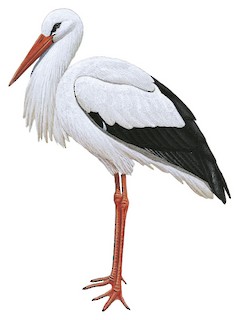
Where does the White Stork live?
Ciconia ciconia
Spotted a bird? Identify it instantly with the Birdby app
Open the appThe White Stork lives in specific habitats and regions. Knowing where, and when, to look improves your chances of a successful sighting.
Biomes
Grasslands, wet meadows, agricultural fields, floodplains, steppes, open woodlands near water, and occasionally urban areas.
Geographic range
Breeds across most of Europe (primarily central and eastern), northwest Africa, and parts of Asia, extending east to Central Asia. Winters primarily in sub-Saharan Africa, and parts of the Indian subcontinent and Arabian Peninsula.
Preferred environments
Open country with short vegetation, access to wetlands or damp areas for foraging, and suitable elevated structures (trees, buildings, utility poles, artificial platforms) for nesting.
Elevation range
Typically found in lowlands and open plains, rarely above 1,000 meters.
Where to look
Agricultural Landscapes
Search in recently mowed fields, pastures, and farmland where prey is easily accessible.
Wetlands and Floodplains
Look for them foraging in shallow water, marshes, and riverbanks.
Villages and Towns
During the breeding season, check rooftops, chimneys, towers, and utility poles for their characteristic large nests.
Migration Bottlenecks
During spring and autumn migration, observe large numbers passing over straits and land bridges like the Bosphorus, Strait of Gibraltar, and parts of the Middle East and East Africa.
Field tips
- Scan the Sky. Especially during migration, look for large flocks of soaring birds, often circling in thermals at great heights.
- Check Elevated Structures. In traditional breeding areas, diligently check prominent high points in villages and towns for nests and adult storks.
- Look in Open Fields. White Storks are frequently seen walking and foraging in open agricultural areas, often near livestock.
- Listen for Bill-Clattering. Near active nests, the distinctive bill-clattering sound can be a strong indicator of their presence.
Migration
A long-distance migrant. Western European populations typically migrate across the Strait of Gibraltar to West Africa. Eastern populations follow a route over the Bosphorus, through Turkey and the Middle East, to East and Southern Africa, avoiding large stretches of over-water flight. Returns north in spring to breed.
Explore the White Stork
Identify birds anywhere
Free on iOS, Android, and Web. Photo & sound identification, full species database, and your personal life list.