
How to identify the White Stork
Ciconia ciconia
Spotted a bird? Identify it instantly with the Birdby app
Open the appTo correctly identify the White Stork (Ciconia ciconia), check each of these features. Birds can be tricky: habit, habitat, and call often confirm a sighting that a single photo cannot.
Size at a glance
- Length
- 100-115 cm
- Wingspan
- 155-215 cm
- Weight
- 2.3-4.5 kg
Physical features to check
- 1
Plumage
Overall feather coloration and pattern.
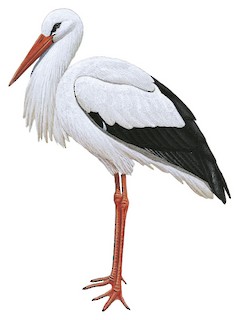
Adults have brilliant white body plumage, contrasting sharply with glossy black primary and secondary flight feathers (remiges). The black is iridescent, sometimes showing green or purple sheen in good light. Juveniles have duller white plumage and a greyer, less vibrant red beak and legs, which gradually brighten with age.
- 2
Beak shape
Shape and color of the bill: a key field mark.
Long, stout, and pointed; bright red in adults, duller reddish-brown or greyish-orange in juveniles.
- 3
Eye color
Iris color and any distinctive eye markings.
Dark, typically black-brown.
- 4
Leg color
Leg and foot color.
Long, slender legs that are bright red in adults, duller greyish-red or pinkish-grey in juveniles.
- 5
Distinguishing features
Standout features that separate this species.
Large size, predominantly white plumage with black wingtips, long red beak, and red legs. In flight, the straight neck and extended legs are characteristic. Known for its 'clattering' vocalization produced by snapping the mandibles together.
- 6
Juvenile appearance
How young birds differ from adults.
Juveniles resemble adults but have a duller, sometimes buff-tinged white plumage, particularly on the head and neck. Their beak is dark brown, greyish, or dull reddish-brown, and their legs are greyish-pink to dull red, gradually acquiring the adult's bright red coloration over their first year.
- 7
Seasonal changes
Plumage variation between breeding and non-breeding seasons.
No significant seasonal plumage changes. The intensity of beak and leg coloration can vary slightly with health and breeding condition, being brightest during the breeding season.
- 8
Sexual dimorphism
How males and females differ.
Males and females are visually similar in plumage and size, though males may be slightly larger on average.
Key field marks
- Plumage. Look for the stark white body with contrasting black primary and secondary flight feathers (wingtips and trailing edge of wings).
- Beak and Legs. Bright red, long, pointed beak and long red legs are distinctive in adults.
- Flight Silhouette. Observe its flight with a straight neck and extended legs, often soaring in thermals. The black and white pattern is very clear against the sky.
- Behavior. Listen for bill-clattering, especially near nests. Watch for its deliberate walking and foraging in open fields or wet meadows.
- Nesting Sites. Often nests conspicuously on man-made structures in human settlements, which can be a key identification clue.
Explore the White Stork
Identify birds anywhere
Free on iOS, Android, and Web. Photo & sound identification, full species database, and your personal life list.