
Spotted a bird? Identify it instantly with the Birdby app
Open the appAbout
The Western Marsh Harrier is a large, slender raptor found primarily in wetlands across Eurasia and parts of Africa. It is characterized by its buoyant, harrier-like flight, typically holding its wings in a shallow 'V' shape. This species exhibits significant sexual dimorphism in plumage, making identification of sexes relatively straightforward.
Size & lifespan
- Length
- 48-56 cm (19-22 in)
- Wingspan
- 110-140 cm (43-55 in)
- Weight
- Males: 400-670 g (0.88-1.48 lb); Females: 500-1200 g (1.1-2.65 lb)
- Lifespan
- Typically 6-10 years in the wild, up to 17 years recorded.
- Diet
- Highly varied, consisting mainly of small to medium-sized birds (especially waterfowl and their chicks), small mammals (voles, mice, young rabbits), amphibians, reptiles (lizards, snakes), and large insects. Opportunistically takes fish and carrion.
Physical characteristics
- Plumage
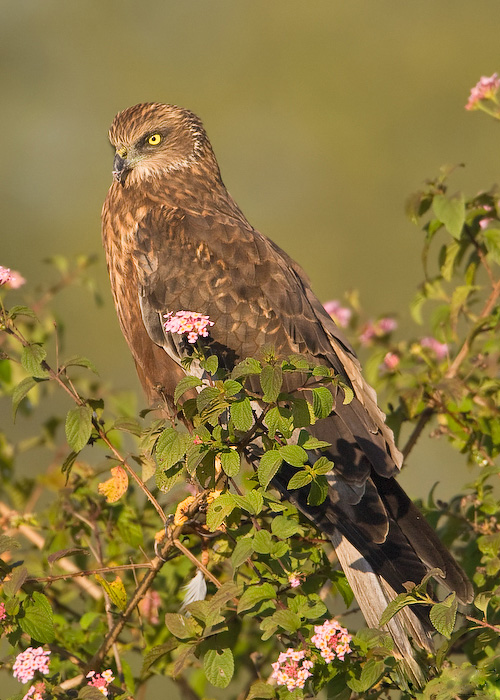
- Adult males have a striking plumage: brown back, rusty-brown underparts, grey tail, and complex grey wings with black wingtips. Adult females are largely dark brown with a creamy-yellow cap and leading edge to the wing. Juveniles resemble adult females but often have a more uniformly dark body and a less defined creamy cap, sometimes with a pale patch on the nape.
- Beak shape
- Hooked, characteristic of raptors, designed for tearing flesh.
- Eye color
- Adult males: yellow; Adult females: yellow to yellowish-brown; Juveniles: dark brown.
- Leg color
- Yellow
- Distinguishing features
- Long wings and tail, buoyant flight with wings held in a shallow 'V' (dihedral) while soaring or quartering, especially when hunting. The dark brown body and distinctive creamy head/wing patches of females and juveniles are key. Males are unique among harriers in their complex grey, black, and brown wing pattern.
- Juvenile appearance
- Similar to adult females but generally darker overall. They typically have a more uniform dark brown body and often a less bright or more restricted creamy-yellow cap, sometimes appearing as a pale nape patch rather than a full cap.
- Seasonal changes
- No significant seasonal plumage changes for adults. Juveniles molt into adult plumage over 1-2 years.
- Sexual dimorphism
- Pronounced. Males are smaller and much lighter in plumage, with grey on wings and tail, and rusty underparts. Females are larger and predominantly dark brown with a distinct creamy-yellow head and forewing patch. Juveniles resemble females.
How to identify
- 1
Flight Profile
Look for a characteristic low, buoyant flight over wetlands, often with wings held in a shallow 'V' (dihedral). This allows them to scan the ground below effectively.
- 2
Size and Build
It is a relatively large and robust harrier compared to other European harriers, with broad wings.
- 3
Male Plumage
Adult males are unmistakable: brown body, grey tail, and complex grey wings with black wingtips. This combination is unique among harriers.
- 4
Female Plumage
Adult females are dark brown overall with a striking creamy-yellow cap and a prominent creamy-yellow patch on the leading edge of the inner wing (carpal joint). The facial area is often paler.
- 5
Juvenile Plumage
Juveniles resemble females but are typically a more uniform dark brown with a less distinct, sometimes paler, creamy cap or nape patch. They lack the strong pale forewing patch of adult females.
- 6
Habitat
Its strong association with extensive reedbeds and marshlands is a key identification clue. If you see a large harrier in such a habitat, it is most likely a Western Marsh Harrier.
Habitat & range
- Biomes
- Temperate grasslands, wetlands, freshwater lakes, rivers, marshes, reedbeds, coastal lagoons, agricultural areas.
- Geographic range
- Breeds across much of temperate Europe and Asia, extending to parts of North Africa. Winters in southern Europe, Africa (especially sub-Saharan Africa), and southern Asia.
- Elevation range
- Primarily lowlands, rarely observed above 1000 meters.
- Preferred environments
- Extensive reedbeds, dense marsh vegetation, and wet grasslands adjacent to open water bodies. They require dense cover for nesting and roosting, but also open areas for hunting.
Behavior
- Activity time
- Diurnal, active primarily during daylight hours.
- Feeding habits
- Hunts by quartering low over open ground or water, often gliding with wings in a shallow dihedral, meticulously scanning for prey. It often hovers briefly before dropping onto unsuspecting prey. Opportunistically snatches birds from flight or water surface. Frequently robs nests.
- Social behavior
- Generally solitary outside the breeding season, though sometimes forms communal roosts in winter. During breeding, pairs are monogamous, but polygyny can occur in areas with abundant food. Males often provision several females.
- Flight pattern
- Characterized by a buoyant, graceful flight, often with wings held in a shallow dihedral. It performs slow, deliberate wing beats interspersed with glides while hunting. Display flights involve exaggerated undulations and dives.
- Migration pattern
- Many populations are migratory, moving south for the winter. Northern and eastern European populations are generally migratory, wintering in Africa and southern Asia. Western and southern European populations may be resident or partially migratory.
- Territoriality
- Males establish breeding territories, defending nesting areas against intruders, especially other harriers.
Song & calls
- Song
- Males perform a 'sky-dancing' display flight with a series of rising and falling undulations, often accompanied by a rapid, repeated 'kek-kek-kek' call. This is primarily a display vocalization.
- Call
- Common calls include a sharp 'kek-kek-kek' or 'kew-kew-kew' alarm call, often given when disturbed near the nest or when mobbing intruders. Females have a softer 'peeh' call when soliciting food from the male. A 'pyeek' call is also associated with food transfers.
- When they vocalize
- Most vocal during the breeding season, especially during courtship displays and when adults are provisioning young or alarmed.
Breeding & reproduction
- Breeding season
- Typically April to August, varying with geographic location.
- Nesting habits
- Nests are large platforms built from reeds, sedges, and other vegetation, usually located in dense reedbeds or thick marsh vegetation, often near water. The female primarily builds the nest, sometimes assisted by the male.
- Clutch size
- Typically 3-8 eggs, most commonly 4-5.
- Egg description
- Usually 3-8 eggs, typically plain white or pale bluish-white, sometimes faintly marked with reddish-brown spots. They become stained brown during incubation.
- Incubation period
- Approximately 31-38 days, mainly by the female.
- Fledging period
- Chicks fledge around 35-40 days after hatching, but remain dependent on parents for another 2-3 weeks.
- Parental care
- Female incubates and broods the young. Male provides most of the food for the female and young during incubation and early nestling stages, dropping prey for the female to retrieve mid-air (aerial food pass). Both parents feed the older nestlings.
Where to find
Wetlands
Look for large expanses of reedbeds, marshes, and fens. These provide ideal nesting and hunting grounds.
Lakes and Rivers
Areas with extensive fringing vegetation along slow-moving rivers, lakes, and reservoirs are prime habitats.
Coastal Lagoons and Estuaries
Coastal wetlands, especially those with brackish water and reedbeds, are also suitable.
Agricultural Land (Wintering)
In winter, they may forage over agricultural fields, particularly if adjacent to suitable roosting sites.
Field tips
- Scan Low Over Reedbeds. Western Marsh Harriers typically hunt by flying low, just above the top of the reeds. Look for them quartering back and forth.
- Observe for 'Sky-Dancing'. During the breeding season, especially in spring, males perform impressive aerial courtship displays ('sky-dancing') often high above the nesting area.
- Look for Communal Roosts (Winter). In winter, they may gather in communal roosts, often in dense reedbeds. Observing at dusk can reveal birds flying into these roosts.
- Listen for Calls. During the breeding season, listen for their distinctive 'kek-kek-kek' calls, especially when disturbed or during food passes.
- Use a Scope or Binoculars. Their often distant flight and detailed plumage require good optics for accurate identification, especially to distinguish sexes and age.
Similar species
Eurasian Marsh Harrier
Circus aeruginosus
The Western Marsh Harrier was formerly grouped with the Eastern Marsh Harrier (Circus spilonotus) and African Marsh Harrier (Circus ranivorus) as part of a single species complex. However, C. aeruginosus specifically refers to the Western Marsh Harrier. Distinguishing it from Eastern Marsh Harrier requires careful observation of plumage details, particularly in males, and geographic range. Eastern males often show more extensive black on the primary tips and less rusty underparts.
Northern Harrier (Hen Harrier)
Circus cyaneus
Smaller and more slender than the Western Marsh Harrier. Male Northern Harriers are pale grey with white underparts and black wingtips, distinctly different from male Western Marsh Harriers. Female and juvenile Northern Harriers are browner with streaked underparts and a prominent white rump patch, which is absent or much less obvious in Western Marsh Harriers. The flight of Northern Harrier is often described as more buoyant and 'bouncy' with a deeper dihedral.
Pallid Harrier
Circus macrourus
Significantly smaller and more delicate. Adult male Pallid Harriers are very pale grey above, almost white below, with a distinctive black wedge on the outer primaries and often a pale collar, lacking the rusty tones of male Western Marsh Harriers. Female and juvenile Pallid Harriers are often difficult to distinguish from Montagu's Harriers but lack the strong creamy head and forewing patches of female Western Marsh Harriers, instead showing a pale collar and dark streaking.
Montagu's Harrier
Circus pygargus
Smaller and more slender than Western Marsh Harrier. Adult male Montagu's Harriers are pale grey with a black bar on the secondaries and reddish streaking on the flanks, distinct from male Western Marsh Harriers. Female and juvenile Montagu's Harriers are browner than Western Marsh Harriers, with finer streaking and a more defined facial disc, lacking the bold creamy head and forewing patches of female Western Marsh Harriers. Montagu's also has longer wings and a more elegant appearance in flight.
Quick facts
- Habitat Specialization:
- Strongly associated with reedbeds and marshes.
- Flight Style:
- Buoyant, low quartering flight with wings in a shallow 'V'.
- Sexual Dimorphism:
- Very pronounced in plumage.
- Diet Versatility:
- Highly adaptable diet, including birds, mammals, amphibians, and reptiles.
- Nesting Site:
- Large nests built within dense marsh vegetation.
Fun facts
- The 'Marsh' in their name perfectly describes their preferred wetland habitat, where they are apex predators.
- Male Western Marsh Harriers are known for their spectacular 'sky-dancing' courtship displays, involving high undulations and dives.
- They often employ a unique aerial food pass, where the male drops prey to the female in mid-air, a skilled maneuver that minimizes time spent away from the nest.
- Historically, populations suffered due to habitat loss and persecution, but they have shown remarkable recovery in many areas due to conservation efforts.
Scientific classification
- Kingdom
- Animalia
- Phylum
- Chordata
- Class
- Aves
- Order
- Accipitriformes
- Family
- Accipitridae
- Genus
- Circus
- Species
- Circus aeruginosus
Explore the Western Marsh Harrier
Identify birds anywhere
Free on iOS, Android, and Web. Photo & sound identification, full species database, and your personal life list.