
Spotted a bird? Identify it instantly with the Birdby app
Open the appAbout
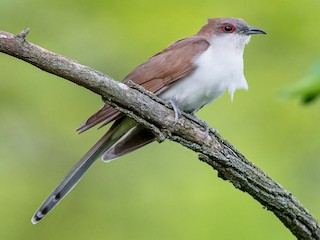
The Black-billed Cuckoo is a slender, medium-sized migratory bird known for its secretive nature and distinctive call. It is an insectivorous species, particularly noted for its ability to consume large numbers of caterpillars, including hairy species often avoided by other birds. Its cryptic coloration allows it to blend seamlessly into dense foliage.
Size & lifespan
- Length
- 28-31 cm (11-12 in)
- Wingspan
- 38-42 cm (15-16.5 in)
- Weight
- 40-65 g (1.4-2.3 oz)
- Lifespan
- Up to 5 years in the wild, though typical lifespan is likely shorter.
- Diet
- Primarily large insects, especially caterpillars (including tent caterpillars, gypsy moth larvae, and fall webworms), cicadas, katydids, grasshoppers, and beetles. Also consumes some spiders, snails, and small fruits/berries.
Physical characteristics
- Plumage
- Adults have uniform grayish-brown upperparts, including the crown, nape, back, rump, and upper tail. The underparts are clean white. The flight feathers (primaries) have a reddish-cinnamon wash visible in flight, especially on the inner webs. The undertail coverts are white. The tail is long and graduated, with six central rectrices tipped with white, which are less prominent than those of the Yellow-billed Cuckoo.
- Beak shape
- Slender, slightly downcurved bill. The upper mandible is entirely black or dark gray; the lower mandible is also entirely black or dark gray, distinguishing it from the Yellow-billed Cuckoo.
- Eye color
- Dark brown, surrounded by a distinct red orbital ring (red eye-ring).
- Leg color
- Bluish-gray to dark gray.
- Distinguishing features
- Completely dark bill, prominent red orbital ring, and subtle white tips on the undertail feathers. In flight, the cinnamon patch on the primaries is a key identifier.
- Juvenile appearance
- Juveniles resemble adults but often have a less distinct red eye-ring, and their plumage may be slightly duller brown with less pronounced white tail tips. The cinnamon wing patch may be less extensive or absent.
- Seasonal changes
- No significant seasonal plumage changes. Birds appear similar year-round, though fresh plumage after molt in late summer/early fall may appear slightly richer in color.
- Sexual dimorphism
- Males and females are visually similar in plumage and size.
How to identify
- 1
Bill Color
Entirely black or dark gray bill is the most distinguishing field mark, setting it apart from the Yellow-billed Cuckoo.
- 2
Eye-ring
A distinct, bright red orbital ring around the dark eye is characteristic of the adult Black-billed Cuckoo.
- 3
Tail Pattern
The undertail appears mostly dark with relatively small, often subtle white tips on the outermost tail feathers, unlike the large, bold white spots of the Yellow-billed Cuckoo.
- 4
Wing Patch
A reddish-cinnamon patch on the primaries is visible, especially in flight, though it is generally less extensive than in the Yellow-billed Cuckoo.
- 5
Vocalization
The rapid, accelerating 'cu-cu-cu...' song (often described as a wooden clapper) is a definitive auditory identifier.
Habitat & range
- Biomes
- Temperate forests, woodlands, shrublands, and riparian zones.
- Geographic range
- Breeds across southern Canada and the eastern United States. Winters primarily in South America, east of the Andes, from northern Colombia and Venezuela south to Peru, Bolivia, and northern Argentina.
- Elevation range
- Typically found from sea level up to around 1,500 meters (4,900 feet) in breeding grounds, and similar or slightly higher elevations in wintering areas.
- Preferred environments
- Prefers dense deciduous or mixed woodlands, thickets, successional habitats, forest edges, and areas with dense undergrowth, especially near water. Often found in areas experiencing insect outbreaks, such as those with abundant caterpillars.
Behavior
- Activity time
- Primarily diurnal, though nocturnal during migration.
- Feeding habits
- Forages secretively within dense foliage, often climbing and hopping through branches in search of insects. It can also hover briefly to snatch prey. It has a unique method of digesting hairy caterpillars by shedding its stomach lining, which is then regurgitated, along with the indigestible hairs.
- Social behavior
- Generally solitary, especially during the breeding season. Pairs form for nesting, but individuals are not typically seen in flocks. During migration, they may be loosely aggregated.
- Flight pattern
- Direct and swift, but often low and short-distance, particularly when moving between dense cover. When migrating, flight is strong and purposeful.
- Migration pattern
- Long-distance Neotropical migrant. Travels at night and is known for its relatively late spring migration and early fall migration compared to many other passerines.
- Territoriality
- Territorial during the breeding season, defending nesting and foraging areas with vocalizations and occasional chases.
Song & calls
- Song
- A distinctive, rapid, monotonous, and relatively low-pitched 'cu-cu-cu-cu-cu...' accelerating towards the end, often described as sounding like a wooden clapper. It lacks the 'k-k-k-kow-kow-kowp' song of the Yellow-billed Cuckoo.
- Call
- Other calls include a soft 'coo-coo-coo' and a rapid, clicking 'tuk-tuk-tuk'. Alarm calls are typically sharper and more abrupt.
- When they vocalize
- Most vocal during the breeding season, particularly in the morning and evening, but can call throughout the day. Often calls more frequently when there is an abundance of caterpillars.
Breeding & reproduction
- Breeding season
- Typically late May through August, often peaking during periods of high insect abundance, especially caterpillar outbreaks. May have a second brood if conditions are favorable.
- Nesting habits
- Nests are flimsy, shallow platforms of twigs, usually lined with dried leaves, bark, and sometimes caterpillar hairs. They are typically placed in dense thickets, shrubs, or small trees, 1 to 4 meters (3-13 ft) above the ground. Both parents participate in nest building.
- Clutch size
- Usually 2-3 eggs, but can range from 1-6. In years of extreme caterpillar outbreaks, clutch size can increase significantly, and facultative brood parasitism (laying eggs in other cuckoos' or other species' nests) may occur, though less commonly than in Yellow-billed Cuckoos.
- Egg description
- Pale greenish-blue, unmarked, oval. Smaller and darker blue than those of the Yellow-billed Cuckoo.
- Incubation period
- 9-11 days, remarkably short for its size. Both parents incubate.
- Fledging period
- 5-9 days after hatching. Young cuckoos develop very rapidly, often leaving the nest before they can fly well.
- Parental care
- Both parents feed the nestlings and fledglings. The rapid growth and fledging period are adaptations to capitalize on ephemeral insect outbreaks.
Where to find
Dense Thickets and Woodlands
Look in areas with dense deciduous trees, shrubby borders, and young forest growth, particularly near streams or wetlands.
Riparian Corridors
Areas along rivers and streams with abundant vegetation often provide ideal habitat.
Orchards and Old Fields
Can be found in overgrown orchards and fields transitioning back to forest, especially during caterpillar outbreaks.
Field tips
- Listen for their distinctive call. Black-billed Cuckoos are often heard before they are seen. Their unique, clappering song is the best way to locate them.
- Be patient and observant. They are secretive and move deliberately through dense foliage. Scan thickets slowly and look for subtle movements. They often perch motionless for extended periods.
- Target caterpillar outbreaks. During outbreaks of tent caterpillars or gypsy moths, cuckoos become more common and conspicuous as they exploit the abundant food source.
- Look for movement in dense canopy. Focus on the middle to upper canopy of dense trees and shrubs, especially where leaves are rustling unexpectedly.
Similar species
Yellow-billed Cuckoo
Coccyzus americanus
The Yellow-billed Cuckoo has a prominent yellow lower mandible (often with a dark tip), a less distinct eye-ring (sometimes yellow or pale), and large, bold white tips on the underside of its tail feathers. Its flight feathers show a more extensive reddish-cinnamon patch. Its song is slower, more rhythmic 'k-k-k-kow-kow-kowp' rather than the Black-billed's faster, clappering series.
Quick facts
- Diet Specialty:
- Known for eating hairy caterpillars, which most other birds avoid.
- Migration Speed:
- One of the latest spring migrants and earliest fall migrants among North American songbirds.
- Nesting Time:
- Adjusts its breeding season and clutch size to coincide with peak insect availability.
- Call Sound:
- Often described as sounding like a 'wooden clapper' due to its mechanical, accelerating rhythm.
- Secrecy:
- Highly cryptic and often difficult to observe, even when vocalizing.
Fun facts
- Black-billed Cuckoos have a remarkable ability to shed the lining of their stomachs to get rid of indigestible caterpillar hairs, allowing them to eat large quantities of these otherwise unpalatable insects.
- Their breeding success is directly tied to the cyclic outbreaks of their preferred caterpillar prey; in years with abundant food, they may lay more eggs and raise more broods.
- Unlike many European cuckoos, the Black-billed Cuckoo is primarily a nest builder and parent, though facultative brood parasitism (laying eggs in other nests) occasionally occurs, particularly during periods of high food abundance.
- They are considered one of the 'harbingers of rain' in some folklore, though this is likely due to increased vocalization preceding or during humid weather.
Scientific classification
- Kingdom
- Animalia
- Phylum
- Chordata
- Class
- Aves
- Order
- Cuculiformes
- Family
- Cuculidae
- Genus
- Coccyzus
- Species
- erythropthalmus
Explore the Black-billed Cuckoo
Identify birds anywhere
Free on iOS, Android, and Web. Photo & sound identification, full species database, and your personal life list.