
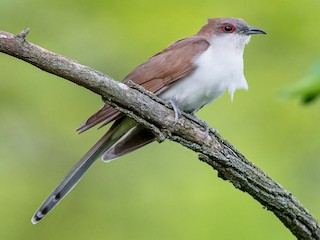
How to identify the Black-billed Cuckoo
Coccyzus erythropthalmus
Spotted a bird? Identify it instantly with the Birdby app
Open the appTo correctly identify the Black-billed Cuckoo (Coccyzus erythropthalmus), check each of these features. Birds can be tricky: habit, habitat, and call often confirm a sighting that a single photo cannot.
Size at a glance
- Length
- 28-31 cm (11-12 in)
- Wingspan
- 38-42 cm (15-16.5 in)
- Weight
- 40-65 g (1.4-2.3 oz)
Physical features to check
- 1
Plumage
Overall feather coloration and pattern.
Adults have uniform grayish-brown upperparts, including the crown, nape, back, rump, and upper tail. The underparts are clean white. The flight feathers (primaries) have a reddish-cinnamon wash visible in flight, especially on the inner webs. The undertail coverts are white. The tail is long and graduated, with six central rectrices tipped with white, which are less prominent than those of the Yellow-billed Cuckoo.
- 2
Beak shape
Shape and color of the bill: a key field mark.
Slender, slightly downcurved bill. The upper mandible is entirely black or dark gray; the lower mandible is also entirely black or dark gray, distinguishing it from the Yellow-billed Cuckoo.
- 3
Eye color
Iris color and any distinctive eye markings.
Dark brown, surrounded by a distinct red orbital ring (red eye-ring).
- 4
Leg color
Leg and foot color.
Bluish-gray to dark gray.
- 5
Distinguishing features
Standout features that separate this species.
Completely dark bill, prominent red orbital ring, and subtle white tips on the undertail feathers. In flight, the cinnamon patch on the primaries is a key identifier.
- 6
Juvenile appearance
How young birds differ from adults.
Juveniles resemble adults but often have a less distinct red eye-ring, and their plumage may be slightly duller brown with less pronounced white tail tips. The cinnamon wing patch may be less extensive or absent.
- 7
Seasonal changes
Plumage variation between breeding and non-breeding seasons.
No significant seasonal plumage changes. Birds appear similar year-round, though fresh plumage after molt in late summer/early fall may appear slightly richer in color.
- 8
Sexual dimorphism
How males and females differ.
Males and females are visually similar in plumage and size.
Key field marks
- Bill Color. Entirely black or dark gray bill is the most distinguishing field mark, setting it apart from the Yellow-billed Cuckoo.
- Eye-ring. A distinct, bright red orbital ring around the dark eye is characteristic of the adult Black-billed Cuckoo.
- Tail Pattern. The undertail appears mostly dark with relatively small, often subtle white tips on the outermost tail feathers, unlike the large, bold white spots of the Yellow-billed Cuckoo.
- Wing Patch. A reddish-cinnamon patch on the primaries is visible, especially in flight, though it is generally less extensive than in the Yellow-billed Cuckoo.
- Vocalization. The rapid, accelerating 'cu-cu-cu...' song (often described as a wooden clapper) is a definitive auditory identifier.
Explore the Black-billed Cuckoo
Identify birds anywhere
Free on iOS, Android, and Web. Photo & sound identification, full species database, and your personal life list.