
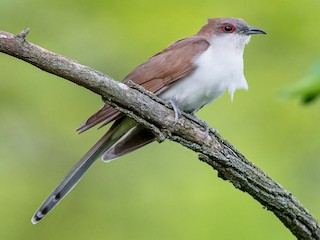
Where does the Black-billed Cuckoo live?
Coccyzus erythropthalmus
Spotted a bird? Identify it instantly with the Birdby app
Open the appThe Black-billed Cuckoo lives in specific habitats and regions. Knowing where, and when, to look improves your chances of a successful sighting.
Biomes
Temperate forests, woodlands, shrublands, and riparian zones.
Geographic range
Breeds across southern Canada and the eastern United States. Winters primarily in South America, east of the Andes, from northern Colombia and Venezuela south to Peru, Bolivia, and northern Argentina.
Preferred environments
Prefers dense deciduous or mixed woodlands, thickets, successional habitats, forest edges, and areas with dense undergrowth, especially near water. Often found in areas experiencing insect outbreaks, such as those with abundant caterpillars.
Elevation range
Typically found from sea level up to around 1,500 meters (4,900 feet) in breeding grounds, and similar or slightly higher elevations in wintering areas.
Where to look
Dense Thickets and Woodlands
Look in areas with dense deciduous trees, shrubby borders, and young forest growth, particularly near streams or wetlands.
Riparian Corridors
Areas along rivers and streams with abundant vegetation often provide ideal habitat.
Orchards and Old Fields
Can be found in overgrown orchards and fields transitioning back to forest, especially during caterpillar outbreaks.
Field tips
- Listen for their distinctive call. Black-billed Cuckoos are often heard before they are seen. Their unique, clappering song is the best way to locate them.
- Be patient and observant. They are secretive and move deliberately through dense foliage. Scan thickets slowly and look for subtle movements. They often perch motionless for extended periods.
- Target caterpillar outbreaks. During outbreaks of tent caterpillars or gypsy moths, cuckoos become more common and conspicuous as they exploit the abundant food source.
- Look for movement in dense canopy. Focus on the middle to upper canopy of dense trees and shrubs, especially where leaves are rustling unexpectedly.
Migration
Long-distance Neotropical migrant. Travels at night and is known for its relatively late spring migration and early fall migration compared to many other passerines.
Explore the Black-billed Cuckoo
Identify birds anywhere
Free on iOS, Android, and Web. Photo & sound identification, full species database, and your personal life list.