
Spotted a bird? Identify it instantly with the Birdby app
Open the appAbout
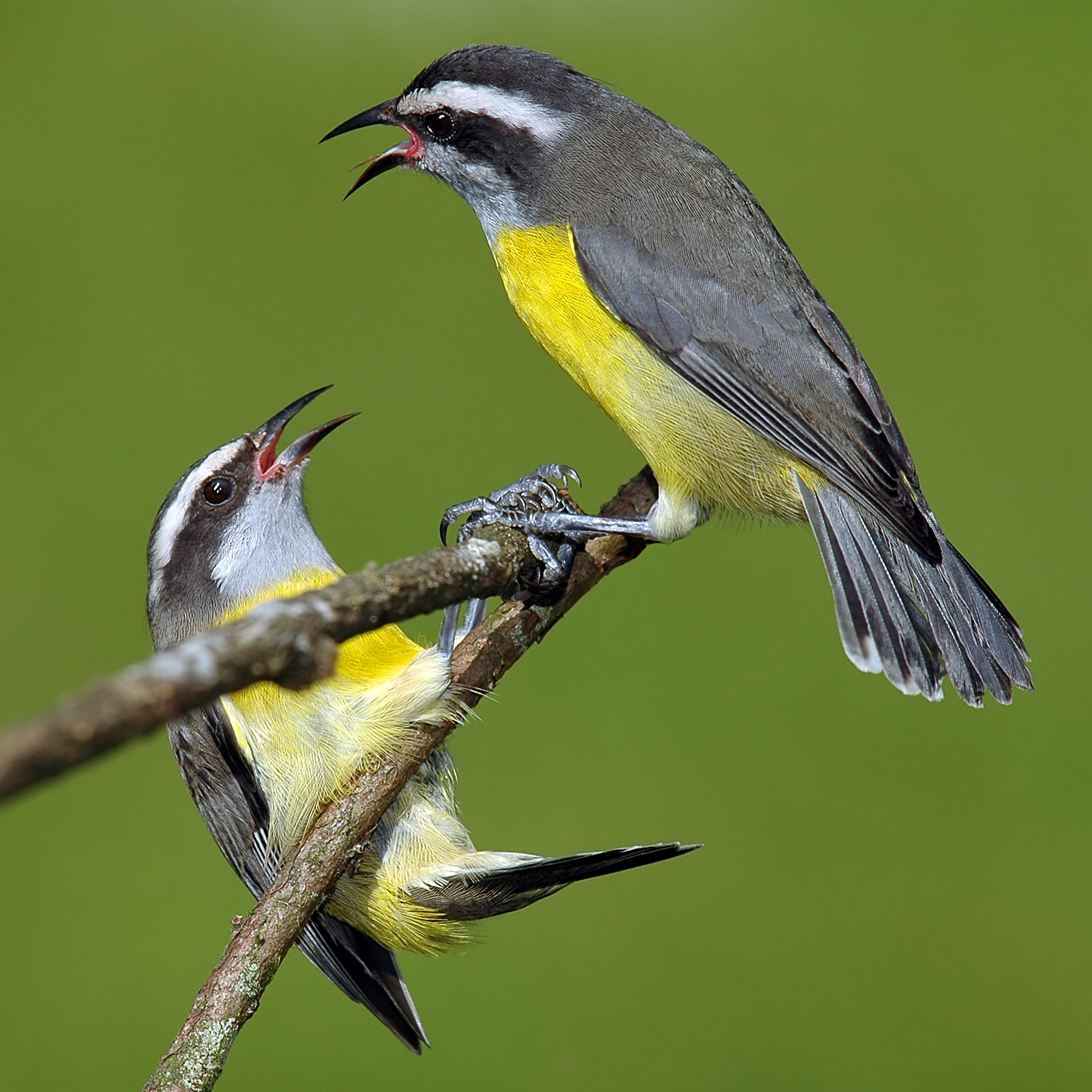
The Bananaquit (Coereba flaveola) is a small, active passerine bird, widely distributed throughout the Neotropics. It is known for its distinctive downcurved bill, bright yellow underparts, and a prominent white supercilium. Often seen foraging for nectar, fruits, and small insects, it is a common and adaptable species found in a variety of habitats, from gardens to forests.
Size & lifespan
- Length
- 10-12 cm (4-4.7 in)
- Wingspan
- 15-18 cm (5.9-7.1 in)
- Weight
- 6-13 g (0.21-0.46 oz)
- Lifespan
- Typically 2-5 years in the wild, though some individuals may live longer.
- Diet
- Nectarivore (primarily nectar), Frugivore (fruits), Insectivore (small insects and spiders).
Physical characteristics
- Plumage
- Adults typically have a dark grey to black upperparts, a prominent white supercilium (eyebrow stripe), and bright yellow underparts. The throat is dark grey to black, contrasting with the white malar stripe (mustache stripe) and the yellow belly. The rump is often yellow, and there is a small white patch at the base of the primary flight feathers, visible in flight. Plumage can vary significantly across subspecies.
- Beak shape
- Slender, sharply pointed, and distinctly downcurved, adapted for probing into flowers for nectar. Color is typically black.
- Eye color
- Dark brown.
- Leg color
- Dark grey to black.
- Distinguishing features
- The combination of a downcurved bill, bright yellow belly, dark upperparts, and a prominent white supercilium is diagnostic. The white spot at the base of the primaries is also a good field mark.
- Juvenile appearance
- Juveniles resemble adults but often have duller plumage, with less intense yellow on the underparts and a less distinct white supercilium. Their upperparts may be more brownish-grey than black.
- Seasonal changes
- No significant seasonal plumage changes. Plumage remains consistent year-round.
- Sexual dimorphism
- Males and females are generally monomorphic in plumage, appearing identical. There might be slight size differences, with males sometimes marginally larger, but this is not a reliable field mark.
How to identify
- 1
Plumage
Look for the striking contrast of dark grey/black upperparts with bright yellow underparts. The white supercilium (eyebrow stripe) is a key feature.
- 2
Bill Shape
Observe the slender, sharply pointed, and distinctly downcurved black bill, perfectly adapted for nectar feeding.
- 3
White Wing Patch
Note the small but often visible white patch at the base of the primary flight feathers, especially noticeable in flight.
- 4
Behavior
Watch for its active foraging style, often probing flowers or visiting hummingbird feeders. Its quick, darting movements are characteristic.
- 5
Vocalization
Listen for its high-pitched, buzzy, and variable song, or its sharp 'tsip' calls.
Habitat & range
- Biomes
- Tropical and subtropical moist broadleaf forests, dry broadleaf forests, savannas, shrublands, mangroves, gardens, parks, and urban areas.
- Geographic range
- Widespread throughout the Neotropics, from southern Mexico and the Caribbean islands south through Central America and much of South America, reaching northern Argentina and Uruguay. Absent from high Andean elevations and parts of the Amazon basin.
- Elevation range
- Sea level up to approximately 2,000 meters (6,500 feet), occasionally higher in some regions.
- Preferred environments
- Highly adaptable, preferring areas with abundant flowering plants. Commonly found in open woodlands, forest edges, clearings, plantations, suburban gardens, and urban parks. They thrive in disturbed habitats.
Behavior
- Activity time
- Diurnal, active during daylight hours.
- Feeding habits
- Primarily a nectarivore, using its specialized bill to probe flowers. It often pierces the base of flowers to access nectar, a behavior known as 'nectar robbing.' Also consumes small fruits, berries, and insects (especially small spiders, caterpillars, and flies), which are gleaned from foliage or caught in short aerial sallies. Will readily visit hummingbird feeders.
- Social behavior
- Generally solitary or found in pairs, especially during the breeding season. May join mixed-species foraging flocks outside of breeding. Can be quite tame and accustomed to human presence in gardens.
- Flight pattern
- Flight is typically direct, fast, and somewhat undulating over longer distances. Short flights between flowers or branches are quick and agile.
- Migration pattern
- Mostly resident throughout its range, with no significant migratory movements. Local movements may occur in response to flowering seasons or food availability.
- Territoriality
- Pairs defend a breeding territory, especially around the nest site. Individuals may also defend rich feeding patches, particularly flowering plants or feeders.
Song & calls
- Song
- The song is a high-pitched, thin, and often buzzy series of notes, highly variable across its extensive range and among individuals. It can be described as a rapid, jumbled warble, often incorporating trills and whistles, sometimes sounding like 'swee-swee-swee-tsee-tsee' or 'tsee-tsee-tsee-tsee-tsee'.
- Call
- Common calls include a sharp, high-pitched 'tsip' or 'seet' note, often given repeatedly. Alarm calls are typically more insistent and rapid versions of these notes.
- When they vocalize
- Vocalizes frequently throughout the day, especially during the breeding season, to defend territory and communicate with mates. Calls are given year-round.
Breeding & reproduction
- Breeding season
- Varies geographically, often coinciding with periods of abundant food resources (flowering and fruiting). Can breed year-round in some tropical areas, with peaks during rainy seasons. In temperate parts of its range, breeding is typically from spring to late summer.
- Nesting habits
- Builds a globular or domed nest with a side entrance, often suspended from a branch or placed in a dense shrub or tree. Nests are typically constructed from fine plant fibers, grasses, rootlets, leaves, and spider silk, often lined with softer materials. Both sexes participate in nest building.
- Clutch size
- Usually 2-3 eggs.
- Egg description
- Typically 2-3 eggs, white or creamy white, often with fine reddish-brown or purplish spots and speckles, particularly concentrated at the larger end.
- Incubation period
- Approximately 12-14 days, primarily by the female.
- Fledging period
- Chicks fledge (leave the nest) around 17-19 days after hatching. Both parents feed the young.
- Parental care
- Both male and female participate in feeding the nestlings and fledglings. The female primarily incubates, but the male may bring food to her on the nest.
Where to find
Gardens and Parks
Very common in suburban and urban gardens, especially those with flowering plants or hummingbird feeders.
Forest Edges and Clearings
Frequently found at the edges of tropical and subtropical forests, in clearings, and along trails.
Plantations
Abundant in coffee, banana, and other agricultural plantations where flowering plants are present.
Mangroves
Can be found in coastal mangrove habitats, feeding on nectar from mangrove flowers.
Field tips
- Look for movement in flowering plants. Bananaquits are highly active. Scan flowering shrubs and trees for their quick movements as they probe for nectar.
- Check hummingbird feeders. They are frequent visitors to hummingbird feeders and will often chase away smaller hummingbirds to access the sugar water.
- Listen for their calls. Their distinctive high-pitched calls and buzzy songs can often lead you to their location before you see them.
- Observe their feeding technique. Watch for their 'nectar robbing' behavior, where they pierce the base of flowers with their bill to get nectar without pollinating.
Similar species
Orangequit
Euneornis campestris
Found only in Jamaica. Males are entirely dark blue-black with a bright orange throat patch. Females are duller. Bananaquits have yellow underparts and a white supercilium.
Yellow-faced Grassquit
Tiaris olivaceus
Smaller, with a conical bill. Males have a black face with a yellow supercilium and malar stripe, and olive-green upperparts. Females are duller. Lacks the Bananaquit's downcurved bill and bright yellow belly.
Black-faced Grassquit
Tiaris bicolor
Smaller, with a conical bill. Males have a black head and breast, olive-green upperparts, and greyish underparts. Females are duller. Lacks the Bananaquit's yellow underparts and white supercilium.
Quick facts
- Diet:
- Nectar, fruits, insects
- Habitat:
- Gardens, forests, urban areas
- Status:
- Least Concern
- Distinguishing Mark:
- White supercilium, yellow belly, downcurved bill
- Vocalization:
- High-pitched, buzzy song; sharp 'tsip' calls
Fun facts
- The Bananaquit is the national bird of the U.S. Virgin Islands.
- Despite its small size, it is known for its aggressive behavior towards other birds, especially hummingbirds, when defending food sources like feeders or flowering plants.
- It is one of the most widespread and common passerine birds in the Neotropics, showcasing remarkable adaptability to various habitats, including highly urbanized environments.
- The genus name 'Coereba' is derived from a Tupi word for a small, dark bird, while 'flaveola' is Latin for 'yellowish', referring to its prominent yellow plumage.
- There are numerous subspecies of Bananaquit (over 40 recognized), which exhibit considerable variation in plumage, particularly in the extent of black on the throat and the intensity of yellow on the underparts, leading to some taxonomic debate in the past.
Scientific classification
- Kingdom
- Animalia
- Phylum
- Chordata
- Class
- Aves
- Order
- Passeriformes
- Family
- Coerebidae
- Genus
- Coereba
- Species
- Coereba flaveola
Explore the Bananaquit
Identify birds anywhere
Free on iOS, Android, and Web. Photo & sound identification, full species database, and your personal life list.