
How to identify the Bananaquit
Coereba flaveola
Spotted a bird? Identify it instantly with the Birdby app
Open the appTo correctly identify the Bananaquit (Coereba flaveola), check each of these features. Birds can be tricky: habit, habitat, and call often confirm a sighting that a single photo cannot.
Size at a glance
- Length
- 10-12 cm (4-4.7 in)
- Wingspan
- 15-18 cm (5.9-7.1 in)
- Weight
- 6-13 g (0.21-0.46 oz)
Physical features to check
- 1
Plumage
Overall feather coloration and pattern.
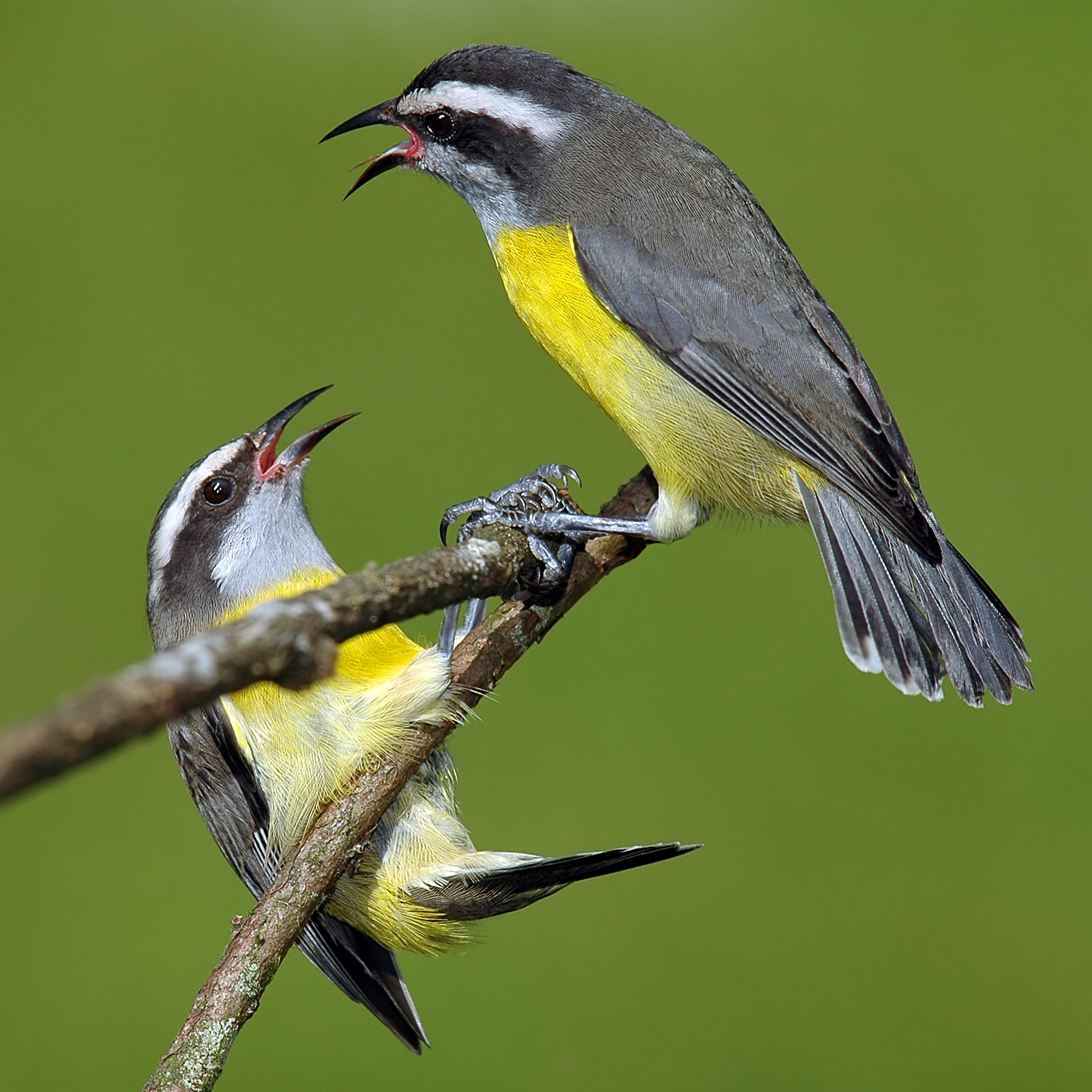
Adults typically have a dark grey to black upperparts, a prominent white supercilium (eyebrow stripe), and bright yellow underparts. The throat is dark grey to black, contrasting with the white malar stripe (mustache stripe) and the yellow belly. The rump is often yellow, and there is a small white patch at the base of the primary flight feathers, visible in flight. Plumage can vary significantly across subspecies.
- 2
Beak shape
Shape and color of the bill: a key field mark.
Slender, sharply pointed, and distinctly downcurved, adapted for probing into flowers for nectar. Color is typically black.
- 3
Eye color
Iris color and any distinctive eye markings.
Dark brown.
- 4
Leg color
Leg and foot color.
Dark grey to black.
- 5
Distinguishing features
Standout features that separate this species.
The combination of a downcurved bill, bright yellow belly, dark upperparts, and a prominent white supercilium is diagnostic. The white spot at the base of the primaries is also a good field mark.
- 6
Juvenile appearance
How young birds differ from adults.
Juveniles resemble adults but often have duller plumage, with less intense yellow on the underparts and a less distinct white supercilium. Their upperparts may be more brownish-grey than black.
- 7
Seasonal changes
Plumage variation between breeding and non-breeding seasons.
No significant seasonal plumage changes. Plumage remains consistent year-round.
- 8
Sexual dimorphism
How males and females differ.
Males and females are generally monomorphic in plumage, appearing identical. There might be slight size differences, with males sometimes marginally larger, but this is not a reliable field mark.
Key field marks
- Plumage. Look for the striking contrast of dark grey/black upperparts with bright yellow underparts. The white supercilium (eyebrow stripe) is a key feature.
- Bill Shape. Observe the slender, sharply pointed, and distinctly downcurved black bill, perfectly adapted for nectar feeding.
- White Wing Patch. Note the small but often visible white patch at the base of the primary flight feathers, especially noticeable in flight.
- Behavior. Watch for its active foraging style, often probing flowers or visiting hummingbird feeders. Its quick, darting movements are characteristic.
- Vocalization. Listen for its high-pitched, buzzy, and variable song, or its sharp 'tsip' calls.
Explore the Bananaquit
Identify birds anywhere
Free on iOS, Android, and Web. Photo & sound identification, full species database, and your personal life list.