
Spotted a bird? Identify it instantly with the Birdby app
Open the appAbout
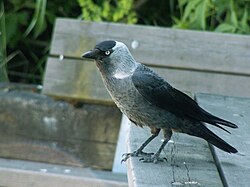
The Western Jackdaw is a small, intelligent, and highly social passerine bird in the crow family. It is characterized by its glossy black plumage, grey nape, and pale eyes. Known for its adaptability, it thrives in a variety of habitats, often in close proximity to human settlements.
Size & lifespan
- Length
- 33-39 cm
- Wingspan
- 67-74 cm
- Weight
- 175-280 g
- Lifespan
- Up to 20 years in the wild, typically 5-10 years
- Diet
- Omnivore
Physical characteristics
- Plumage
- Adults have glossy black plumage over most of the body, with a distinctive silvery-grey nape and sides of the neck. The crown is black, and the underparts are sooty black. The wings and tail are black with a bluish-purple sheen in good light.
- Beak shape
- Short, stout, and conical black beak, well-suited for a varied diet.
- Eye color
- Striking pale grey or whitish-blue iris, contrasting sharply with the dark plumage. This is a key identification feature.
- Leg color
- Black
- Distinguishing features
- The combination of the grey nape, pale eyes, and relatively small size (for a corvid) are the most distinctive features. They have a jaunty, upright posture.
- Juvenile appearance
- Juveniles are duller overall, with less glossy black plumage and a less distinct, often brownish-grey nape. Their eyes are typically dark brown, gradually lightening to pale grey/white over their first year.
- Seasonal changes
- No significant seasonal plumage changes. Plumage may appear duller when worn before molting.
- Sexual dimorphism
- Males and females are generally monomorphic in plumage, appearing identical. Males may be slightly larger on average, but this is not discernible in the field.
How to identify
- 1
Size and Shape
Relatively small for a corvid, with a compact body and a short, stout bill. Often appears quite upright.
- 2
Plumage
Look for the glossy black body contrasting with the distinctive silvery-grey nape and sides of the neck. This grey patch is the most reliable field mark.
- 3
Eye Color
The pale, almost white or light blue iris is a striking feature and highly diagnostic, especially in adults. Juveniles have dark eyes.
- 4
Vocalization
Listen for the characteristic sharp, metallic 'chak' or 'tchack' call, which is distinct from other corvids.
- 5
Behavior
Often seen in flocks, especially outside the breeding season, foraging on the ground or perched on buildings and trees. Their social nature is a good clue.
Habitat & range
- Biomes
- Temperate forests, woodlands, open country with scattered trees, cliffs, urban and suburban areas, agricultural land.
- Geographic range
- Widespread across Europe, western Asia, and North Africa. Its range extends from the British Isles and Scandinavia in the west, across central and eastern Europe, into Russia, and parts of the Middle East and North Africa.
- Elevation range
- Sea level up to 2,000 meters, occasionally higher in mountainous regions.
- Preferred environments
- Highly adaptable, preferring areas with a mix of open ground for foraging and structures (trees, cliffs, buildings) for nesting and roosting. Commonly found in towns, villages, parks, farmland, and ruins. In the region of Avanos, Nevşehir, Türkiye, they would be found in and around human settlements, agricultural areas, and the characteristic rock formations and valleys.
Behavior
- Activity time
- Diurnal
- Feeding habits
- Highly opportunistic omnivores. Diet includes insects, spiders, snails, worms, seeds, fruits, berries, eggs and nestlings of other birds, carrion, and human refuse. They forage on the ground, in trees, and will readily visit bird feeders. They are known to cache food.
- Social behavior
- Extremely social birds, often forming large flocks, especially outside the breeding season. They are monogamous and form strong pair bonds, often for life. Pairs remain together within larger flocks. They are known for their complex social structures and intelligence.
- Flight pattern
- Direct and strong flight with rapid wing beats. Often seen soaring or gliding on thermals. In flocks, their flight can appear synchronized and agile.
- Migration pattern
- Mostly resident throughout much of its range, particularly in western and southern Europe. Northern and eastern populations are partially migratory, moving south and west for the winter. In Türkiye, including the Nevşehir region, Western Jackdaws are generally resident, though local movements and some influx of wintering birds from further north may occur.
- Territoriality
- While nesting pairs defend a small area around their nest site, they are not highly territorial in the broader sense, often nesting colonially and foraging in communal areas.
Song & calls
- Song
- Jackdaws do not have a complex song. Their vocalizations are primarily calls.
- Call
- The most characteristic call is a sharp, metallic 'chak' or 'tchack', often repeated. They also produce a variety of other calls, including softer 'chup' notes, harsh 'kraa' calls, and chattering sounds, especially during social interactions or when alarmed. Their calls are distinct from other corvids, being higher-pitched and less guttural than crows or rooks.
- When they vocalize
- Vocalize year-round, but particularly active and noisy during the breeding season and when forming large roosting flocks.
Breeding & reproduction
- Breeding season
- Typically April to July, varying slightly with latitude and local conditions. In Türkiye, breeding generally starts in April.
- Nesting habits
- Nests are built in cavities: tree holes, rock crevices, old buildings, chimneys, and even artificial nest boxes. They are colonial nesters, often forming dense colonies. The nest is a bulky structure of sticks, lined with wool, hair, rags, and other soft materials.
- Clutch size
- 4-6 eggs, occasionally 3-8.
- Egg description
- Eggs are pale blue or greenish-blue, speckled and blotched with dark brown or black, particularly at the broader end. Typically oval-shaped.
- Incubation period
- 17-18 days, primarily by the female.
- Fledging period
- 28-35 days after hatching. Young remain dependent on parents for some time after fledging.
- Parental care
- Both parents participate in feeding and caring for the young. The male often feeds the female during incubation.
Where to find
Urban and Suburban Areas
Parks, gardens, city centers, and villages are prime locations due to abundant food sources and nesting sites in buildings and trees. In Avanos, look around the town itself.
Agricultural Land
Fields and farmlands, especially those with scattered trees or nearby human habitation, provide excellent foraging opportunities. The agricultural plains around Avanos would be suitable.
Rocky Outcrops and Cliffs
Natural rock formations, such as those characteristic of Cappadocia, offer nesting crevices. The fairy chimneys and valleys near Avanos are ideal.
Historical Sites and Ruins
Old castles, churches, and other ruins provide numerous nesting cavities and roosting spots. The historical sites in and around Nevşehir province are excellent places to find them.
Field tips
- Look for Flocks. Western Jackdaws are highly social. If you see one, there are likely more nearby. Look for groups foraging on the ground or flying together.
- Listen for Calls. Their distinctive 'chak' call is often heard before the bird is seen. Learn this call to aid in detection.
- Check Roosts. In the evenings, large numbers of Jackdaws often gather at communal roosts in tall trees or on buildings. These can be very noisy and active.
- Observe Behavior. Watch for their intelligent and curious behavior. They are often seen investigating objects or interacting with each other.
- Focus on Nape and Eyes. Once you spot a black corvid, specifically look for the grey nape and pale eyes to confirm it's a Jackdaw, especially if other corvids are present.
Similar species
Rook
Corvus frugilegus
Rooks are larger, have a shaggy appearance, and adults have a distinctive bare, greyish-white patch at the base of the bill. Their eyes are dark, not pale. Rooks have a more pointed head shape and a different call ('kaah').
Carrion Crow
Corvus corone
Carrion Crows are significantly larger and entirely black with no grey nape. Their eyes are dark, and their bill is heavier. Their call is a harsh 'kraa-kraa-kraa'.
Hooded Crow
Corvus cornix
Hooded Crows are larger and easily distinguished by their bicolored plumage: grey body with black head, wings, and tail. Their eyes are dark.
Quick facts
- Social Structure:
- Highly social, often in large flocks
- Diet Type:
- Omnivorous and opportunistic
- Key ID Feature:
- Grey nape and pale eyes
- Nesting Sites:
- Cavities (tree holes, buildings, cliffs)
- Intelligence:
- Known for problem-solving and tool use
Fun facts
- Western Jackdaws are one of the few bird species known to recognize individual human faces and remember them over time, especially if they have had negative interactions.
- They form lifelong pair bonds and the pair often stays together within the larger flock, even during foraging and roosting.
- Jackdaws have been observed using tools, such as dropping stones to break open eggs or using sticks to extract insects.
- Their pale eyes are thought to play a role in their complex social communication, as they are highly visible against the dark plumage.
- They are known to 'play' by dropping objects and catching them in mid-air, or by sliding down snowy roofs.
Scientific classification
- Kingdom
- Animalia
- Phylum
- Chordata
- Class
- Aves
- Order
- Passeriformes
- Family
- Corvidae
- Genus
- Coloeus
- Species
- Coloeus monedula
Explore the Western Jackdaw
Identify birds anywhere
Free on iOS, Android, and Web. Photo & sound identification, full species database, and your personal life list.