
How to identify the Western Jackdaw
Coloeus monedula
Spotted a bird? Identify it instantly with the Birdby app
Open the appTo correctly identify the Western Jackdaw (Coloeus monedula), check each of these features. Birds can be tricky: habit, habitat, and call often confirm a sighting that a single photo cannot.
Size at a glance
- Length
- 33-39 cm
- Wingspan
- 67-74 cm
- Weight
- 175-280 g
Physical features to check
- 1
Plumage
Overall feather coloration and pattern.
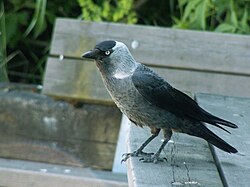
Adults have glossy black plumage over most of the body, with a distinctive silvery-grey nape and sides of the neck. The crown is black, and the underparts are sooty black. The wings and tail are black with a bluish-purple sheen in good light.
- 2
Beak shape
Shape and color of the bill: a key field mark.
Short, stout, and conical black beak, well-suited for a varied diet.
- 3
Eye color
Iris color and any distinctive eye markings.
Striking pale grey or whitish-blue iris, contrasting sharply with the dark plumage. This is a key identification feature.
- 4
Leg color
Leg and foot color.
Black
- 5
Distinguishing features
Standout features that separate this species.
The combination of the grey nape, pale eyes, and relatively small size (for a corvid) are the most distinctive features. They have a jaunty, upright posture.
- 6
Juvenile appearance
How young birds differ from adults.
Juveniles are duller overall, with less glossy black plumage and a less distinct, often brownish-grey nape. Their eyes are typically dark brown, gradually lightening to pale grey/white over their first year.
- 7
Seasonal changes
Plumage variation between breeding and non-breeding seasons.
No significant seasonal plumage changes. Plumage may appear duller when worn before molting.
- 8
Sexual dimorphism
How males and females differ.
Males and females are generally monomorphic in plumage, appearing identical. Males may be slightly larger on average, but this is not discernible in the field.
Key field marks
- Size and Shape. Relatively small for a corvid, with a compact body and a short, stout bill. Often appears quite upright.
- Plumage. Look for the glossy black body contrasting with the distinctive silvery-grey nape and sides of the neck. This grey patch is the most reliable field mark.
- Eye Color. The pale, almost white or light blue iris is a striking feature and highly diagnostic, especially in adults. Juveniles have dark eyes.
- Vocalization. Listen for the characteristic sharp, metallic 'chak' or 'tchack' call, which is distinct from other corvids.
- Behavior. Often seen in flocks, especially outside the breeding season, foraging on the ground or perched on buildings and trees. Their social nature is a good clue.
Explore the Western Jackdaw
Identify birds anywhere
Free on iOS, Android, and Web. Photo & sound identification, full species database, and your personal life list.