
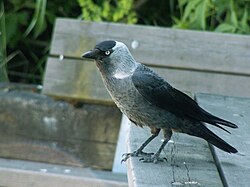
Where does the Western Jackdaw live?
Coloeus monedula
Spotted a bird? Identify it instantly with the Birdby app
Open the appThe Western Jackdaw lives in specific habitats and regions. Knowing where, and when, to look improves your chances of a successful sighting.
Biomes
Temperate forests, woodlands, open country with scattered trees, cliffs, urban and suburban areas, agricultural land.
Geographic range
Widespread across Europe, western Asia, and North Africa. Its range extends from the British Isles and Scandinavia in the west, across central and eastern Europe, into Russia, and parts of the Middle East and North Africa.
Preferred environments
Highly adaptable, preferring areas with a mix of open ground for foraging and structures (trees, cliffs, buildings) for nesting and roosting. Commonly found in towns, villages, parks, farmland, and ruins. In the region of Avanos, Nevşehir, Türkiye, they would be found in and around human settlements, agricultural areas, and the characteristic rock formations and valleys.
Elevation range
Sea level up to 2,000 meters, occasionally higher in mountainous regions.
Where to look
Urban and Suburban Areas
Parks, gardens, city centers, and villages are prime locations due to abundant food sources and nesting sites in buildings and trees. In Avanos, look around the town itself.
Agricultural Land
Fields and farmlands, especially those with scattered trees or nearby human habitation, provide excellent foraging opportunities. The agricultural plains around Avanos would be suitable.
Rocky Outcrops and Cliffs
Natural rock formations, such as those characteristic of Cappadocia, offer nesting crevices. The fairy chimneys and valleys near Avanos are ideal.
Historical Sites and Ruins
Old castles, churches, and other ruins provide numerous nesting cavities and roosting spots. The historical sites in and around Nevşehir province are excellent places to find them.
Field tips
- Look for Flocks. Western Jackdaws are highly social. If you see one, there are likely more nearby. Look for groups foraging on the ground or flying together.
- Listen for Calls. Their distinctive 'chak' call is often heard before the bird is seen. Learn this call to aid in detection.
- Check Roosts. In the evenings, large numbers of Jackdaws often gather at communal roosts in tall trees or on buildings. These can be very noisy and active.
- Observe Behavior. Watch for their intelligent and curious behavior. They are often seen investigating objects or interacting with each other.
- Focus on Nape and Eyes. Once you spot a black corvid, specifically look for the grey nape and pale eyes to confirm it's a Jackdaw, especially if other corvids are present.
Migration
Mostly resident throughout much of its range, particularly in western and southern Europe. Northern and eastern populations are partially migratory, moving south and west for the winter. In Türkiye, including the Nevşehir region, Western Jackdaws are generally resident, though local movements and some influx of wintering birds from further north may occur.
Explore the Western Jackdaw
Identify birds anywhere
Free on iOS, Android, and Web. Photo & sound identification, full species database, and your personal life list.