
Spotted a bird? Identify it instantly with the Birdby app
Open the appAbout
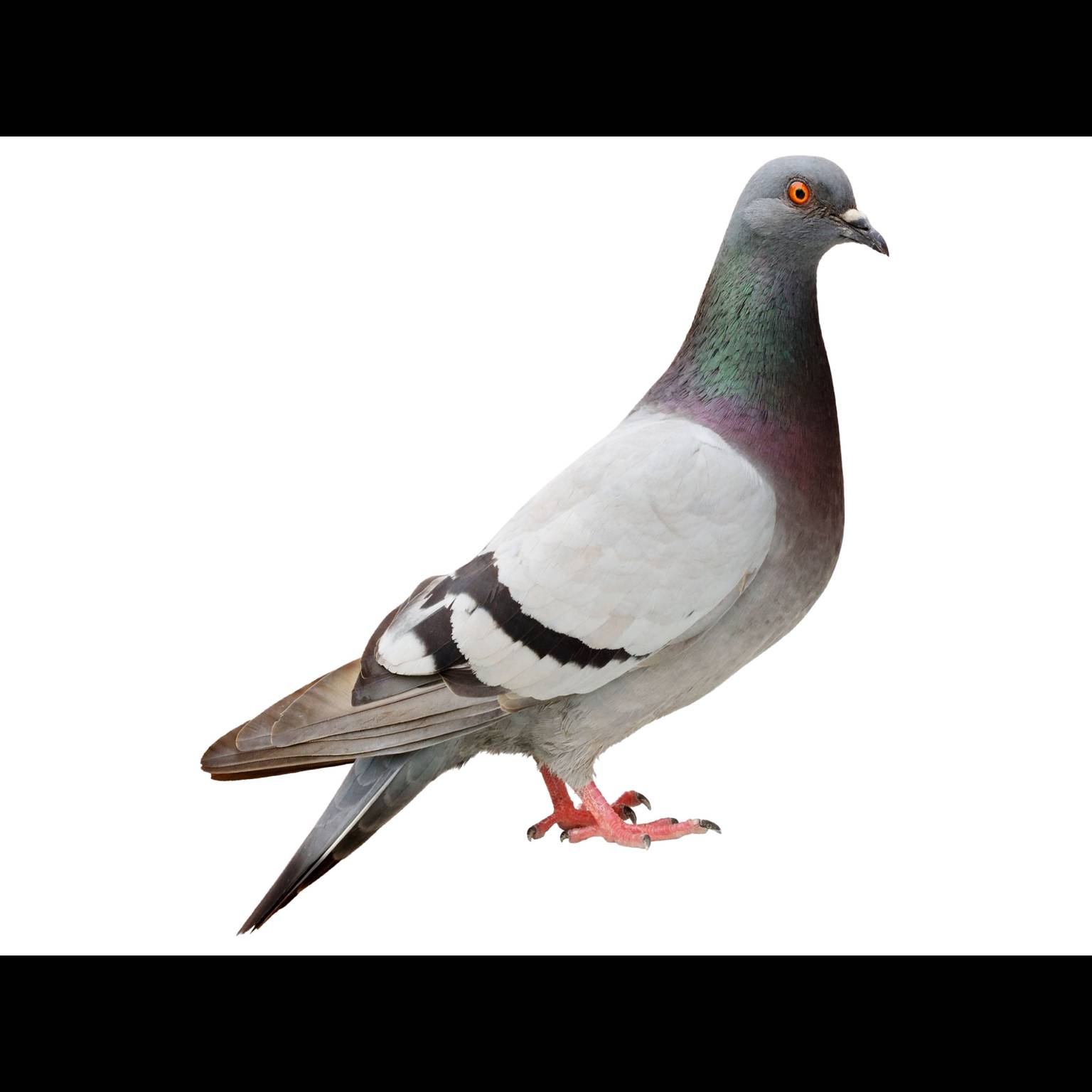
The Rock Pigeon, also known as the Feral Pigeon, is a widespread bird species found globally, primarily in urban and suburban environments. It is the ancestor of all domestic pigeons and is characterized by its stout body, short neck, and small head. While the wild form is typically grey with iridescent neck feathers and two black wing bars, feral populations exhibit a wide range of plumage variations due to interbreeding with domesticated strains.
Size & lifespan
- Length
- 30-35 cm (12-14 in)
- Wingspan
- 62-72 cm (24-28 in)
- Weight
- 238-380 g (8.4-13.4 oz)
- Lifespan
- 3-5 years in the wild, up to 15 years in captivity
- Diet
- Granivore (primarily seeds and grains), but highly opportunistic, consuming human food scraps, insects, and other invertebrates.
Physical characteristics
- Plumage
- The ancestral wild type (often seen in feral populations) is slate-grey with a whitish rump, two distinct black bars on the secondary wing feathers, and a broad black band on the tail. The neck and breast feathers are iridescent, displaying green and purplish hues. Feral populations show immense variation, including solid black, white, brown, pied (mixed colors), and various patterns of grey, often lacking the distinct wing bars or rump patch.
- Beak shape
- Slender, dark grey to black bill with a prominent white cere (fleshy patch) at the base.
- Eye color
- Orange to reddish-orange, with a pale inner ring.
- Leg color
- Reddish-pink to purplish-red.
- Distinguishing features
- The classic wild-type plumage with two black wing bars, white rump, and iridescent neck. The characteristic head-bobbing walk and strong, direct flight. The prominent white cere at the base of the bill is also a good field mark.
- Juvenile appearance
- Juveniles are duller than adults, with less iridescence on the neck and breast. Their plumage is generally softer and looser, and their eyes may be a duller brown or grey before developing the adult orange color.
- Seasonal changes
- No significant seasonal plumage changes. Plumage remains consistent year-round, though feather wear can make colors appear duller over time.
- Sexual dimorphism
- Minimal. Males tend to be slightly larger and have more pronounced iridescence on the neck and breast, especially during courtship displays. Females may appear slightly duller.
How to identify
- 1
Plumage (Wild Type)
Look for the classic slate-grey body, iridescent green/purple neck, two prominent black wing bars, and a white rump patch. This is the ancestral form, though many feral birds are highly variable.
- 2
Head and Bill
Note the small head, dark bill, and the distinctive white, fleshy cere at the base of the bill.
- 3
Eyes and Legs
Orange to reddish-orange eyes with a pale inner ring, and reddish-pink legs and feet.
- 4
Behavior
Observe their characteristic head-bobbing walk while foraging on the ground. Their flight is strong and direct, often with a clatter of wings upon takeoff.
- 5
Vocalization
Listen for the soft, guttural 'coo-roo-coo-coo' call, especially from males during courtship.
- 6
Habitat
Most commonly encountered in urban and suburban environments, around human structures.
Habitat & range
- Biomes
- Urban, suburban, agricultural, coastal cliffs, rocky outcrops.
- Geographic range
- Cosmopolitan. Native to Europe, North Africa, and Asia, but introduced and established worldwide, particularly in urban areas.
- Elevation range
- Sea level up to 4,000 meters (13,000 feet) in some mountainous regions, though most common at lower elevations.
- Preferred environments
- Human-modified landscapes, including cities, towns, farms, and industrial areas. They prefer structures with ledges, eaves, and sheltered spaces for nesting and roosting, mimicking their ancestral cliff-dwelling habits.
Behavior
- Activity time
- Diurnal. Active during daylight hours, roosting in sheltered locations at night.
- Feeding habits
- Primarily ground feeders, foraging for seeds, grains, and discarded human food. They often feed in flocks, pecking rapidly. They are highly adaptable and will consume almost anything edible found in their environment. They require access to water for drinking.
- Social behavior
- Highly social, typically found in flocks of varying sizes, especially when foraging or roosting. They form monogamous pairs during the breeding season but often remain in close proximity to other pairs.
- Flight pattern
- Strong, direct, and rapid flight with powerful wing beats. They can achieve considerable speed. When startled, they take off with a characteristic loud clatter of wings.
- Migration pattern
- Non-migratory; resident throughout their range. They may make local movements in search of food or suitable roosting/nesting sites.
- Territoriality
- Males defend a small nesting territory around the nest site, primarily through cooing displays and occasional aggressive pecking or wing-slapping towards intruders. Foraging areas are generally not defended.
Song & calls
- Song
- The 'song' is a soft, guttural cooing sound, often described as 'coo-roo-coo-coo' or 'doo-doo-doo'. This is primarily used by males during courtship displays to attract mates and establish territory.
- Call
- A variety of cooing and grunting calls. A common alarm call is a sharp 'hoo-hoo-hoo' when startled. Nestlings emit soft peeping sounds.
- When they vocalize
- Vocalize most frequently during the breeding season, particularly in the mornings and evenings. Cooing can be heard year-round, especially in urban environments.
Breeding & reproduction
- Breeding season
- Year-round in many urban areas, with peaks in spring and summer (March-October in temperate regions).
- Nesting habits
- Nests are typically flimsy platforms of twigs, grass, and debris, often lined with finer materials. They are built on ledges, in crevices, under bridges, in abandoned buildings, or on window sills, mimicking cliff ledges. Both parents participate in nest building.
- Clutch size
- 1-3 eggs, most commonly 2.
- Egg description
- Typically 2 eggs per clutch, pure white, elliptical to oval in shape. Approximately 39 x 29 mm.
- Incubation period
- 17-19 days, incubated by both parents.
- Fledging period
- 25-32 days. Young are fed 'pigeon milk' (crop milk) by both parents initially, transitioning to regurgitated seeds.
- Parental care
- Both parents share incubation duties and care for the young. They feed the squabs 'crop milk' for the first few days, gradually introducing solid food. Young are dependent on parents for several weeks after fledging.
Where to find
Urban Centers
Parks, city squares, building ledges, bridges, and any area with human activity and food sources.
Suburban Areas
Backyards, shopping centers, farm buildings, and residential areas.
Agricultural Lands
Barns, silos, and fields where grains are grown or stored.
Coastal Cliffs/Rocky Outcrops
In their native range and some introduced areas, they can still be found nesting on natural cliff faces.
Field tips
- Look for flocks. Rock Pigeons are highly social and are almost always found in groups, especially when feeding or roosting.
- Observe feeding behavior. They are ground feeders, constantly pecking for seeds and scraps. Watch for their characteristic head-bobbing.
- Listen for cooing. Their distinctive cooing calls are a common sound in urban environments and can help locate them.
- Check ledges and eaves. These are preferred nesting and roosting sites, mimicking their ancestral cliff habitats.
- Be aware of plumage variation. Don't be confused by the wide array of colors and patterns in feral populations; focus on overall shape, behavior, and the white cere.
Similar species
Eurasian Collared-Dove
Streptopelia decaocto
Smaller and more slender than a Rock Pigeon, with a longer tail. Plumage is uniformly pale grey-buff with a distinctive black half-collar on the nape. Lacks the iridescent neck and black wing bars of the wild-type Rock Pigeon. Its call is a distinctive three-note 'coo-COO-coo'.
Band-tailed Pigeon
Patagioenas fasciata
Larger and stockier, found in forested areas of western North America. Has a distinctive white band on the nape and a pale band across the tail. Lacks the iridescent neck and black wing bars of the Rock Pigeon. Its call is a deep, owl-like 'hoo-hoo-hoo'.
Stock Dove
Columba oenas
Similar in size but lacks the white rump and distinct black wing bars of the wild-type Rock Pigeon. Its plumage is a more uniform blue-grey, and it has black primary flight feathers. Found in more rural, wooded habitats in Europe and Asia.
Quick facts
- Ancestral Species:
- All domestic pigeons originated from the Rock Pigeon.
- Crop Milk:
- Both parents produce 'pigeon milk' to feed their young.
- Navigation:
- Known for their exceptional homing abilities.
- Global Distribution:
- One of the most widespread bird species globally.
- Adaptability:
- Highly adaptable to human-modified environments.
Fun facts
- Rock Pigeons have been domesticated for thousands of years, used for food, sport, and carrying messages (homing pigeons).
- They can see in color and are believed to be able to detect polarized light, which aids in navigation.
- Despite their commonality, the wild ancestral form of the Rock Pigeon is actually quite rare and restricted to specific coastal cliff habitats.
- Pigeons are one of the few bird species that drink by sucking water, rather than tilting their heads back to swallow.
- Their ability to thrive in urban environments is a testament to their intelligence and adaptability, often outcompeting native species in these niches.
Scientific classification
- Kingdom
- Animalia
- Phylum
- Chordata
- Class
- Aves
- Order
- Columbiformes
- Family
- Columbidae
- Genus
- Columba
- Species
- Columba livia
Explore the Rock Pigeon
Identify birds anywhere
Free on iOS, Android, and Web. Photo & sound identification, full species database, and your personal life list.