
Spotted a bird? Identify it instantly with the Birdby app
Open the appAbout
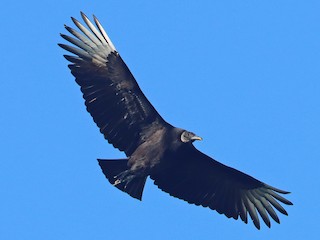
The Black Vulture is a large New World vulture, characterized by its entirely black plumage, featherless gray-black head, and short tail. It is a scavenger, primarily feeding on carrion, and is often seen soaring in thermals or perched in groups. Unlike the Turkey Vulture, it relies more on sight than smell to locate food.
Size & lifespan
- Length
- 56-74 cm (22-29 in)
- Wingspan
- 133-160 cm (52-63 in)
- Weight
- 1.6-3.0 kg (3.5-6.6 lbs)
- Lifespan
- Up to 25 years in the wild, over 30 years in captivity
- Diet
- Carnivore (primarily carrion, but also preys on small, vulnerable animals and consumes eggs and young birds)
Physical characteristics
- Plumage
- Adults are entirely black, with a glossy sheen on the upperparts. The underside of the primary flight feathers has distinctive white patches, visible in flight. Juveniles are similar but may have a slightly paler head.
- Beak shape
- Hooked, relatively short and stout, dark gray to black.
- Eye color
- Dark brown.
- Leg color
- Grayish-white to pale gray, often stained with uric acid (urohidrosis).
- Distinguishing features
- Featherless, wrinkled, dark gray head and neck; short, square-tipped tail; white patches at the base of the primary flight feathers (wingtips) visible from below in flight; heavy, powerful build.
- Juvenile appearance
- Similar to adults, but the head may appear slightly less wrinkled and a bit paler gray. The white wing patches are present from a young age.
- Seasonal changes
- No significant seasonal plumage changes.
- Sexual dimorphism
- None; sexes are monomorphic in plumage and size.
How to identify
- 1
Plumage
Look for an entirely black body and wings. The head is featherless and dark gray/black.
- 2
Head
The dark, featherless head is a key feature, distinguishing it from the red-headed adult Turkey Vulture.
- 3
Tail
Observe the short, square-tipped tail, which barely extends beyond the trailing edge of the wings in flight.
- 4
Underwing Pattern
In flight, look for prominent white patches at the base of the primary flight feathers (wingtips), contrasting sharply with the otherwise dark underwing.
- 5
Flight Style
Note the relatively flat wing profile (or very shallow dihedral) and more frequent, shallow wing beats compared to the teetering, deep-dihedral flight of the Turkey Vulture.
- 6
Behavior
Often seen in groups, especially at carcasses or roosts. They are more aggressive at food sources than Turkey Vultures.
Habitat & range
- Biomes
- Tropical and subtropical forests, open woodlands, savannas, grasslands, agricultural areas, urban and suburban environments.
- Geographic range
- Southeastern United States, Mexico, Central America, and most of South America (excluding the Andes at high altitudes and extreme southern regions).
- Elevation range
- Sea level up to approximately 2,500 meters (8,200 feet), occasionally higher.
- Preferred environments
- Prefers open country interspersed with woodlands for roosting and nesting. Often found near human settlements due to readily available food sources (landfills, roadkill).
Behavior
- Activity time
- Diurnal.
- Feeding habits
- Primarily a scavenger, feeding on a wide variety of carrion. Often seen at roadkill, landfills, and slaughterhouses. Unlike Turkey Vultures, they have a poor sense of smell and often follow Turkey Vultures or other Black Vultures to food sources. They can be aggressive at carcasses, often displacing Turkey Vultures. They will also opportunistically prey on vulnerable live animals, such as newborn livestock, eggs, and young birds.
- Social behavior
- Highly social, often roosting and feeding in large groups. They form communal roosts, sometimes numbering in the hundreds or thousands, especially in winter. They are often seen in mixed flocks with Turkey Vultures.
- Flight pattern
- Flies with shallow, rapid wing beats interspersed with long glides. Wings are held flat or in a very shallow dihedral (V-shape) when soaring. Often soars in tight circles on thermals. The white patches at the wingtips are a key identification feature in flight.
- Migration pattern
- Generally resident throughout its range, though northern populations in the United States may make short-distance movements south during harsh winters. Juveniles may disperse more widely.
- Territoriality
- Not territorial over feeding grounds, but pairs will defend their nesting site.
Song & calls
- Song
- Black Vultures do not have a true song. They lack a syrinx (voice box) capable of producing complex vocalizations.
- Call
- Vocalizations are limited to a variety of hisses, grunts, and snorts, especially when disturbed, competing for food, or interacting at the roost. These sounds are generally low-pitched and guttural.
- When they vocalize
- Mainly vocalize when agitated, feeding, or during social interactions at roosts or nests.
Breeding & reproduction
- Breeding season
- Varies geographically, typically late winter to early summer (e.g., February-June in the southeastern U.S.).
- Nesting habits
- Does not build a traditional nest. Eggs are laid directly on the ground in dark, secluded locations such as caves, hollow logs, dense thickets, abandoned buildings, or rock crevices. Both parents participate in incubation and raising the young.
- Clutch size
- 1-3 eggs (most commonly 2).
- Egg description
- Typically 1-3 (usually 2) eggs. Eggs are pale greenish-white to bluish-white, heavily blotched and spotted with brown, lavender, and purple, particularly at the larger end.
- Incubation period
- 38-41 days.
- Fledging period
- Approximately 75-80 days after hatching, but young remain dependent on parents for several weeks to months after fledging.
- Parental care
- Both parents share incubation duties and feed the young by regurgitation. Young are altricial (helpless at birth).
Where to find
Roadsides
Frequently seen feeding on roadkill, especially in rural and semi-urban areas.
Landfills/Dumps
Commonly found foraging at waste disposal sites where food is abundant.
Open Country with Woodlands
Look for them soaring over open fields, pastures, and agricultural lands, often near wooded areas used for roosting.
Communal Roosts
Large numbers can be found roosting together in tall trees, communication towers, or other elevated structures, especially in winter.
Field tips
- Scan the skies. Look for large, dark birds soaring in circles, often at considerable heights, especially during the warmer parts of the day when thermals are active.
- Check for groups. Black Vultures are highly social; if you see one, there are often more nearby. They frequently congregate at food sources and roosts.
- Observe flight pattern. Distinguish from Turkey Vultures by their flatter wing profile and more active wing beats. The white wing patches are diagnostic.
- Look for roosts. At dawn or dusk, observe large trees or structures where they may be gathering to roost or disperse from.
Similar species
Turkey Vulture
Cathartes aura
The Turkey Vulture has a red, featherless head (adults) and a longer tail. In flight, its wings are held in a pronounced dihedral (deep V-shape), and it exhibits a teetering flight style. It lacks the white wing patches of the Black Vulture and has silvery flight feathers on the underside of the wings, contrasting with darker wing linings. Turkey Vultures rely heavily on their sense of smell to find carrion.
King Vulture
Sarcoramphus papa
The King Vulture is larger, with striking white plumage and black flight feathers. Its head is brightly colored (red, orange, yellow, purple) and featherless. Its range is more restricted to tropical lowlands of Central and South America, generally not overlapping with the northern extent of the Black Vulture's range in the U.S.
Quick facts
- Diet:
- Carrion, occasionally live prey
- Sociality:
- Highly social, communal roosts
- Flight:
- Flat wings, frequent flapping, white wing patches
- Head:
- Dark, featherless
- Vocalization:
- Hisses, grunts, snorts
Fun facts
- Black Vultures practice 'urohidrosis,' defecating on their legs to cool themselves through evaporation, a behavior also seen in other vultures and storks.
- They often follow Turkey Vultures to locate carcasses, as Turkey Vultures have a superior sense of smell.
- Despite their scavenging habits, Black Vultures are known to occasionally prey on vulnerable live animals, such as newborn calves or lambs, which can lead to conflicts with livestock owners.
- Black Vultures are highly intelligent and have been observed using tools, such as dropping stones on eggs to break them open.
- They play a crucial ecological role as natural clean-up crews, preventing the spread of disease by consuming decaying carcasses.
Scientific classification
- Kingdom
- Animalia
- Phylum
- Chordata
- Class
- Aves
- Order
- Cathartiformes
- Family
- Cathartidae
- Genus
- Coragyps
- Species
- C. atratus
Explore the Black Vulture
Identify birds anywhere
Free on iOS, Android, and Web. Photo & sound identification, full species database, and your personal life list.